


Every business wants to GROW… But not every path to growth is the right one.
We’ve all seen stories of companies collapsing because of shady decisions, toxic cultures, or unethical shortcuts.
From global unethical business scandals like Enron and Satyam to everyday workplace issues, the pattern is always the same – short-term thinking, long-term damage.
Unethical business practices might bring short-term gains, but they always lead to long-term damage to your reputation, your team, and your bottom line.
As a business owner, you don’t just set the strategy… You set the standard.
In this blog, I’ll break down what unethical practices in business really mean, share examples you can recognise, and highlight the behaviours you must avoid if you want to build a business rooted in trust and respect.
Ready to get started?
In simple words, unethical business practices are actions that break trust, misuse power, or go against fairness and honesty.
These can happen at any level…
Sometimes they’re obvious, like bribery or discrimination.
Other times, they’re subtle, like hiding important information from customers or favouring family over skilled employees.
The key thing to remember is this!
If a business decision benefits you but harms your employees, customers, or society, it’s unethical.
Unethical behaviour might give you quick wins, but it weakens your company’s culture, damages your reputation, and often leads to legal or financial trouble down the road.

Unethical behaviour in business comes in many forms.
Here are a few common examples that you might have seen (or even unknowingly overlooked) in workplaces…
These are just a few unethical business practices examples, but they highlight a simple truth: unethical shortcuts can destroy a brand faster than competition ever could.
Unethical behaviour doesn’t always come with alarms. It often sneaks in quietly.
But its impact can be as damaging as termites in wood… You don’t notice until the whole structure shakes.
Let’s break them down one by one!
Giving promotions or jobs to friends or family over skilled employees is unfair—it values relationships over merit.
It kills motivation.
Let’s say you are running a race where the finish line is moved closer for one runner… It’s demoralising for everyone else.
Over time, good employees leave, and your team quality suffers.
Judging people by gender, caste, religion, or background instead of talent denies equal opportunity.
It poisons the workplace culture.
Think of a garden where you water only one type of flower. Everything else withers. Right?
In the long run, diversity and innovation die.
Using company’s confidential information for personal financial gain is akin to stealing secrets meant to remain confidential.
It breaks trust at the highest level.
Employees lose faith in leadership, and customers doubt your integrity. One act like this can collapse investor confidence overnight.
Using company funds, laptops, or property for personal gain is stealing from your own house.
It creates a ripple effect. When one person misuses resources, others feel justified, too.
Soon, the business bleeds money silently, like a bucket with small holes.
Harassment strips away respect and dignity, turning the workplace into a battlefield instead of a safe space.
Employees don’t feel safe, productivity drops, and your company risks legal trouble.
It’s like trying to grow crops on poisoned soil… Nothing thrives.
Overpromising or hiding flaws cheats customers who trusted you.
Once trust is broken, it’s nearly impossible to win back. It’s like serving a beautifully decorated cake that’s stale inside. People won’t come back for a second bite.
Using money or favours to influence decisions creates unfair advantages and kills healthy competition.
It damages your brand permanently.
Imagine playing a cricket match where the umpire is bought. It ruins the spirit of the game, and nobody wants to play with you again.
Selling or leaking customer data is a betrayal of trust.
Customers feel exposed and unsafe.
It’s like leaving your friend’s house door open after promising to lock it. In today’s digital world, this one mistake can destroy credibility overnight.
Underpaying staff or overworking them without care is taking more than you give.
Employees feel like disposable machines, not valued humans. It’s like squeezing juice out of an orange and throwing it away.
You lose the long-term value of loyalty and experience.
Compromising safety to save costs puts lives at risk.
One accident can destroy years of goodwill. It’s like skipping a seatbelt because you’re in a hurry… One crash changes everything.
Hiding important information from employees, partners, or customers creates suspicion.
People lose confidence. Imagine sailing on a ship where the captain won’t tell you the destination. You’ll jump off at the first island.
Transparency builds trust, secrecy breaks it.
Unethical behaviour eats away at trust, the backbone of every business. r
Without trust, no strategy, product, or team can survive for long.
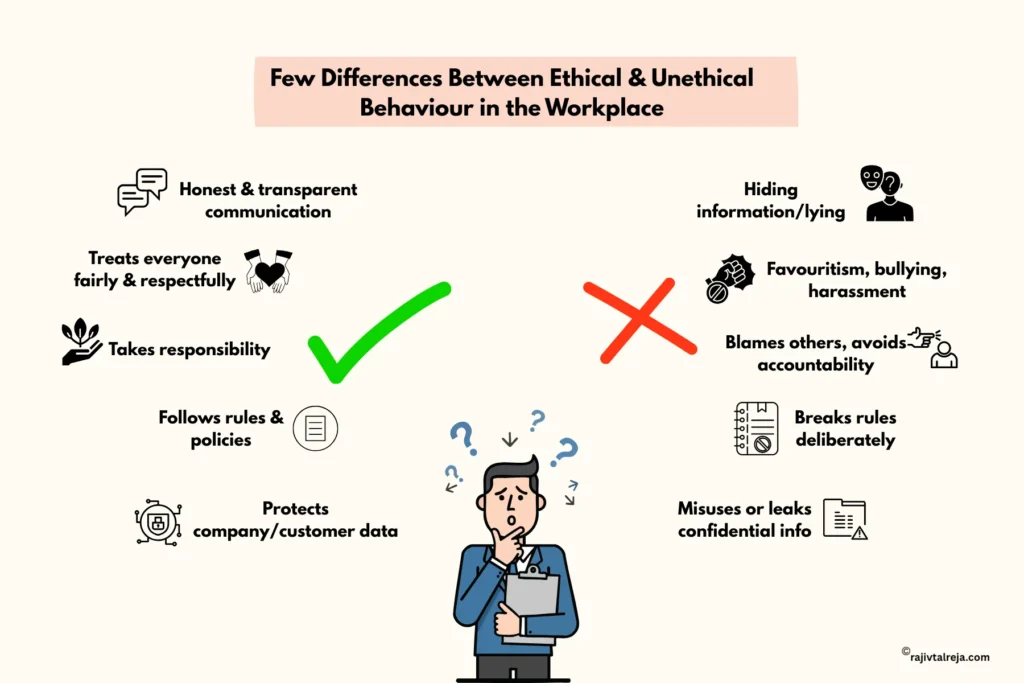
| Aspect | Ethical Behaviour | Unethical Behaviour | Example in the Workplace |
| Decision-making | Fair, transparent, based on merit. | Biased, hidden, based on favouritism. | Promoting the most qualified employee vs promoting a relative (Nepotism). |
| Treatment of People | Equal, respectful, inclusive. | Discriminatory, unfair, disrespectful. | Offering equal pay for equal work vs paying women less for the same role. |
| Use of Resources | Honest and responsible use. | Misuse, theft, or manipulation. | Using company funds for business trips vs using them for personal vacations. |
| Relationship with Customers | Honest & clear communication. | Misleading, hiding flaws, & false promises. | Selling a product with genuine claims vs exaggerating benefits just to close sales. |
| Culture & Conduct | Safe, supportive, zero-tolerance for harassment. | Toxic, unsafe, tolerates harassment. | Enforcing anti-harassment policies vs ignoring complaints. |
| Data & Confidentiality | Protects privacy and trust. | Misuses or leaks data. | Keeping customer data secure vs selling it without consent. |
| Leadership | Leads by example with integrity. | Breaks rules, expects others to follow. | A leader refusing bribes vs a leader offering bribes to win contracts. |
Ethical behaviour is like the foundation of a strong house… Steady, reliable, and built to last.
Unethical behaviour is like building on sand… It might stand for a while, but it will collapse sooner or later.
Reading about unethical behaviour is one thing. Seeing its consequences play out in the real world is another.
Here are a few unethical business scandals that made headlines, and what business owners can take away from them.
Enron was once one of the most admired companies in the world.
Behind the scenes, leadership was hiding billions in debt through complex accounting tricks. When the truth came out, the company collapsed, thousands lost their jobs, and top executives faced prison time.
The consequence of unethical business practices here was total destruction of a $65 billion company.
Satyam’s founder admitted to inflating cash balances by over Rs. 5,000 crore.
What was called “India’s Enron” shattered investor confidence and led to criminal convictions. A business that took decades to build was undone by years of dishonesty.
Volkswagen programmed software in diesel cars to fake emissions test results.
The unethical business scandal cost the company over $30 billion in fines and settlements, destroyed consumer trust, and led to criminal charges against multiple executives.
The lesson is always the same. Unethical shortcuts don’t save time. They borrow it. And the payback comes with interest.
If you think cutting ethical corners only carries moral weight, think again. The consequences of unethical business practices are very real and very measurable.
Legal penalties and fines – Bribery, data misuse, discrimination, and fraud can all invite lawsuits, government investigations, and heavy fines. For small businesses, even one legal battle can drain resources and attention for years.
Loss of customer trust – Trust takes years to build and seconds to break. Once customers learn that a business has been dishonest, they leave, and they tell others. In the age of social media, one scandal can reach lakhs of people overnight.
Employee attrition – Good employees don’t stay in toxic environments. If your team sees that unethical behaviour is tolerated or rewarded, your best people will quietly walk out the door, and your hiring costs will keep climbing.
Damaged brand reputation – Reputation is your most valuable asset, especially for MSMEs that rely on word-of-mouth and community trust. Once damaged, it takes years to rebuild if it can be rebuilt at all.
Financial losses – From lost customers to legal fees to falling revenue, the financial impact of unethical practices is far greater than whatever short-term gain they provided.
Unethical behaviour doesn’t stop by itself. It stops when leaders set the right tone.
Here are 5 practical steps every business owner can take…
Write down what your business stands for [honesty, fairness, respect, responsibility] and make sure every employee knows them.
Values are like the compass that guides every decision.
Make it crystal clear: harassment, bribery, discrimination, or misuse of resources will not be accepted under any circumstances.
Put it in writing, share it openly, and follow through consistently.
Employees copy what leaders do, not what they say. If you cut corners, they will too. If you practice transparency and fairness, they’ll mirror it. Leadership is one of the strongest form of training…
You should set up safe ways for your team to raise concerns, such as anonymous forms, HR support, or direct access to leadership.
People should feel protected, not punished, for speaking up.
You should not just talk about ethics once during onboarding.
Conduct short refresher sessions, share stories, and remind your team why integrity matters.
Preventing unethical practices isn’t about adding more rules. It’s about building a culture where doing the right thing is the easiest choice.
At the end of the day, business is built on trust… Trust from your employees, customers, and community.
Unethical business practices may give you a quick win, but they always leave lasting damage.
As a business owner, your reputation is your biggest asset.
You should protect it by leading with integrity, setting the right example, and creating a workplace where fairness and respect are non-negotiable.
Ethical businesses don’t just survive… They thrive.
Found this blog helpful? Stay tuned for more business-related articles!
Some everyday unethical practices include false advertising, hidden fees, employee exploitation, bribing for deals, fake scarcity tactics, misuse of customer data, and copying competitors’ ideas. They may look “harmless” initially, but they destroy trust, brand value, and long-term reputation.
Yes, and those who think otherwise lack strategy. Companies that win long-term focus on transparency, value creation, customer trust, and ethical growth.
Shortcuts may boost early numbers, but trust compounds faster than tricks.
Stay ethical, but stay smart… Document proof, report to authorities if required, educate customers subtly (not by attacking), double-down on value and transparency & build a brand customers trust.
Start by identifying the root cause. Is it a people problem, a policy gap, or a culture issue? Then address it with clear policies, open reporting channels, consistent consequences, and regular ethics training. Most importantly, leadership must model the behaviour they expect from the team.
Write down your company’s core values [honesty, fairness, respect, accountability]. Define specific behaviours that are acceptable and unacceptable. Share this code with every employee during onboarding, display it visibly, and revisit it annually. A code only works when it’s enforced consistently at every level.
All illegal practices are unethical, but not all unethical practices are illegal. For example, overworking employees without fair compensation may not break the law in every case, but it is still unethical. The best businesses hold themselves to a standard higher than just “what’s legal.”
It destroys it. When employees see favouritism, harassment, or dishonesty going unchecked, they lose trust in leadership. Productivity drops, absenteeism rises, and your best performers start looking for the exit. Ethical workplaces retain talent; unethical ones repel it.
It’s possible, but difficult. Recovery requires full accountability, transparent communication, corrective action, and time. Large companies can afford PR teams and legal support. For small businesses, prevention is always far cheaper than recovery.
Leadership sets the tone. If the business owner cuts corners, the team will too. Ethical leadership means being transparent, treating people fairly, enforcing policies consistently, and holding yourself to the same standard you expect from others. Your team mirrors what they see at the top.


