


Ever feel like your business is running you?
You’re always putting out fires, handling daily problems, and struggling to stay afloat.
But what if you could shift from just getting by to winning?
A strong business-level strategy is the tool that transforms your daily hustle into a clear, focused path toward dominating your market.
This blog will provide you with an easy, step-by-step plan to create that winning business-level strategy and take charge of your business’s future.
A business-level strategy is the high-level game plan that answers one critical question.
“How are we going to compete and win in our specific market?”
This plan shapes every choice, from setting prices to promoting your offerings, making sure each step brings you closer to your end goal.
This is the core of your business-level strategic planning.
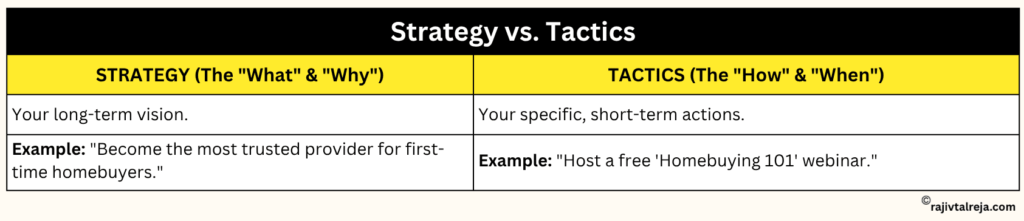
To build your plan, you must understand the difference between the two often-confused terms, strategy and business tactics.
The Golden Rule: Strategy always comes before business tactics.
This prevents you from wasting time on actions that don’t support your plan.
To grasp where your plan fits, picture a “Strategy Pyramid.”

These are often referred to as the levels of strategic planning.
Pretty much every business, from worldwide giants to local shops, works on three strategic levels.
Getting these levels helps make sure all parts of your business are working together.
The corporate strategy (or Corporate Strategy) sits at the top of the pyramid.
This is the highest level of planning, and it asks the big-picture question “What business or businesses should we be in?”
For a massive conglomerate like Tata, this involves decisions about being in steel, cars, software, and hospitality all at once.
It’s about managing a portfolio of different business interests and aligning business and corporate-level strategies.
This top-down view is the first step in company-level strategy.
This is the middle tier and the main focus of our playbook.
The business-level strategy gets more detailed.
It asks, “How can we compete and beat our competitors in this particular market?”
Here, you choose your competitive advantage.
Will you offer the lowest prices (Cost Leadership)?
The most distinctive products (Differentiation)?
Or the top choice for a small, specific group of customers (Focus)?
In a big company, each division (for example, a bank’s retail banking compared to its investment arm) has its own separate business-level strategy.
The functional-level strategy sits at the bottom of the pyramid.
This strategy works at the most hands-on level, spelling out how your main departments will back up the business-level strategy.
These are your functional level strategies.
It tackles the down-to-earth question “How do our everyday tasks in marketing, sales, and operations make the plan real?”
Let’s say your business strategy aims to stand out for top-notch quality.
In that case, your production team’s business functional strategy would be to put in place tougher quality control checks.
Clear business and functional level strategies ensure everyone is pulling in the same direction.
| This structure is the framework for a scalable company. A good business coach helps you actually build it and implement it smoothly. |
Now for the most important decision you’ll make:
How will you choose to compete?
Your choice here is the important part of your business-level competitive strategy.
Legendary strategist Michael Porter laid out the fundamental options, often called business-level strategy types:
Competing on price (being the cheapest) and on uniqueness (being different and better).
Your most important decision is choosing how to compete.
You have two main paths:
| Type | Type 1: “Cheapest Price” (Cost Leadership) | Type 2: “Stand Out” (Differentiation) |
| What It Means | Being the lowest-cost producer in your market. | Being unique in a way that your customers truly value. |
| MSME Risk Level | Very High. It’s extremely difficult to beat large corporations on price and scale. | Low. This is the recommended path for most MSMEs. |
| How to Win? | Aim for “Niche Operational Mastery”, being the cheapest for one very specific service. | Win by using your unique strengths: Exceptional customer serviceA powerful brand storyTop-notch quality or new ideasA narrow, focused marke |
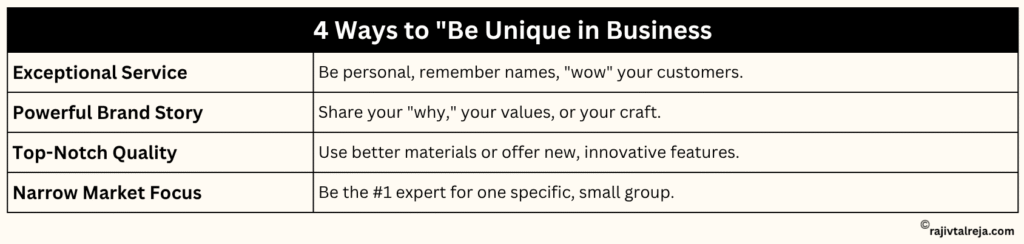
A strategy is just a wish until you write it down.
This part offers a straightforward, doable process for a busy owner to create a real strategic plan.
You need to know where you stand before you can map out your journey.
This means looking both outside and inside your business.
This process is known as business-level strategic analysis.
A SWOT Analysis works best for this, but with a key twist.
Checking out your market (External)
Understanding your capabilities (Internal)
These are your internal capabilities.
This raw customer feedback turns your SWOT from guesswork into a fact-based tool.
Those are your Opportunities.
Those are your Threats.
Once you finish your SWOT, it’s time to decide what your next step is.
This means setting high-level strategic goals for the next 1-3 years.
This stage of business policy and strategic analysis sets your direction.
To work well, these targets need to be SMART
Don’t say, “I want to grow my business.”
Say this instead,
“I will secure four new high-value corporate clients for my landscaping business (Specific Achievable) in the next three months (Time-bound).
Boosting monthly revenue by Rs. 1,00,000 (Measurable) by showcasing my knack for unique low-maintenance designs (Relevant).”
Here’s where strategy turns into action.
For each SMART goal, create a simple action plan.
This becomes a high-level marketing plan for achieving your goals.
| Key Initiatives | What main tasks do you need to complete to reach the goal? |
| Who’s Responsible | Assign one person to lead each initiative. |
| Timelines | Put due dates on each project and its major steps along the way. |
| Key Performance Indicators (KPIs) | What specific numbers will you track to know if you’re winning? |
For a goal to boost customer loyalty, your KPIs might be “how many customers stick around” or “Net Promoter Score (NPS).”
These are the gauges on your business dashboard.
However, this process can be challenging to navigate alone.
Many entrepreneurs find that working with a business coach for small businesses can provide clarity and accountability.
| If you’re stuck on your analysis, a one-on-one business coaching session is the fastest way to get an unbiased view of your SWOT and set the right goals. |



As your MSME grows more complex, you might find a single structure is holding you back.
For a business at this stage, organizing into Strategic Business Units (SBUs) can unlock the next level of growth.
Consider an SBU as a small business inside your main company.
It’s an independent unit that takes care of a particular product line or market area.
A strategic business unit has its own goals, rivals, and financial accountability, but it still answers to you.
Setting up SBUs brings major perks.
The advantages of a strategic business unit structure for a company that’s expanding include:
| Sharper Focus | Every unit has one clear goal, which leads to higher productivity |
| Better Resource Allocation | You can assign budget and staff based on what each SBU needs and can achieve. |
| Clear Accountability | Each SBU has a boss who takes full responsibility for how it performs. |
| Improved Risk Management | This is the most critical benefit for an MSME. If one SBU underperforms or a new venture fails, the damage is contained and doesn’t threaten the health of your core business. |
Understanding the advantages of a strategic business unit can be the best opportunity to scale your operations.
Strategic planning has a huge impact on your ability to move past daily tasks and create a business with a clear goal and direction.
When you examine your position, make a firm decision about how you’ll compete, and turn that choice into real action, you change your business.
It goes from just getting by to being set up for success.
Now’s the time to quit just playing along and begin to set the rules yourself.
Ready to grow your MSME? Click here to read more blogs on strategy and business growth.
It’s the high-level game plan answering how you will compete and win in your specific market.
The three levels of strategic planning are: Company-level strategy (Corporate), business-level strategy, and Functional-level strategy.
The two main paths are the Cost Leadership strategy (being the cheapest) or the Differentiation strategy (being unique).
A strategic business unit (SBU) is like a small, independent business within your main company.


