


Every year on November 25th, “International Day for the Elimination of Violence Against Women”, many businesses put up a nice Instagram post, share a quote, maybe change the colour of their feed for the day.
But let’s be honest.
Are you only going to post… or are you actually doing something inside your organisation for workplace violence prevention?
As a business owner, do you have a team or a policy in place to handle harassment, discrimination, or unsafe situations?
Have you built a culture where your employees feel protected, or have you assumed that because your team is small and close-knit, “ I’d notice if something wasn’t right.”
These assumptions are dangerous.
They don’t protect your people, and they definitely don’t protect your business.
Your first step starts here, not with a social media post, but with real action.
This blog gives you a simple, practical approach any MSME can follow.
More than one in five workers worldwide has experienced violence or harassment at work.
For MSMEs, these hidden costs hit hardest –
You might say, “No one’s complained to me.” But don’t assume that means everything’s fine.
Studies show 75% of people who face harassment never report it to their manager.
Silence doesn’t mean a healthy workplace; it often means there’s no safe or confidential way to speak up.
This is why a clear workplace violence prevention strategy is not optional.
Ready to fix that?
This includes tackling all forms of workplace harassment and job harassment.
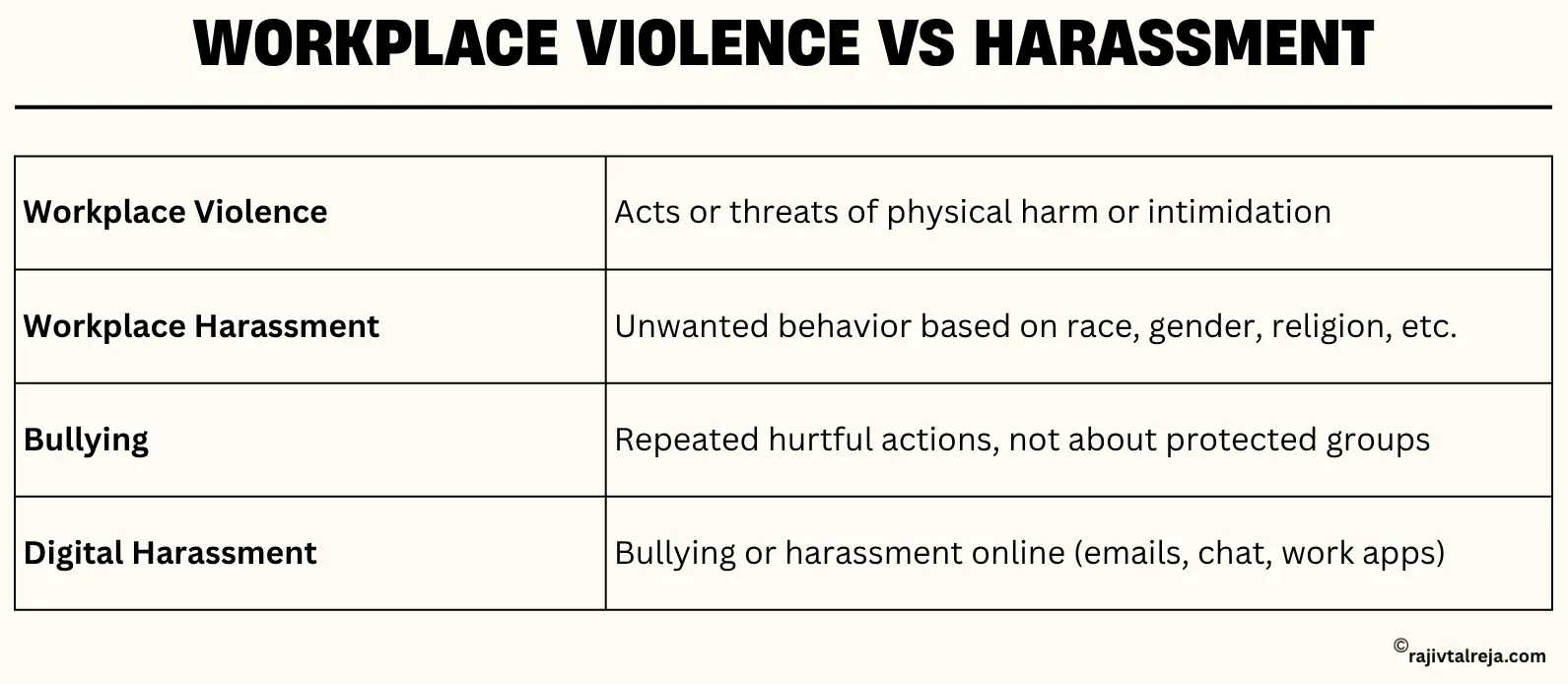
First, let’s get clear on what we’re really tackling.
To build a plan that works, you and your team need to speak the same language.
Managers can face big legal issues when they fail to distinguish between a temporary bad mood and actions that count as illegal harassment.
Understanding these differences is key to preventing harassment and discrimination in the workplace.
| You can’t grow a toxic business. Don’t let legal risks pause your growth. A business and leadership coach will help you build a safe culture and a strong foundation for scaling your business. |
And here’s a more detailed look at the types of behavior your policy must ban –
Let’s look at more workplace harassment examples.
| Type | Examples | Impact |
| Sexual | Unwelcome flirting, “you scratch my back, I’ll scratch yours,” requests for sexual favors, sharing explicit or sexual photos, touching without consent, invading personal space, or making sexually toned remarks. | Creates an uncomfortable or unfriendly workplace, upsets employees, and may lead to serious legal trouble under Title VII (US) and the POSH Act (India), which specifically addresses the harassment on women at work. |
| Verbal | Insults, mean jokes, bad language, talking down to people, overly harsh remarks, spreading rumors, or saying hurtful things about others. This is a common form of employee harassment. | Causes emotional stress, hurts team morale, increases employee turnover, and can even lead to physical conflict. |
| Physical | Unwanted touching, pushing, shoving, kicking, hitting, threatening with fists, breaking things, or throwing objects to scare or harm someone. | Creates an immediate safety risk, causes physical injury, and leads to legal issues like assault or battery. |
| Psychological | Intimidating coworkers, isolating someone from the group, spreading false rumors, making people question themselves, lying maliciously, or misusing power as a boss. | Damages mental health, leading to anxiety, sadness, burnout, or even forcing someone to quit. |
These are all critical types of harassment at work to include in your policy.
This is your superpower as an MSME owner.
Violence at work doesn’t just appear out of nowhere.
It’s the end of a “behavior escalation cycle.”
This escalation gives you chances to intervene.
Spotting Phase 1 plays a key role in preventing the event from ever reaching Phase 3.
Crying, sulking, frequent lateness or absenteeism, blaming others, and social isolation.
Harsh words, rudeness, and an uncooperative attitude.
Restlessness, pacing, crossed arms, frowning, and avoiding eye contact.
Monitor, Document, Intervene. Listen to understand the problem. Arrange a private meeting.
Highlight the troubling behavior and review the rules together.
Write down what was said.
Increased aggression, blatant disregard for rules.
Specific threats (“I’ll get him”), picking fights, shouting.
Tight fists, trembling, violating personal space.
Stay calm and use de-escalation techniques – speak gently, show you understand, set boundaries.
Separate those individuals if needed to maintain safety.
Document the event in the incident log.
Physical assault and property destruction.
Displaying or using a weapon, physical attacks, or imminent danger.
Call 911 (or your local emergency number).
Evacuate immediately. Do not try to intervene or calm the situation.
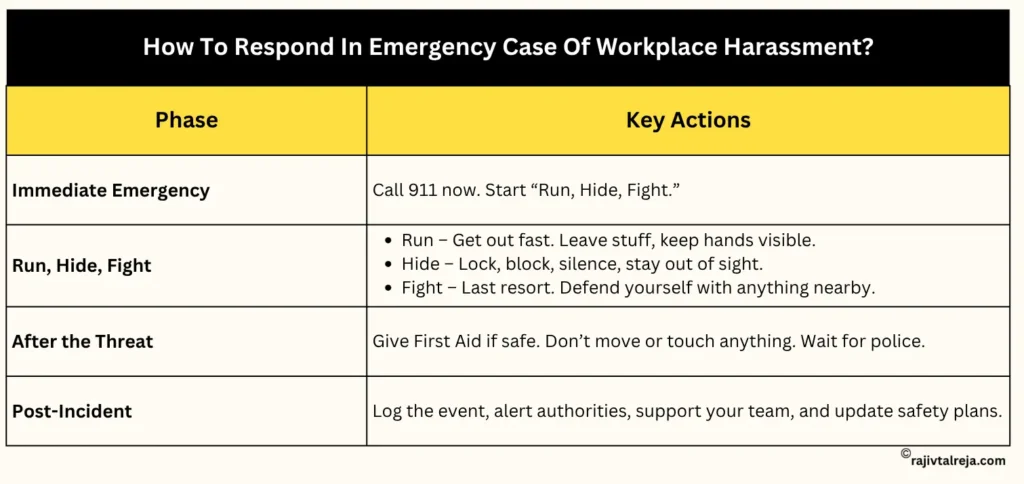
Follow the organization’s “Run, Hide, Fight” emergency protocol.
Secure the scene after danger has passed.
Recognizing warning signs is half the battle. The other half is knowing what the law requires you to do.
Knowing these stages is the core of proactive workplace violence prevention.
This is where you stop potential violence at workplace before it escalates.
| Before you create a workplace violence prevention plan, understand the laws. Download this guide to read all key workplace harassment laws in one place. |
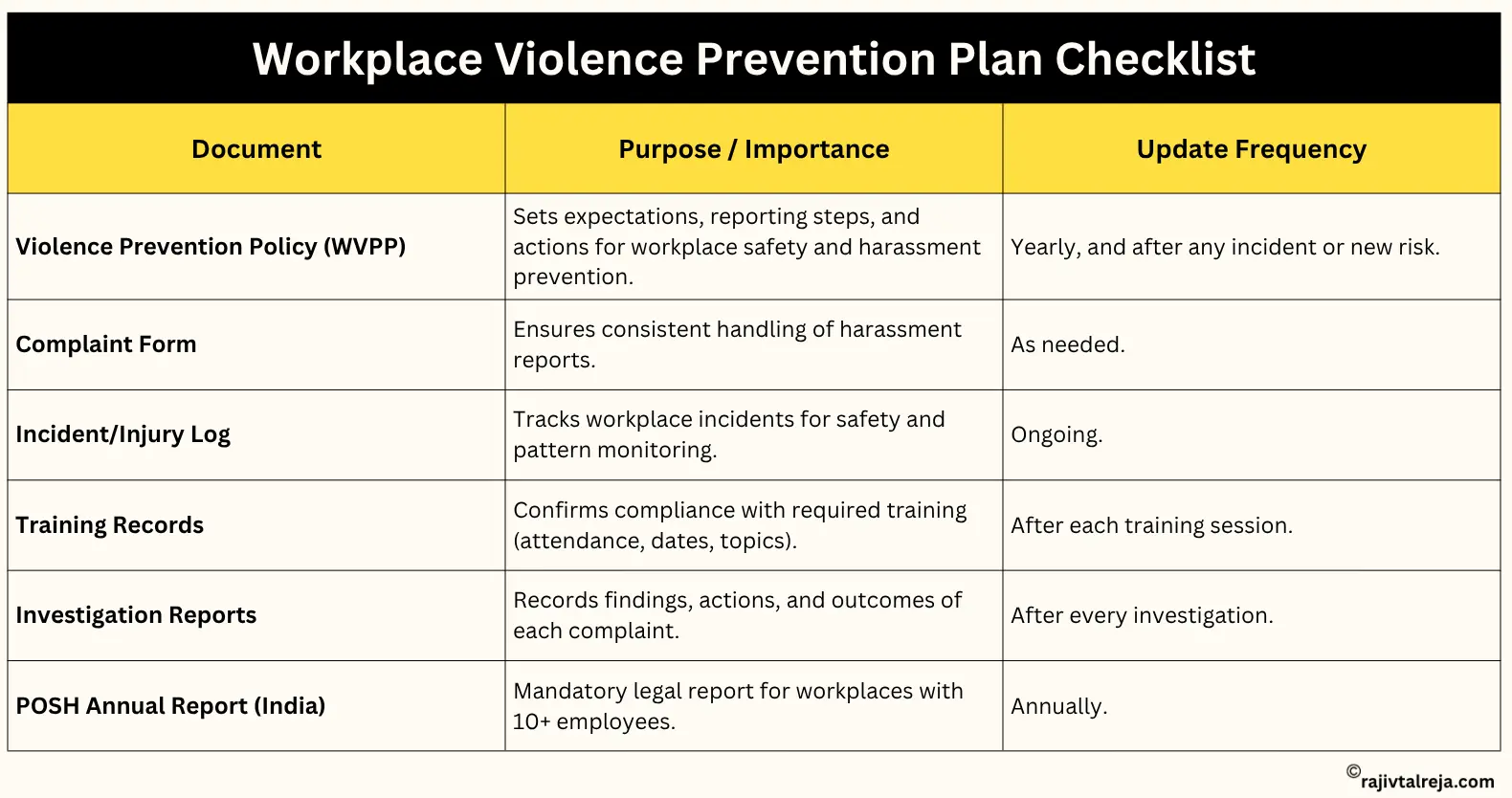
Your Workplace Violence Prevention Plan (WVPP) is both your shield and your guide.
It proves that you take everyone’s safety seriously.
Avoid using a generic template you found online.
Your plan should be customized to fit your business.
A generic plan won’t cover the specific risks of workplace violence you face.
Creating a “Closed Loop” System –
Your goal is to make safety an ongoing cycle –
Log → Respond → Assess → Update → Train
This loop is the engine of continuous improvement for your workplace violence prevention plan.
Here’s a checklist to keep your documents in order –
Now, the inevitable happens.
An employee walks into your office and says, “I’m being harassed.” What do you do right now?
| Struggling to read your team’s behaviour? Our business coaching services help you diagnose and fix toxic dynamics and uncover hidden cultural issues holding your business back. |

This is a critical moment.
How you respond will be judged just as much as the harassment itself.
A wrong step here can cause as much legal damage as the incident.
A poor response to an employee harassment claim can be devastating.
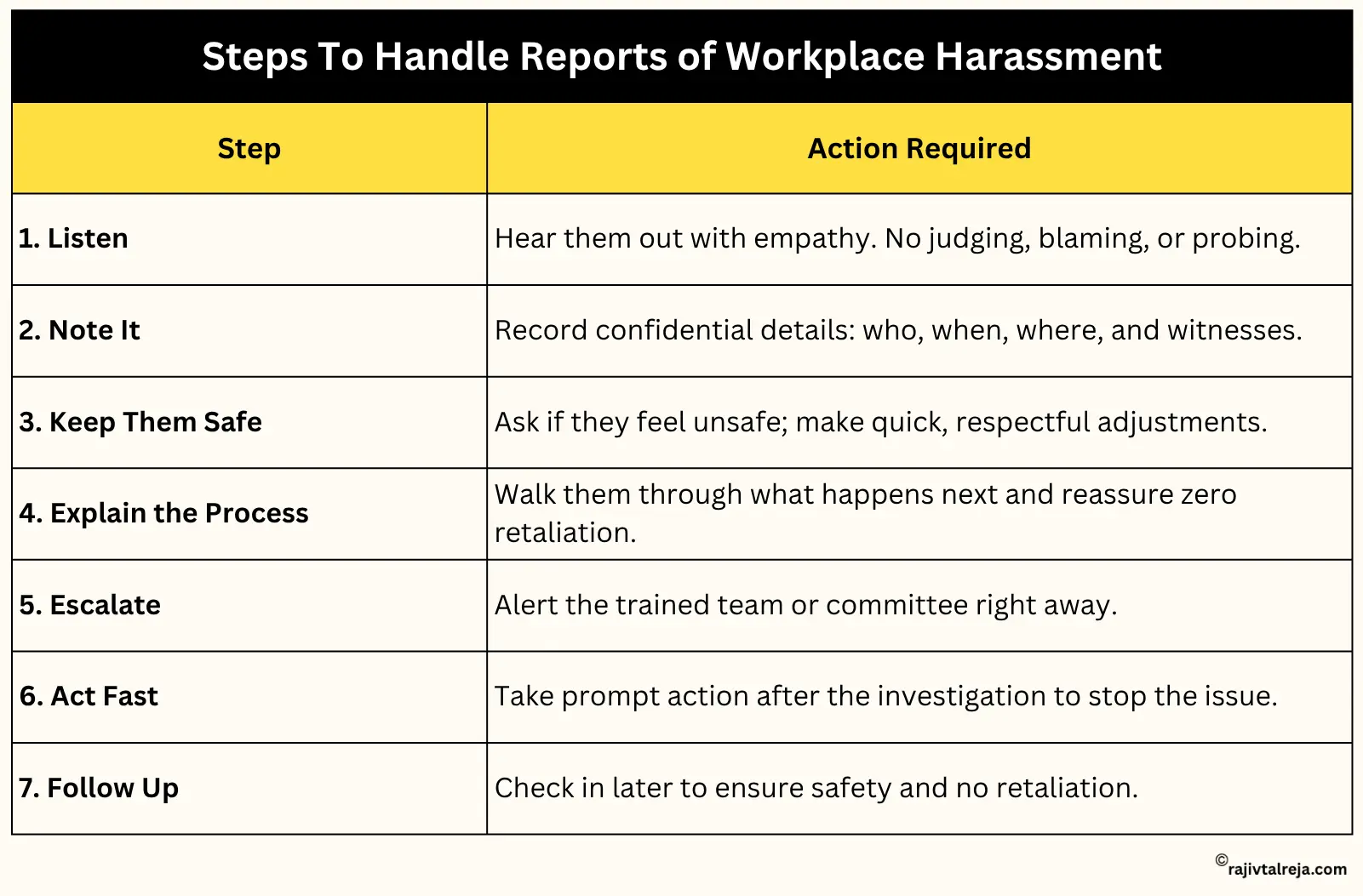
Make sure your policy clearly outlines how to handle job harassment complaints.
Remember, retaliation is a separate offence that can lead to a lawsuit.
Even if the original harassment claim isn’t proven.
This is the plan you hope you never use.
It deals with a Stage 3 active physical violence scenario.
Most people follow the Run, Hide, Fight method during such events.
This may feel like a lot to take in.
But as an MSME owner, you know protecting your business means protecting what keeps it running – Your people.
International Day of the Elimination of Violence against Women isn’t just about staying compliant with India’s POSH Act and other Workplace Harassment Acts.
It’s about avoiding the heavy costs of staff turnover, lost productivity, and harm to your reputation.
It’s an investment in productivity, stability, and the long-term growth of the business you’ve built from the ground up.
Want more expert tips for MSME growth? Keep reading our blogs!
It’s your customized guide and shield that proves you take safety and workplace violence seriously.
Use a “Closed-Loop” system: Log incidents, Respond, Assess what went wrong, Update the plan, and Train staff.
To protect your people, reputation, and business from high costs, lost productivity, and legal fees.
Four types of harassment at work: Sexual, Verbal, Physical, and Psychological.
The POSH Act is one of India’s key workplace harassment laws for women, mandatory for firms with 10+ employees.
Spotting Stage 1 (early) warning signs. This includes behaviors like sulking, lateness, or rudeness.
Listen, document, investigate fairly, and never retaliate against the reporter.
1: Early (behavioral signs). 2: Escalation (threats, shouting). 3: Emergency (physical assault).


