


What’s the one thing that really decides if your business will sink or swim?
Big companies can solve problems by spending cash. But you need to be cleverer.
You need to be quick.
And that quickness comes straight from your TEAM.
When you have an amazing team, it sparks a chain reaction – they strengthen your business, and in return, your improved business attracts even better talent.
Strong teams don’t just improve performance, they improve employee retention, which reduces hiring costs and builds long-term stability.
Let’s dig into how you, the busy owner, can use sustainable team building to create that unstoppable force.
To define sustainable growth simply, it is growth that repeats itself without breaking the system.
It’s not as fast, but it’s solid.
It’s a practical, three-pillar strategy –
These three pillars all lean on each other, and they all start with your team.
Now that we’re aiming for the right kind of growth, let’s look at the team that will get you there.
| Characteristic | Average Team (or “Team of High-Performers”) | High-Performing Team (This is Your Goal) |
| Work Approach | Everyone focuses on their own “wins” and personal metrics. | Everyone asks, “How do we succeed together?” They are tight-knit and supportive. |
| Key Currency | People are valued for their personal output. This is the typical corporate model. | People are valued for their trustworthiness. A low-trust person (even a star) is seen as toxic. |
| Communication | People share information when necessary. Giving feedback is rare and often makes everyone uneasy. | Feedback moves around without causing stress. |
| Problem-Solving | The team either agrees too quickly or everyone just does their own thing. | Everyone values new ideas. They challenge outdated methods because no one is afraid of getting blamed. |
| Results | How well the team does often hangs on one or two “stars” who might be fighting for control. | The team is disciplined and accountable. Performance is a predictable output of a healthy system. |
| Business Impact | Lower productivity, lower profitability, and high turnover. | These teams are 23% more profitable and 18% more productive in sales. |
Before diving into strategies, understand that wow workplaces aren’t built overnight.
They require leadership skills training and a commitment to employee training and development.
| You see the difference in the numbers. Our business success workshop is designed to help you build exactly this kind of culture. |
You can’t just ‘empower‘ people.
Your team are the pieces of a puzzle that fit together. Each part relies on the others.
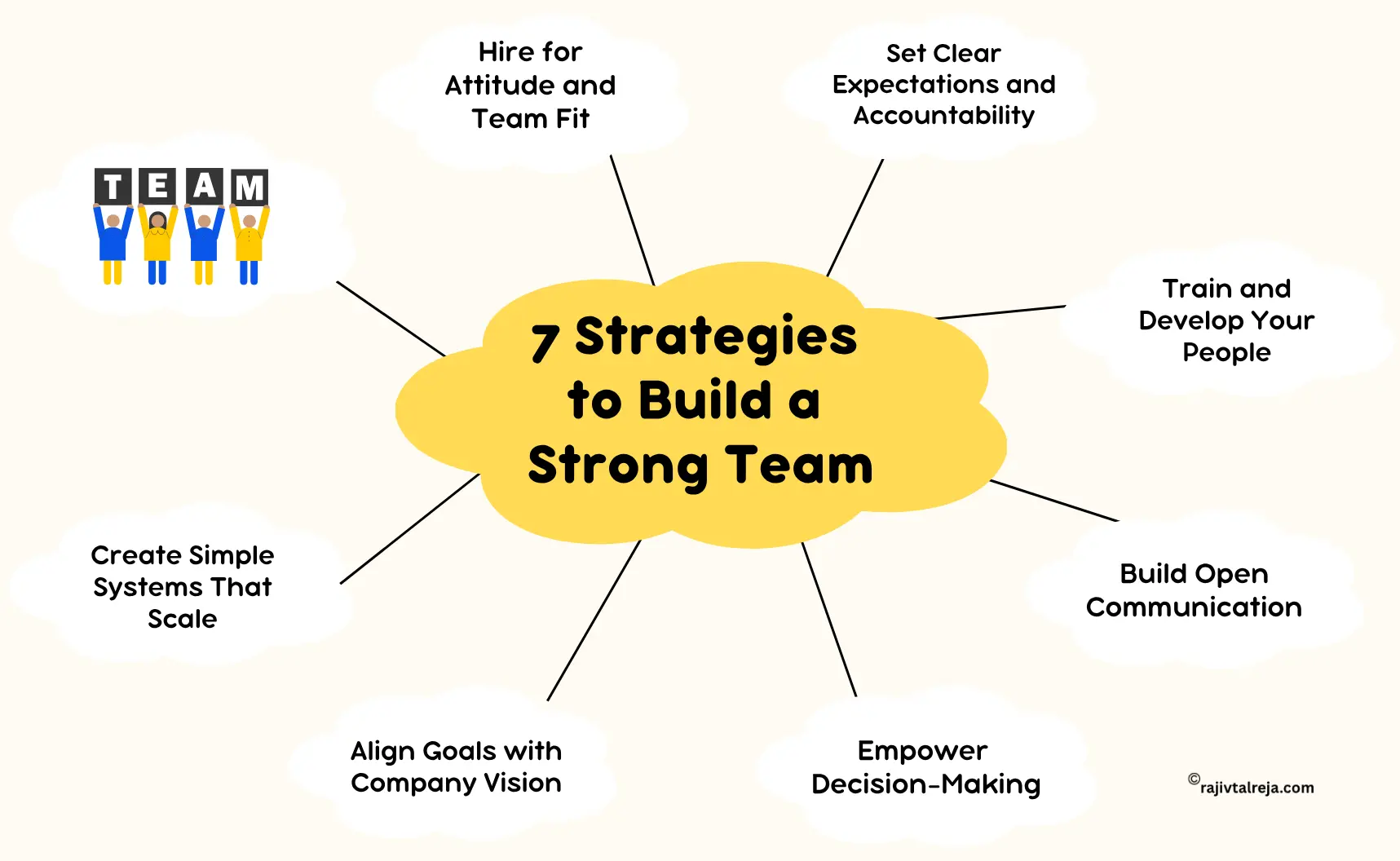
Let’s start with the first, and most crucial, step – who you bring on board.
You can teach skills.
You can’t teach attitude.
In a small team, one toxic person infects everyone.
Skills are teachable. A positive attitude is NOT.
How to do it –
Ambiguity is the main killer of team performance.
When people don’t know what “success” means, they can’t achieve it.
How to do it – Follow these six simple steps to get things done –
Training proves you care about their future, not just their daily work.
This makes people loyal and enhances employee training and development.
How to do it-
Have employees teach each other their jobs.
It’s free, builds skills, and creates redundancy for when someone is sick.
Pair up experienced workers with new hires to help them learn faster.
This fosters second-line leadership.
Purchase 5 copies of a top-notch business book.
Talk about one chapter during lunch each week.
This helps build trust.
Create a space in your organisation where your team feel confident to speak up and share their thoughts.
How to do it –
Put your phone face down in meetings.
Focus on understanding what others are saying instead of just waiting for your turn to talk.
Be the first to admit mistakes and the first to ask for feedback, like “What’s one thing I could do better to support you?”
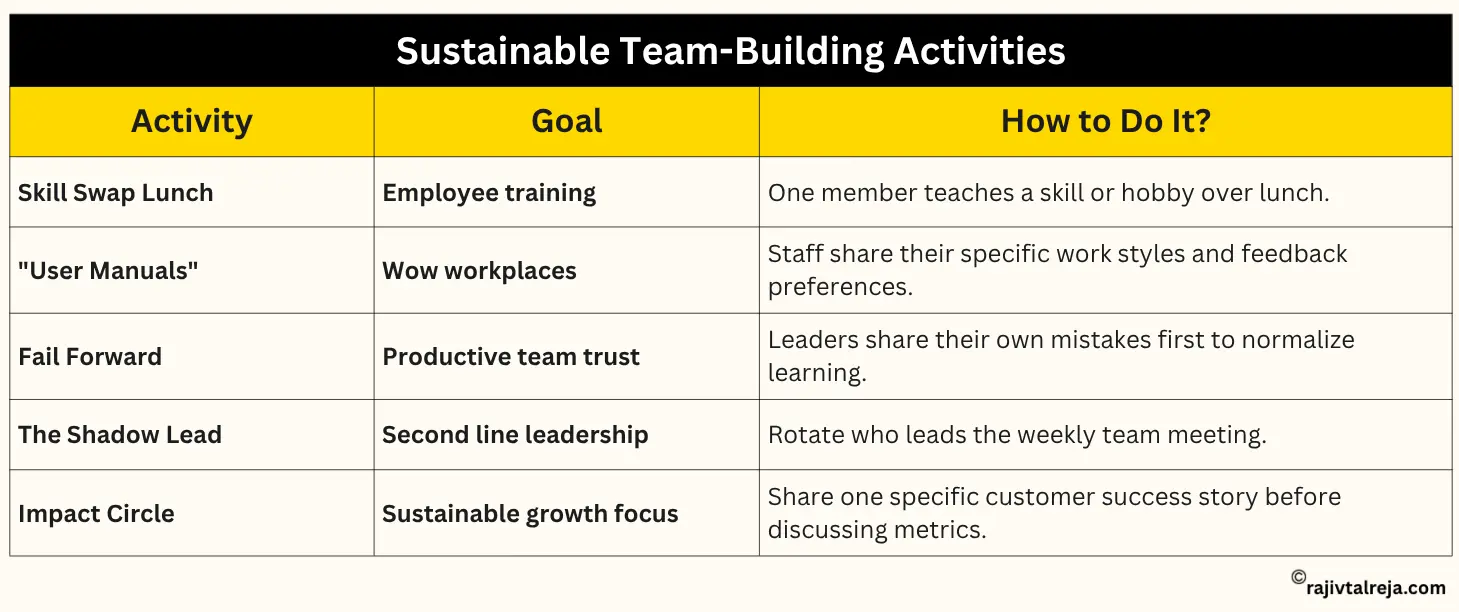
With communication, you also need action steps to improve how the team connects. Here are five high-impact, low-cost sustainable team-building activities you can start this week to foster deep trust and a productive team.
| Culture issues are hard to spot from the inside. The best business coach can help you diagnose the hidden culture gaps you can’t see. |



Don’t become a roadblock.
Watching over every little thing shows you don’t trust your team and is a main reason good staff leave.
How to do it –
Define the “what” and the “why,” then let your team figure out the “how.”
Ask the team, “What insights or lessons can we as a team learn from this?” instead of focusing on “Who made the mistake?”
Take time to understand their career goals and find simple ways to support them in reaching those goals.
A paycheck makes people show up.
A shared vision makes them care.
How to do it –
For example, say, “Our goal is to reduce customer service response time. This isn’t just a number. It’s how we achieve our vision to be the most trusted partner in our industry.”
“What worked before might not work now.”
Growth means you can’t rely on “everyone just figuring it out as they go.”
How to do it –
Pick one core process (like invoicing). Write down every step.
Find the bottlenecks. (e.g., “It always gets stuck waiting for my approval.”)
Use budget-friendly tech to automate routine tasks.
Write down the new, improved process in an easy-to-follow list.
These strategies are powerful, but it’s just as important to know what not to do.
You can trip up your own team even when you’re trying to help.
As an MSME owner, your team watches your every move.
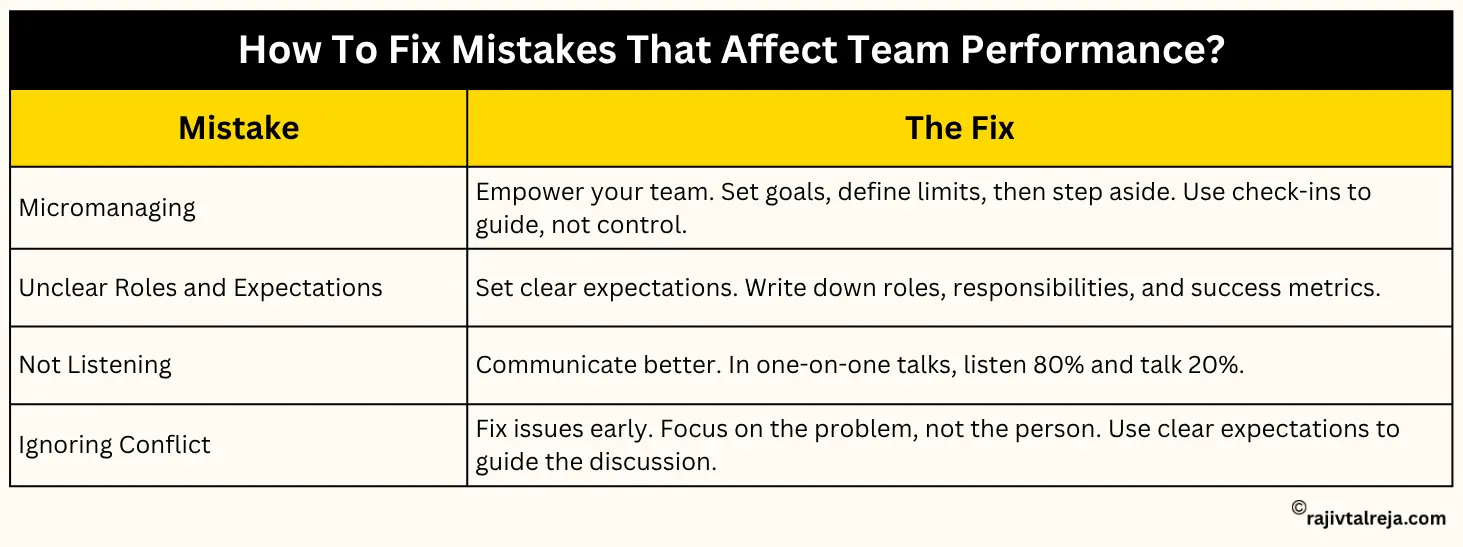
Let’s break this cycle by identifying five common mistakes that could be holding your team back.
| Mistake | How It Hurts |
| Micromanaging | Kills team spirit, shows no trust, and slows decisions. |
| Unclear Roles and Expectations | Creates confusion, frustration, and wasted effort. |
| Not Listening | Team feels ignored; you miss real customer or work insights. |
| Ignoring Conflict | Small issues grow, harming teamwork and trust. |
Building your team isn’t a side job.
It’s your main job.
It’s your only reliable path to steady, profitable growth.
We’ve covered a lot – choosing sustainable growth, how average and a high-performing team works, and laying out seven ways to help you build a strong team.
It all boils down to one thing – TRUST.
And trust starts with listening.
This single act is the first, most powerful step you can take.
Ready to build a team that runs itself? Check out our other blogs on MSME growth.
Financial, Cultural, and Market sustainability.
It creates a resilient model that guards against market chaos and burnout.
It’s growing at a steady pace, supported by cash flow and a productive team.
Prioritizing psychological safety and “Culture Add” over simple culture fit.
Use cross-training, mentorship, and book clubs to build skills without high costs.
Empower decision-making by setting the goal, not the path, to build trust.
Micromanaging and unclear goals create a “doom loop” that kills performance.


One Response
Test