


A business owner we worked with once said, “I pay well, I give bonuses, and they still leave. What am I doing wrong?”
This is the reality for lakhs of MSME owners across India. You invest in hiring and training, then one day, they resign.
The issue usually comes down to one thing: employee satisfaction.
Employee satisfaction is the degree to which your team feels content, valued, and fulfilled in their roles. It is not just about salary. It covers role clarity, feeling heard, growth opportunities, and workplace satisfaction as a whole.
And here is what most business owners miss… This is not an HR department’s job. It is your job. Because when your team is satisfied, your business grows.
In simple terms, employee satisfaction measures how happy your team is with their work. This includes their job satisfaction with daily tasks, their relationship with you, pay, and growth opportunities.
“Is this not the same as employee engagement?” Not quite.
A satisfied employee is content with pay, hours, and environment. But they may still clock in, do the minimum, and clock out. An engaged employee takes ownership and genuinely cares about business outcomes.
You need both. But satisfaction comes first. You cannot build a high-performance team on a foundation of unhappy people.
| Globally, only 21% of employees are truly engaged at work – the lowest in years. Source: Gallup State of the Global Workplace, 2024 |
In our experience working with hundreds of businesses, the ones that struggle with attrition have one thing in common. The owner never measured how the team actually feels about coming to work.
This is not a “feel-good” topic. It is a business growth topic. Let us connect employee happiness to your bottom line.
When your team is satisfied, they stay longer. When they stay, you stop bleeding money on hiring and retraining.
Satisfied vs Dissatisfied Employees – The Business Impact:
| Satisfied Employees | Dissatisfied Employees | Business Impact |
| Stay longer | High attrition every 6–12 months | Hiring costs eat into profits |
| Serve customers better | Low energy in interactions | Referrals and repeat business drop |
| Take ownership of work | Wait for instructions on everything | The owner stays stuck in operations |
| Bring ideas and solve problems | Do the bare minimum | Growth and innovation stall |
| Recommend your company to others | Badmouth the workplace outside | Harder to attract good talent |
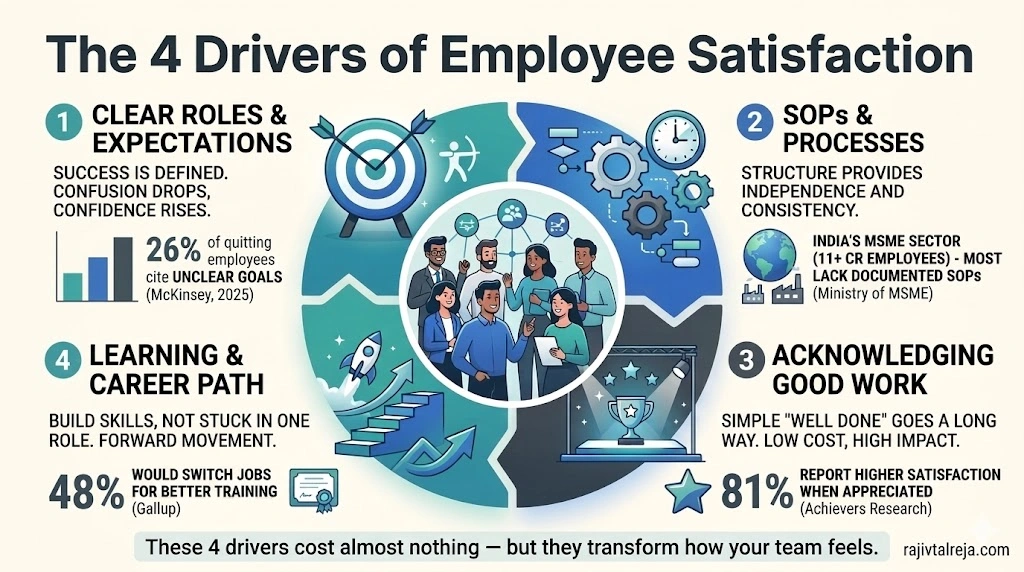
The Numbers That Matter:
| What We Know | Data Point | Source |
| Cost of replacing one employee | 50%-200% of salary | Gallup |
| Employees who say manager could have stopped them quitting | 52% | Gallup |
| How much longer happy workers stay | 2x longer | iOpener Institute |
| Productivity boost from satisfied employees | 13% higher | Oxford University |
| Profitability in highly engaged teams | 23% higher | Gallup Meta-Analysis |
| Global employee engagement rate (2024) | Only 21% | Gallup SGWR |
| Employees with higher satisfaction when appreciated | 81% | Achievers Research |
| Workers who would switch for better training | 48% | Gallup |
| People employed by India’s MSME sector | 11+ crore | Ministry of MSME |
Think about this in the Indian MSME context. If you run a business with 15 people and 30-40% annual attrition, you are rebuilding a third of your team every year. That is survival mode, not growth.
Satisfied employees also deliver better customer experiences. That energy shows up in every interaction, phone call, and delivery.
Struggling with attrition and a disengaged team? The P.A.C.E. Program helps MSME owners build people management systems that work across 190+ industries.
Most articles tell you to run an employee satisfaction survey. Surveys work. But if you have 10 to 50 people, you do not always need a formal tool.
Let us cover both approaches so you can pick what works.
An employee satisfaction survey is a set of questions about work, managers, growth, and environment. A Google Form is enough.
A popular method is eNPS. One question: “On a scale of 0–10, how likely are you to recommend this company as a place to work?”
Promoters (9–10) minus Detractors (0–6) gives your employee satisfaction score. Positive is good. Above 30 is excellent.
You can also use the ESI. Three questions rated 1–10 that give a score between 0 and 100. Both methods are free.
| Average eNPS across industries in Q1 2025 was 37. 84% say they are satisfied, yet only 54% did not apply elsewhere. Source: BambooHR Employee Happiness Index, Q1 2025 |
Add open-ended questions to your employee experience survey or employee opinion survey. “What is one thing we could do better?” often reveals more than ratings.
Not every business needs a formal work satisfaction survey. Here are employee satisfaction measures you can track now:
Attrition rate: If people leave within 6–12 months, something is broken.
Absenteeism: A rise in sick days often signals low employee job satisfaction.
Monthly one-on-ones: 15 minutes. Ask: “How are you? What do you need from me?”
Energy and collaboration: Are people helping each other? Or watching the clock? This tells you about employee happiness.
Employee survey feedback patterns: Even informal feedback in team meetings or WhatsApp gives you signals.
Quick Comparison – Measurement Methods:
| Method | What It Is | Best For | Cost | Frequency |
| eNPS | 1 question: “Would you recommend us as a workplace?” | Quick pulse check | Free | Quarterly |
| ESI | 3 questions rated 1–10. Score: 0–100 | Tracking trends | Free | Quarterly |
| Detailed Survey | 15–25 questions on pay, culture, growth, leadership | Annual deep-dive | Free–Low | Annually |
| One-on-Ones | 15-min conversation with each team member | Catching issues early | Free | Monthly |
| Observation | Track attrition, absenteeism, energy | Ongoing pulse | Free | Always-on |
Start with one-on-ones and observation. Add eNPS or ESI when ready. Run a detailed survey once a year.
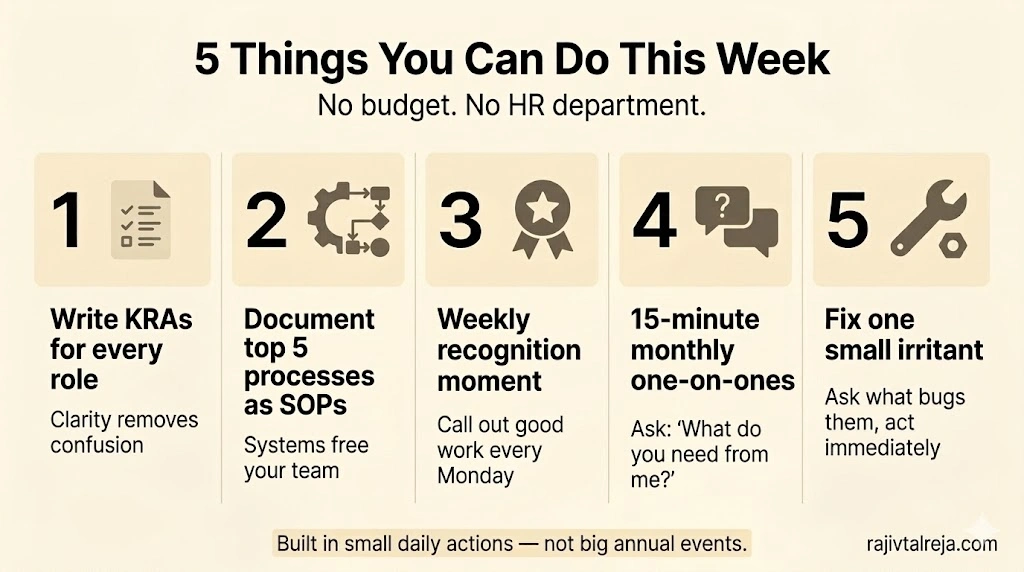
Here are employee satisfaction examples. Real actions that work across Indian businesses. No fancy tools needed.
Write KRAs for every role. If someone does not know what “success” looks like, they cannot achieve it. Ambiguity kills job satisfaction faster than low pay.
When everything depends on you, your team feels powerless. Document key processes. Let your team own their work.
This moves a business from owner-dependent to system-dependent.
Call out good work in Monday meetings. Send a personal message for extra effort.
What we have seen time and again: small, consistent recognition beats a big annual award.
Cross-train people. Have seniors mentor juniors. A weekly 30-minute knowledge session shows you care about their future, not just output.
Sometimes workplace satisfaction drops because of tiny things: a broken chair, unclear leave policies, or a manager who never responds.
Ask your team what bugs them. Then fix it. Fast.
Employee satisfaction is not a corporate luxury. It is a business growth lever for every MSME owner who depends on a small, tight-knit team.
You do not need an HR department or expensive tools. Start with one action from this article. This week. That is how you build a team that stays.
Enjoyed this? Head to our blog page for more practical insights on business growth, leadership, and building a business that actually works for you.
Satisfaction means the employee is happy with pay, role, and environment. Engagement means they are emotionally invested in the business. Satisfaction is the foundation, and engagement is what you build on top.
The best actions are free: write clear KRAs, hold weekly team meetings, recognise good work publicly, and have monthly one-on-ones. People leave because of unclear expectations and feeling invisible, not money.
For eNPS, above 0 is decent, above 30 is strong, and above 50 is excellent. For ESI, above 70 out of 100 is healthy. Track the trend over time. A rising good employee satisfaction score matters more than any single number.
A detailed employee happiness survey once a year. A quick eNPS pulse check every quarter. Monthly one-on-ones always. Act on the employee survey feedback you receive. Surveys without action break trust.
Yes. Satisfied workers are 13% more productive (Oxford University). Highly engaged teams see 23% higher profitability (Gallup). Better employee experience also means better customer experience, which drives repeat business.
Unclear roles, no growth path, lack of recognition, poor manager relationships, and no systems. Gallup found 52% of exiting employees say their manager could have prevented them from leaving. A work satisfaction survey helps you catch these issues early.
Five essentials: How satisfied are you with your role? Do you feel recognised? Is your workload manageable? Do you see a growth path? What is one thing we could improve? Keep the employee opinion survey anonymous and act on what you hear.
They are not either-or. Satisfaction is the base. Without it, engagement cannot exist. Fix satisfaction first through clarity, recognition, and growth. Employee job satisfaction then naturally evolves into genuine engagement.
Ready to build a business that runs on systems, not just on you? The P.A.C.E. Program gives you frameworks to build teams, improve retention, and scale with clarity.


