


Why do customers trust some products instantly… even before using them?
Because of what’s inside, or more importantly, what’s highlighted.
That small detail changes everything.
It builds trust. Justifies price. Drives decisions. That’s ingredient branding.
And no, it’s not just for big brands.
In this blog, you’ll learn how to use it in your business… and when it can actually work against you.
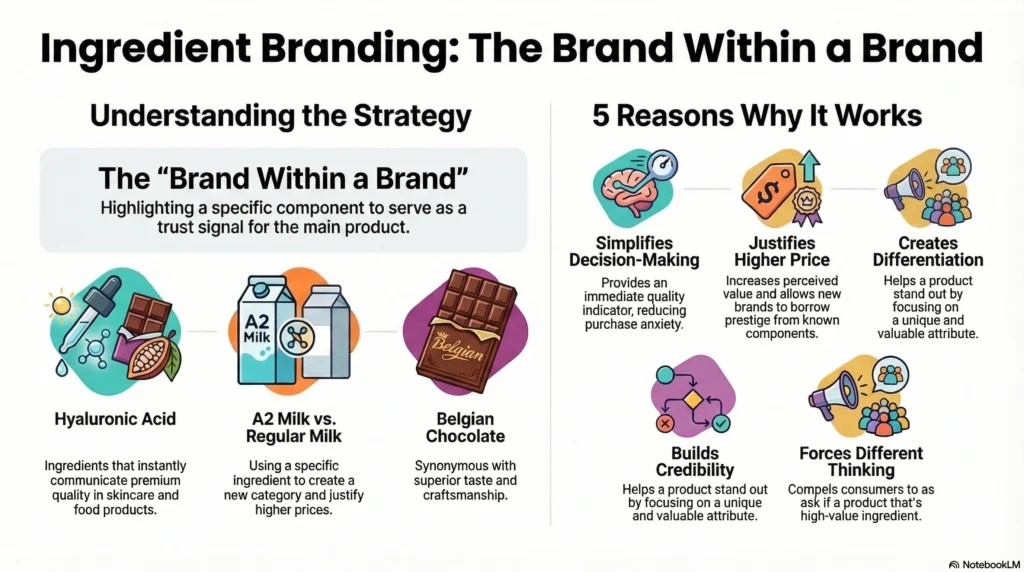
It is a strategy where you highlight a specific component of your product and turn it into a trust signal…
In simple words: It’s a “brand within a brand.”
Instead of just saying “this is a great product,” you show what’s inside that makes it great.
For example:
These are not the main product. But they influence your decision.
Because when customers recognize or believe in that ingredient, they automatically trust the product more.
Now the real question…
Why does this strategy work so consistently across industries?
Customers don’t want to analyse everything.
They look for shortcuts.
A known ingredient becomes that shortcut.
Instead of comparing 10 options, they think: “This has something good inside. It must be better.”
This is why it works especially well in:
When you highlight a specific ingredient, you’re not just selling a product anymore. You’re selling a reason for the price.
Example: “Made with A2 milk” vs “Regular milk”
Same category.
Different perceived value.
Studies in branding show that when customers understand a specific benefit, they’re more willing to pay a premium for it.
In markets where everything looks the same, it creates a new way to stand out.
Example: Fuel is fuel… right?
But when brands highlight additives like engine-cleaning formulas, suddenly it doesn’t feel the same anymore.
Now the customer has a reason to choose.
Building trust from scratch takes time.
Ingredient branding lets you borrow or create credibility faster.
Example:
A small food brand saying “made with Belgian chocolate” instantly feels more premium, even if the brand itself is new.
This is the real power.
This branding introduces a new question in the customer’s mind: “Does this product have that ingredient?”
And once that question exists, your competitors are forced to respond.
You’ve seen it everywhere… You just didn’t realise it had a name.
Here are some everyday examples!
The product is in the same category. But the ingredient makes it feel premium.
Customers may not fully understand the science… but they trust the ingredient.
The fabric becomes the reason to buy, not just the shirt.
Same product. Different perception.
Most businesses try to sell the product.
Smart businesses sell what makes the product better. That’s ingredient branding.
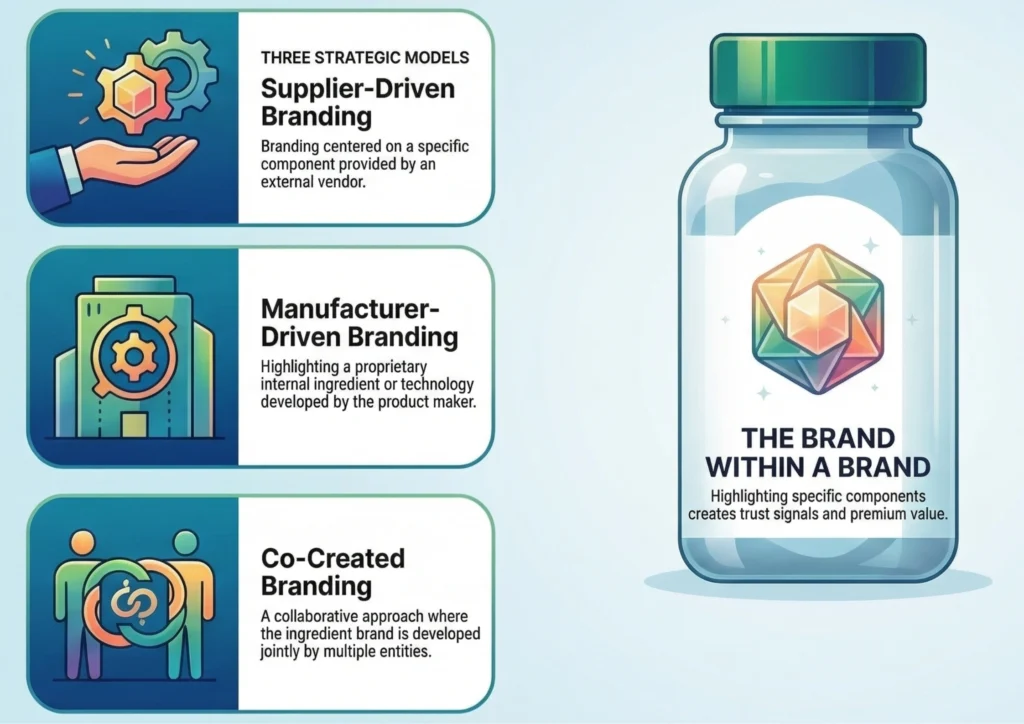
Not all ingredient branding works the same way.
Here are the 3 simple types!
The ingredient brand builds its own identity and gets featured in multiple products.
Example:
Here, the ingredient is the hero.
Customers look for it specifically.
The main brand highlights a specific ingredient to make its own product stand out.
Example:
Here, the product is the hero, and the ingredient supports it.
Both brands benefit and are visible together.
Example:
This is more like a partnership, where both names add value.
You don’t need a big brand to use this.
You just need to be intentional.
Here’s a simple 4-step framework for you.
Ask yourself: What is inside my product that actually makes it better?
It could be:
Rule: If it improves quality and sounds valuable → it can be an ingredient.
If customers can’t see it, they won’t value it.
Highlight it everywhere:
Example: Instead of saying “High-quality oil”, say → “Cold-pressed oil for better nutrition”.
Don’t just label it. Explain why it matters.
Customers don’t buy ingredients. They buy benefits.
Example: “Stone-ground flour” → Retains nutrients & improves taste.
Ingredient branding works only when repeated.
Use the same message:
That’s how it becomes a trust trigger.
| Simple Ingredient Marketing Formula Ingredient + Visibility + Benefit = Trust |
Here’s the honest truth most business owners miss…
| Pros | Cons |
| Builds instant trust | Can overshadow your main brand |
| Justifies premium pricing | Creates dependency on the ingredient |
| Differentiates from competitors | Easy for competitors to copy |
| Simplifies customer decision-making | May confuse customers if overused |
| Works across industries | Not effective if the ingredient isn’t meaningful |
Ingredient branding is powerful… but only when your ingredient actually matters.
Use this quick checklist!
| Ingredient Branding | Co-Branding |
| Focuses on a component inside the product | Focuses on two full brands coming together |
| Ingredients usually support the main product | Both brands are equally visible |
| The goal is to highlight what makes the product better | The goal is to combine the strengths of both brands |
| Example: “Made with A2 milk” | Example: Nike × Apple |
| One brand stays dominant | Both brands share attention |
Customers don’t always understand your product. But they understand what makes it better. That’s where ingredient branding works.
Use it right, and it builds trust instantly.
Use it wrong, and it weakens your brand.
Want more simple, practical strategies like this? Check out the other blogs on our website.
No. Small businesses can use it by highlighting quality ingredients, processes, or sources.
Ingredient branding highlights a component. Private labelling sells someone else’s product under your brand.
Yes. Highlight tools, frameworks, certifications, or methods you use.
Pick something that improves quality, is relevant to customers, and sounds credible.
Yes, if the ingredient adds real value and builds trust.
Yes. If the ingredient overshadows your brand or feels irrelevant.
No. It mainly requires clear positioning and consistent communication.
Yes. That’s why your messaging and execution matter.
No. Ingredient branding is one way to communicate your USP, not the USP itself.


