


Anyone can start a business. Only a few can build one that lasts for decades, or even generations.
When people ask me how to build a legacy business, I tell them it’s not about chasing quick wins or following every trend.
It’s about creating something so valuable, so principled, and so people-focused that it continues to thrive even when you’re not in the room, or no longer at the helm.
A legacy business leaves an impact. It shapes industries, supports communities, and becomes a part of customers’ lives for the long haul.
In this blog, I’ll help you understand exactly what a legacy business is, why it matters more than ever, and 13 practical, proven steps to help you build one, from defining your core values to creating an empowering work environment that people never want to leave.
Because a true legacy isn’t just built. It’s earned, step by step.
A legacy business is an organisation built on strong values and ethics, designed to make a lasting impact on,
Unlike ventures that focus only on short-term gains, a legacy business prioritises…
Think of a legacy family business that’s been around for generations, maybe a local store, a heritage brand, or a multinational started by one visionary founder.
What keeps them alive isn’t just money.
It’s…
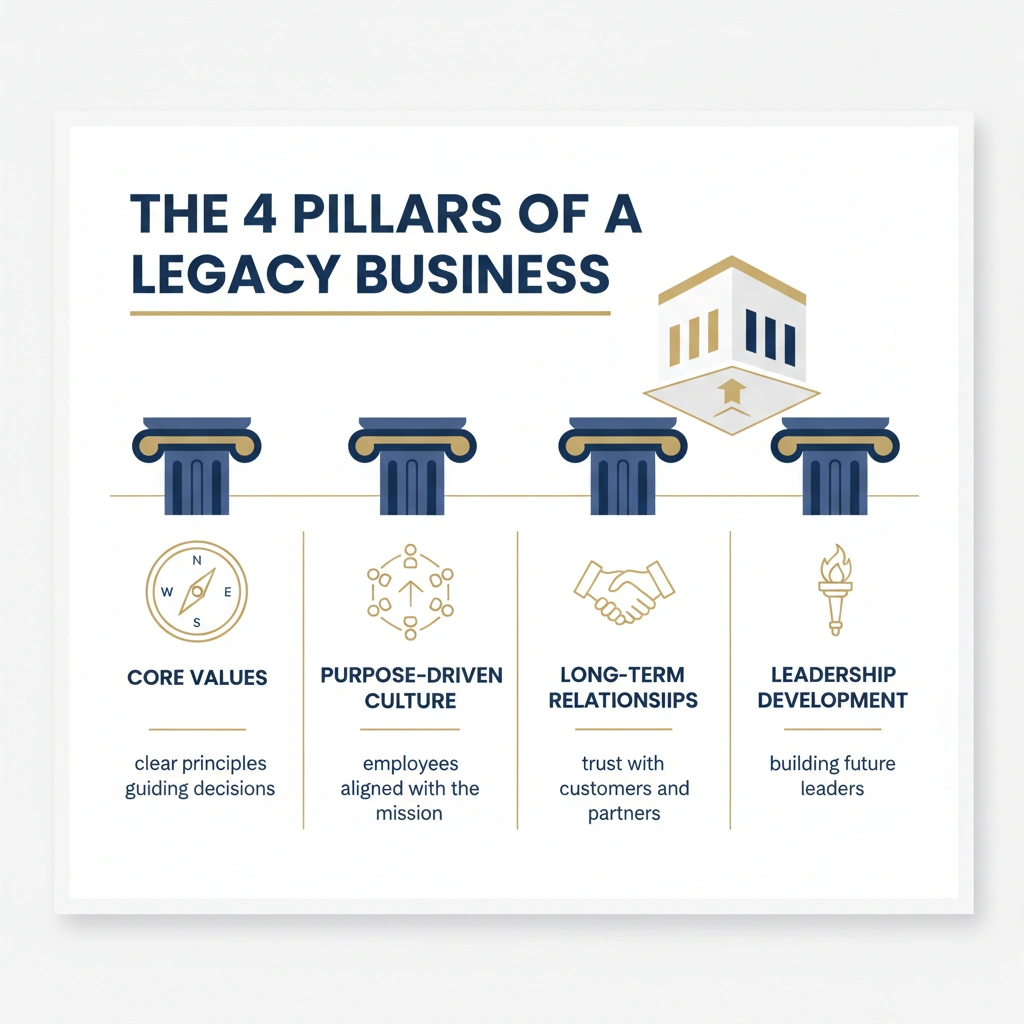
A true legacy business isn’t built on products alone. It’s built on a clear WHY.
Your core values are the non-negotiables that guide every decision, and your mission is the north star.
For example, Tata Group’s mission includes “improving the quality of life of the communities we serve.”
This statement drives their business decisions across industries.
Action Tip for You!
Write down 3 to 5 values you will never compromise on. Then, create a mission statement in one clear sentence that explains your purpose beyond profit.
Your people are the daily ambassadors of your values.
If they don’t live them, customers will never feel them.
For example, if “integrity” is a value, employees must be trained and empowered to be honest with customers, even when it’s inconvenient.
Action Tip?
During hiring, ask behavioural questions that reveal how candidates handle situations aligned with your values.
During appraisals, evaluate how well they live those values alongside their performance metrics.
Values should be visible in your company’s everyday culture, not just stuck in an employee handbook.
For instance, if “innovation” is a value, encourage staff to pitch ideas during monthly “innovation hours” and reward creative thinking.
Your Action Tip!
Celebrate real examples of employees demonstrating values. Share these in team meetings, newsletters, or internal chats to keep the culture alive.
Your culture is HOW you operate; your strategy is WHERE you’re going. If they clash, trust erodes.
Example:
If your strategy is to grow through customer referrals, but your culture prioritises speed over quality, customers won’t recommend you.
Action Tip for You!
When making strategic decisions, ask, “Does this align with our values?” If not, adjust the plan so it works with your culture, not against it.
A people-centric legacy business values relationships more than transactions, both with customers and employees.
For customers, this means listening to feedback, personalising service, and making them feel special.
For employees, it means offering fair pay, recognition, and a safe, empowering work environment.
Action Tip!
Create two feedback loops, one for customers and one for employees, and act on the suggestions regularly.
Legacy businesses survive because their products or services remain relevant and irreplaceable.
Netflix, for example, continues to evolve its offerings based on changing customer preferences, from DVDs to streaming to original content.
Action Tip for You!
Review your top-selling products/services every quarter.
Ask yourself, “Does this still solve my customer’s biggest problem?”
If not, improve or replace it.
A business’s longevity often mirrors the strength of its leadership.
A legacy business advisor will tell you. Leaders must keep learning.
Leadership is about vision, communication, and decision-making under pressure. Your growth directly impacts your team’s growth.
Your Action Tip…
Dedicate at least 10% of your time to personal development. It can be courses, mentoring, or peer networks, and share what you learn with your team.
One of the most underrated steps in building a legacy business is documenting your story, not just for marketing, but for future leaders and customers.
Your journey, the wins, the failures, and the lessons become part of your brand identity.
Think of brands like Amul in India, which documents its evolution through campaigns and archives that inspire trust.
Action Tip…
Maintain a simple “business journal” or archive. Include major decisions, the reasoning behind them, lessons learned, and customer success stories.
This becomes a blueprint for the next generation.
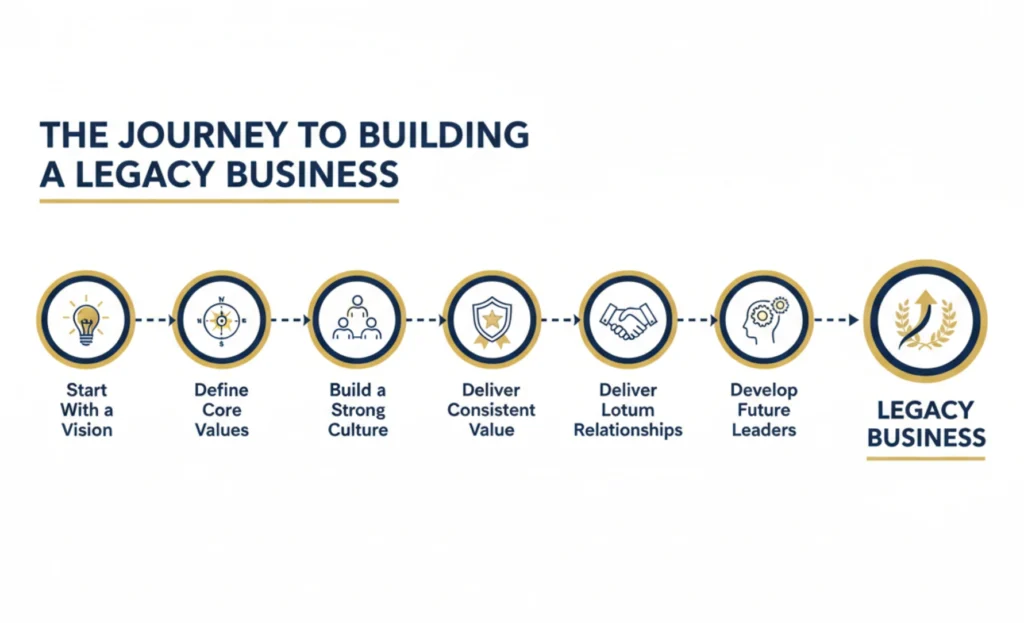
A strong community around your business turns customers into brand advocates.
This doesn’t have to be a formal “club”.
It can be a group of loyal customers who feel connected to your mission. Brands like Harley-Davidson have done this brilliantly with their rider groups.
Action Tip for You!
Start with small gatherings, loyalty programs, or online groups where your customers and partners can connect, share stories, and feel part of something bigger.
Consistency builds trust. If your quality, service, and values are steady over time, people will rely on you.
Look at how Haldiram’s in India has kept its taste and service consistent for decades. Customers know exactly what to expect every single time.
Action Tip for You…
Create standard operating procedures (SOPs) for every key process, from customer service to product delivery, to ensure consistency regardless of who’s in charge.
A business without ethics might grow fast, but it won’t last.
Long-term customers and employees want to work with companies they respect.
Infosys, for example, has built its reputation over decades by sticking to ethical business practices even in challenging times.
Action Tip for You!
Create a “non-negotiable ethics policy” and make it part of onboarding. Review it annually to ensure it’s being followed.
An empowering work environment encourages employees to take ownership, share ideas, and grow.
Companies like Google have mastered this by giving employees flexibility, learning opportunities, and a culture of innovation.
Action Tip!
Hold regular brainstorming sessions where every employee can contribute ideas, not just managers. Empowerment starts with listening.
A true legacy family business or privately-owned company should be ready for leadership transitions long before they’re needed.
Train and mentor potential successors, whether they’re family members or senior employees.
Mahindra & Mahindra is a great example of smooth succession planning while maintaining its core identity.
Action Tip for You!
Identify your potential leaders early, give them increasing responsibility, and involve them in key decision-making processes.
Building a business is an achievement.
But building a legacy business is a responsibility to your customers, your employees, your community, and even to the generations that will come after you.
You don’t need to do all 13 steps overnight. But you DO need to start.
Every step compounds over time, shaping a business that doesn’t just make profits. It makes a difference.
Legacy isn’t about leaving something FOR people. It’s about leaving something IN people.
If this blog helped you think differently about your business, visit our site for more blogs that can help entrepreneurs grow stronger and smarter.
Building a legacy business usually takes years, sometimes decades. Legacy companies grow through consistent values, strong leadership, and long-term customer trust rather than short-term profits. Many well-known legacy businesses took 20–30 years or more to build their reputation and impact.
Yes. Many legacy businesses actually start as small, local companies. What matters is consistent quality, strong customer relationships, and clear core values. Over time, these qualities help small businesses build trust that lasts for generations.
A successful business focuses mainly on profits and growth, while a legacy business focuses on long-term impact, values, and sustainability. Legacy businesses aim to create lasting value for customers, employees, and communities, not just short-term financial results.
Many family businesses struggle after the founder because of poor succession planning, a lack of leadership development, and unclear business systems. A strong legacy family business prepares future leaders early and documents processes to ensure smooth transitions.
Company culture plays a major role in long-term success. When core values are embedded in company culture, employees make decisions that align with the company’s mission, strengthening trust with customers and stakeholders.
Absolutely. In fact, many long-lasting businesses survive because they adapt while staying true to their values. Innovation helps them remain relevant to new generations of customers.
Legacy businesses can exist in almost any industry, including manufacturing, retail, hospitality, and technology. Industries that build strong customer relationships and consistent quality tend to produce long-lasting businesses.
One common mistake is focusing only on short-term growth or profits while ignoring values, culture, and leadership development. Without these foundations, businesses often struggle to sustain long-term success.
No. While many legacy family businesses pass leadership to the next generation, some transition to professional leaders or external management. What matters most is preserving the company’s values, culture, and long-term vision.


