


Ask a business owner what they need to grow, and most will say “more money” or “more people.”
But here’s what we’ve seen after working with thousands of businesses across India: money and people are just two pieces of a much bigger puzzle.
Every business resource you have (or don’t have) shapes whether your business grows, stagnates, or slowly falls apart.
In this blog, we’ll walk you through the types of business resources, real business resources examples, and a simple framework to audit and manage them.
Whether you run a manufacturing unit in Delhi or a service business in Bengaluru, this applies to you.
A business resource is anything your business uses to create value, deliver products or services, and keep operations running.
Think of it as the fuel that powers your business engine.
Here’s a simple way to think about it. If your business stopped having access to something, operations would slow down or halt. That’s a BUSINESS RESOURCE.
| Every business resource connects to another. When one weakens, the whole system suffers. |
Let’s break down the main types of business resources.
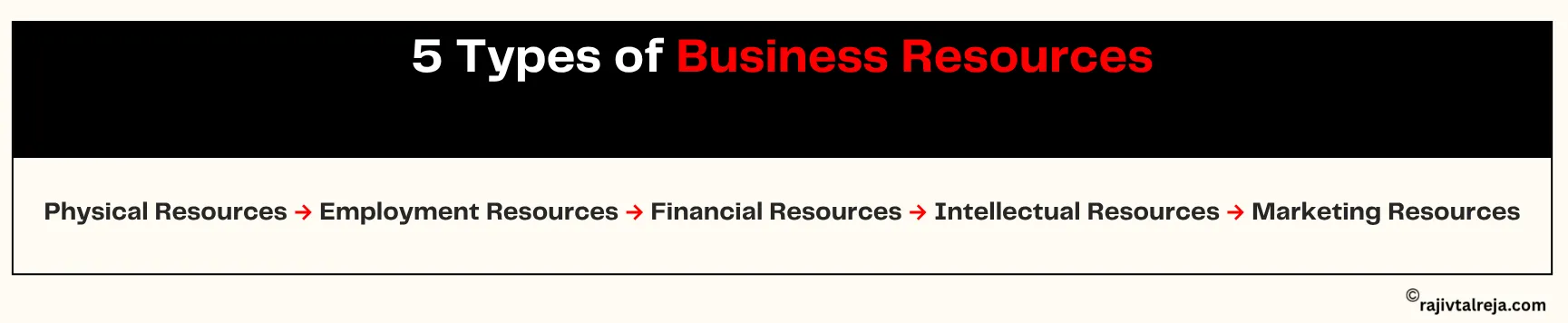
While most articles online list four types, we’ve added a fifth marketing resource because in today’s world, your ability to attract and convert customers is as critical as any other asset.
Here’s a complete comparison with real business resources examples:
| Resource Type | What It Includes | MSME Example | Why It Matters |
| Physical Resources | Equipment, office space, inventory, machinery, vehicles | A bakery’s oven and delivery van in Jaipur | Without it, production stops |
| Human Resources (Employment Resource) | Employees, skills, leadership, team culture | Your sales team, store manager, or factory supervisor | People run your business daily |
| Financial Resources | Cash flow, credit lines, capital, retained profits | Working capital of Rs 5 lakhs, a business loan from the bank | Keeps operations funded and growing |
| Intellectual Resources | SOPs, brand, patents, customer data, processes | Your brand name, customer database, or documented workflows | Gives you a competitive edge others can’t copy |
| Marketing Resources | Leads, campaigns, content, digital tools, email lists | An Instagram page with 10K followers, a Google Ads campaign | Drives visibility, leads, and revenue |
Notice how each type connects to the others?
When one link is weak, the whole chain suffers.
That’s why understanding all five types of business resources matters.
According to SIDBI (May 2025), the MSME sector’s share in India’s Gross Value Added rose from 27.3% in FY2020-21 to 30.1% in FY2022-23.
MSMEs are growing. But the ones that sustain this growth are the ones that manage their resources well.
Here’s why the importance of business resources and their management cannot be ignored:
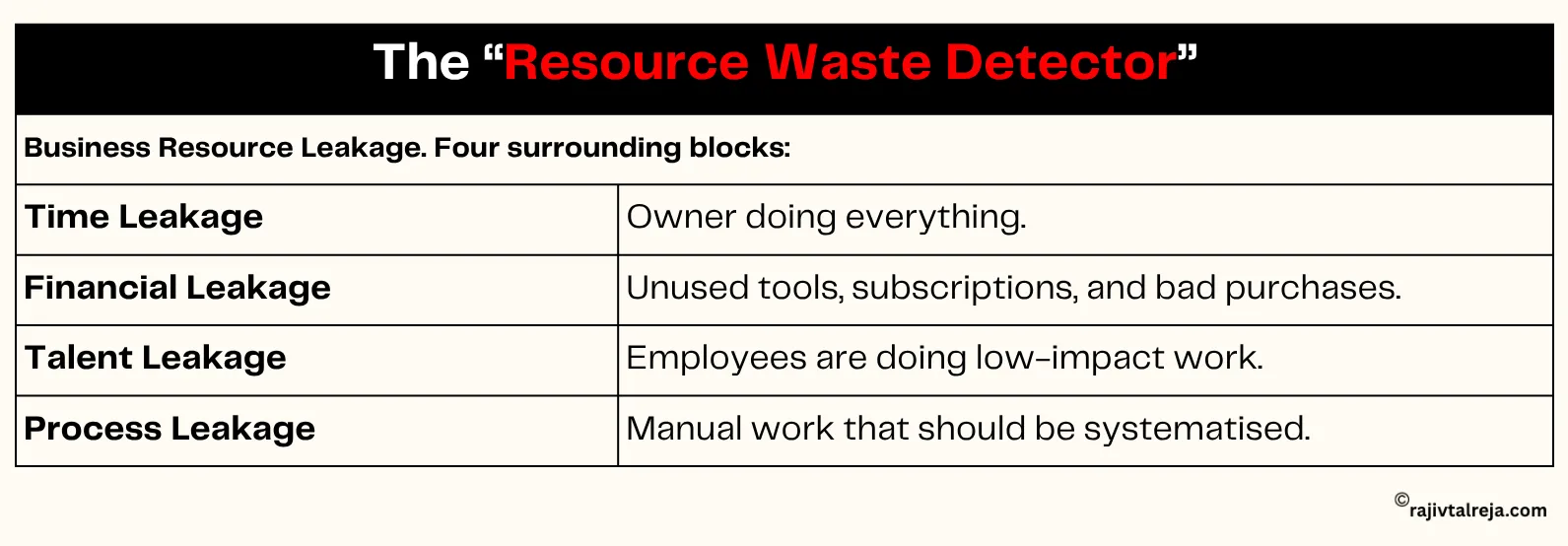
When you don’t know what resources you have, you end up being the resource. You become the salesperson, the accountant, the delivery person.
That’s not a business, that’s a job you created for yourself.
Many business owners earn good revenue but still face cash crunches.
Why? Because their resources, especially financial ones, are not tracked or allocated properly.
Money goes out faster than it comes in.
When you treat your people as a true employment resource and invest in them, they stay longer and perform better.
The cost of replacing an employee can be 50–200% of their annual salary.
A business with well-managed resources can grow without the owner being present 24/7.
Systems replace dependency. Processes replace panic.
| Scaling requires more than just knowing what assets you have; it requires an execution strategy. This is exactly what business coaching for entrepreneurs helps you build. |
In our experience working with hundreds of businesses, we’ve seen the same resource mistakes repeated across industries.
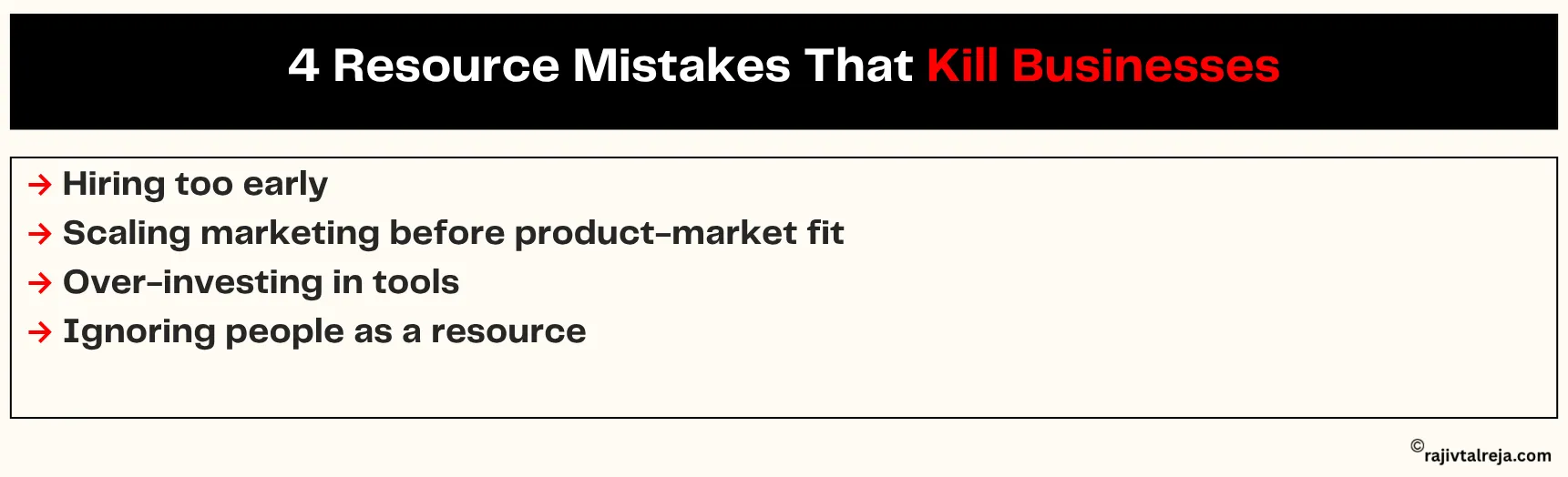
These aren’t just theoretical. They cost real MONEY and real GROWTH.
Let’s look at the most common traps:
| Mistake | What It Looks Like | The Real Cost |
| Hiring too early | Building a team of 10 before systems exist | High salaries, low output, and painful attrition within months |
| Scaling marketing before product-market fit | Pouring Rs 2–3 lakhs into ads without a clear offer or message | Leads come in, but don’t convert — money wasted |
| Over-investing in tools | Buying a CRM, ERP, and project management tool all at once | Expensive software sits unused — the team doesn’t know how to use it |
| Ignoring people as a resource | Treating employees as a cost instead of an asset | Low morale, high turnover, and a business that runs only when the owner is present |
Check for this pattern…
Most of these mistakes come from investing in the wrong business resource at the wrong time.
A business owner in Ahmedabad once told us he spent Rs 4 lakhs on a premium CRM system.
Six months later, his team of 5 was still tracking leads in a notebook.
The tool wasn’t the problem. The timing and readiness were.
Before you invest in any resource, ask: Does my team have the capacity to use this today?
If not, it’s not a resource, it’s a LIABILITY.
| If you recognize any of these costly mistakes in your own operations, an MSME business coach can help you pinpoint exactly where your capital is leaking. |

When most people think of business resources in running a business, they picture money, machines, or manpower.
But some of the most powerful resources are invisible and often free to build.
| Hidden Resource | Why It’s Powerful | How to Build It |
| Customer Loyalty | Repeat revenue without spending on new ads every month | Deliver consistently, follow up after sales, and reward loyal customers |
| Brand Reputation | Attracts referrals, enables premium pricing, and builds trust before the first conversation | Be visible, deliver quality, and stay consistent in communication |
| Founder Network | Opens doors to partnerships, deals, talent, and opportunities | Attend industry events, join business communities, give before you ask |
| Market Insight | Helps you make faster, smarter decisions about products, pricing, and positioning | Talk to customers regularly, track competitors, and stay curious about trends |
Here’s an example.
A garment business owner in Surat had a modest marketing resource, no big ad budget, and no social media team.
But she had an incredibly loyal customer base built over 8 years of consistent quality and personal follow-ups.
Her repeat customers brought in 60% of her revenue every quarter without a single rupee spent on ads.
That customer loyalty was her strongest business resource.
| Women-owned MSMEs now constitute 20.5% of Udyam registrations. |
Many of these businesses are built on exactly these kinds of hidden resources, like relationships, reputation, and deep market insight.
One of the biggest questions business owners ask is:
Where should I put my resources?
How much goes to operations?
How much to grow?
How much to trying new things?
Here’s a simple model we recommend, the 70–20–10 Resource Allocation Rule:
| Allocation | Where It Goes | Examples |
| 70% – Core Operations | The daily engine of your business | Team salaries, rent, raw materials, production costs, utilities |
| 20% – Growth Initiatives | Investments that expand your reach and capacity | Marketing campaigns, new hires, training, systems, process improvement |
| 10% – Experimentation | Calculated bets on the future | Testing a new product line, entering a new market, or trying a new channel |
Why does this work?
Because it forces discipline.
Most MSME business owners either put 100% into operations (and never grow) or dump money into experiments (and run out of cash).
The 70–20–10 rule keeps your business stable while still making room for progress.
It’s not rigid. You can adjust the percentages as your business matures.
But the principle stays the same – PROTECT the CORE, INVEST in GROWTH, and ALWAYS KEEP EXPERIMENTING.
Knowing the types of business resources is one thing.
Actually, auditing and managing them is where the real work begins. Here’s a simple process:
Go department by department: operations, sales, marketing, finance, HR.
Write down every tool, person, system, and asset.
Use the five types from the table above: physical, human, financial, intellectual, and marketing.
This gives you a visual map of where your business is strong and where it’s thin.
The R.O.I Resource Test
Before spending money on any new business resource — a hire, a tool, a piece of equipment — ask these three questions:
| Letter | Question | What It Checks |
| R – Revenue Impact | Will this resource directly increase sales or customer value? | Filters vanity investments from real revenue drivers |
| O – Operational Efficiency | Will it reduce time, errors, or operational costs? | Ensures the resource makes operations leaner |
| I – Irreplaceability | Is this something competitors cannot easily copy? | Tests for long-term competitive advantage |
The rule: if a resource doesn’t satisfy at least two out of three, rethink the investment.
Let’s test it.
A business owner is deciding between buying a fancy CRM (Rs 50,000/year) and hiring a dedicated salesperson.
The CRM scores one, operational efficiency.
But it doesn’t sell by itself (no revenue impact), and any competitor can buy the same software (no irreplaceability).
The salesperson scores all three, directly drives revenue, handles follow-ups efficiently, and, once trained in your business, becomes hard to replicate.
The salesperson wins the R.O.I test.
That’s the kind of clarity this framework gives you.
| We’ve turned the R.O.I Resource Test into a simple scorecard you can fill in before your next big investment. It’s part of our free Business Resource Toolkit. 👉 [Get the Free Scorecard] |
Business resource management is not a one-time exercise.
Set a quarterly review to check what’s working, what’s underused, and what needs to change.
Every business runs on resources.
The question isn’t whether you have them, it’s whether you know what they are, and whether you’re managing them with intention.
When you understand your business resource landscape, the five types, the hidden ones, the mistakes to avoid, and a clear allocation model, you stop reacting and start building.
That’s the difference between a business that survives and one that scales.
And remember, the best business resource you’ll ever have is the clarity to use everything else wisely.
Learned from this?
Explore more practical insights on business growth, leadership, and building a business that actually works for you.
Human, financial, physical, and intellectual assets are used to run and grow a business.
A delivery van, skilled employee, working capital, or brand name.
They help MSMEs manage costs, improve efficiency, and support growth.
Planning and using people, money, tools, and systems efficiently.
Assets that attract customers, like ads, social media, email lists, and content
The workforce and skills employees bring to support operations.
Workspace, team, tools, capital, and marketing channels.
List daily assets and group them into human, financial, physical, and intellectual.
No. Poor resource management leads to waste and unstable growth.


