


A customer walks into your shop, buys once, and never comes back. Sound familiar?
You had the right product. The right price. But something was missing.
There was no connection. No reason for them to remember you over the 10 other options they scrolled past that morning.
That missing piece is often storytelling in marketing. It’s the difference between a business that shouts “buy now” and a business that makes people feel something… something that makes them come back.
Storytelling in marketing is the practice of using narratives, real or structured, to communicate your brand’s message, values, and offerings in a way that emotionally connects with your audience.
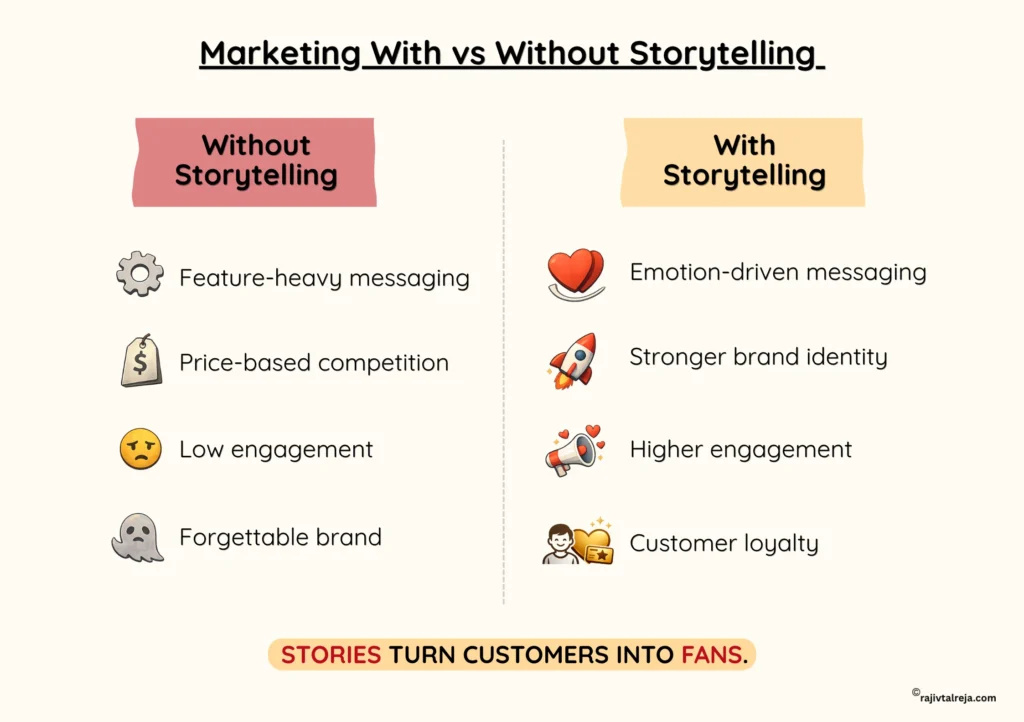
Instead of listing features, you share experiences. Instead of pushing a sale, you pull people into a story they want to be part of.
According to cognitive psychologist Jerome Bruner, people are 22 times more likely to remember a fact when it’s wrapped in a story.
In this blog, we’ll break down exactly how business owners across any industry can use storytelling to attract customers, build trust, and grow.
No jargon. No theory. Just practical, usable strategies.
At its core, content marketing storytelling is about replacing “sell” with “connect.”
Think about the last ad that actually made you stop scrolling. Chances are, it wasn’t a product description. It was a story.
Maybe a small business owner talking about the day they almost gave up. Or a customer describing how one product changed their routine.
Here’s what storytelling is not: making things up or being dramatic for effect.
It’s about structuring your real message, your journey, your customer’s pain, and your solution into a format that people naturally engage with.
Every story has a character, a challenge, and a resolution. In marketing, your customer is the character, their problem is the challenge, and your product or service is the resolution.
That’s it. That’s the framework.
Stories influence how people think, feel, and make decisions.
When brands use emotional storytelling marketing, they tap into human emotions such as inspiration, empathy, or excitement. These emotions make messages more memorable and persuasive.
Storytelling also helps businesses:
For this reason, storytelling is widely used in digital marketing, advertising campaigns, and brand communication strategies.
Not every story needs to be a tear-jerker. In fact, the best types of stories in marketing are the ones that match the moment and the audience.
Here’s a breakdown of the most effective story formats business owners can use:
| Story Type | What It Is | Best Used In | Example |
| Origin Story | How your business started, the struggle behind it | Website, About page, social media | A bakery owner sharing how her grandmother’s recipe became a business |
| Customer Story | A real customer’s journey with your product/service | Ads, testimonials, email campaigns | A salon sharing a client’s transformation story |
| Behind-the-Scenes | What happens inside your business daily | Social media, reels, stories | A manufacturer showing how products are handmade |
| Transformation Story | Before-and-after results a customer achieved | Case studies, landing pages, B2B pitches | A coaching client going from Rs 5 lakh to Rs 25 lakh monthly revenue |
| Values-Based Story | What your business stands for beyond profits | Brand campaigns, CSR content | A brand sharing its commitment to sustainability |
| Failure/Lesson Story | A mistake you made and what you learned | Blogs, podcasts, LinkedIn posts | A business owner sharing how a bad hire taught them to build systems |
The key? Match the story type to the channel and the customer’s stage. A first-time visitor needs your origin story. A returning customer needs your transformation story.
Here’s where most articles on storytelling digital marketing fall short. They tell you “tell stories” but never explain where and how across different channels.
Let’s fix that.
Social media is built for stories. Literally Instagram Stories, Facebook Stories, YouTube Shorts. But storytelling in social media marketing goes beyond the format.
Share micro-stories in your captions. Show behind-the-scenes moments in reels. Let your customers speak through video testimonials.
The goal is to make your feed feel like a conversation, not a catalogue.
A garment shop owner posting a 30-second reel about why they chose organic cotton will get more engagement than a flat product photo with a price tag.
Most marketing emails get deleted in seconds. But storytelling in email marketing flips the script.
Instead of “Flat 20% off this weekend!” try “Last month, Priya from Jaipur told us this one product changed her morning routine. Here’s her story…”
Open with a hook. Build curiosity. Let the story lead naturally to your offer. That’s how you get people to read all the way to the CTA.
Remember, 92% of consumers want ads that feel like stories. Storytelling in advertising isn’t about fancy production. It’s about structure.
Even a simple Facebook ad can tell a story: problem → discovery → result. You don’t need a film crew. You need a relatable character and a genuine outcome.
That’s what makes emotional storytelling marketing so powerful in ads. When people feel some frustration, hope, or relief, they act.
Think storytelling is only for consumer brands? Think again. B2B storytelling is one of the most underused growth levers in business.
Some strong B2B storytelling examples include: case studies showing how your service helped a client save Rs 10 lakh a year, or a LinkedIn post about a client’s transformation from chaos to clarity.
B2B buyers are still humans. They respond to stories of struggle, solution, and measurable results.
Fashion brands thrive on emotion and identity. Storytelling in fashion marketing means going beyond “new collection dropped” to sharing the story behind the design.
These questions, answered through short videos or carousel posts, build a brand that people don’t just buy from what they identify with.
Let’s look at some real examples of storytelling marketing that drove results.
A small mithai shop in Gujarat started posting short videos of their 80-year-old founder making sweets by hand. No fancy camera. Just a phone and a genuine story. Within months, orders started coming in from across India. Why? Because people are connected with heritage, love, and tradition.
Amul’s topical ads have been telling stories tied to current events for over 50 years. It’s not about selling butter. It’s about being part of the national conversation. That’s brand storytelling marketing at its finest.
In our experience working with hundreds of businesses, one of the most powerful marketing tools is a simple before-and-after story.
A business owner who joined a coaching program at Rs 5 lakh monthly revenue and scaled to Rs 25 lakh in 12 months. That story, shared on a landing page or in a webinar, converts better than any feature list.
Spotify didn’t tell a brand story. They let 156 million users tell their own. Wrapped turns listening data into a personal narrative that people share voluntarily. That’s the highest level of storytelling digital marketing.
Here’s a simple, repeatable storytelling marketing strategy you can start using this week.
What keeps your ideal customer up at night? What frustrations do they face daily? Start there. Every great story begins with a real problem.
Refer to the table above. Are you sharing your origin story? Customer success? A lesson from failure? Pick the one that fits your current marketing goal.
Problem → Struggle → Solution → Result. That’s it. Don’t overcomplicate it. Every story you tell should follow this arc.
A 3-minute origin story works on YouTube or a blog. A 15-second customer testimonial works on Instagram. A detailed case study works in a B2B email. Choose the right stage for each story.
Track which stories get the most engagement, clicks, and conversions. Double down on what works. Drop what doesn’t.
Your customers don’t remember your product specs. They remember how you made them feel.
Storytelling in marketing isn’t reserved for big brands with big budgets. It’s for any business owner willing to share something real: a struggle, a win, a lesson. That’s what builds connection. That’s what builds loyalty.
Start with one story. Share it today. See what happens.
For more such insights, explore our blog page and stay ahead in marketing strategy and brand building.

Storytelling in marketing means using narratives to communicate your brand’s message instead of just listing features. For example, a bakery sharing the story of how a grandmother’s recipe inspired their best-selling cake is storytelling in action.
Start by sharing your origin story or a customer’s experience on social media. You don’t need a big budget. A genuine 30-second video or a heartfelt caption can build stronger connections than a paid ad.
The main types include origin stories, customer stories, behind-the-scenes stories, transformation stories, values-based stories, and failure/lesson stories. Each works best on specific channels and at different stages of the customer journey.
Yes. 62% of B2B marketers say storytelling is effective in content marketing. Case studies, client transformation stories, and LinkedIn posts with real results are powerful B2B storytelling tools.
Share micro-stories in captions, use reels for behind-the-scenes content, and let customers speak through video testimonials. Treat your feed like a conversation, not a product catalogue.
A good marketing story has a relatable character, a real challenge, and a clear resolution. It should feel authentic, use specific details, and connect back to your product or service naturally.
Absolutely. Research shows storytelling can boost conversion rates by 30% and increase perceived product value significantly. Stories create trust, and trust drives purchases.


