


The sales report is late…again.
Three team members wait for your approval on simple tasks.
A customer complaint from last week is still unresolved.
Your operations manager is “busy”, but nobody can explain what he actually delivered this month.
Sound familiar?
This is what poor management looks like from the inside.
Not dramatic blow-ups. Not obvious incompetence. Just… slow, silent decay.
In our experience working with hundreds of MSME businesses across India, we’ve seen this pattern repeat.
The owner works 14-hour days. The team waits. The business bleeds.
And the root cause?
Poor management in the workplace that nobody is naming.
Let’s see what it looks like, diagnose it, and fix it for good.
Poor management is the inability of a person in a supervisory role to effectively plan, organise, lead, and deliver results through their team.
It doesn’t always mean the manager is “bad.”
Often, it means they were never TRAINED to MANAGE.
According to Gallup (2023), 70% of the variance in team engagement is determined solely by the manager.
That means your manager is not just “helping.”
They are the single biggest factor deciding whether your team performs or stagnates.
Why?
Because most MSME business owners fall into what management experts call the Peter Principle.
People get promoted based on their current performance, not their ability to manage.
But managing people is a completely different skill.
What we’ve seen time and again is this: the manager keeps doing their old job instead of managing.
The team doesn’t grow.
The owner stays stuck. And nobody calls it what it is, POOR MANAGEMENT.
Let’s go beyond theory.
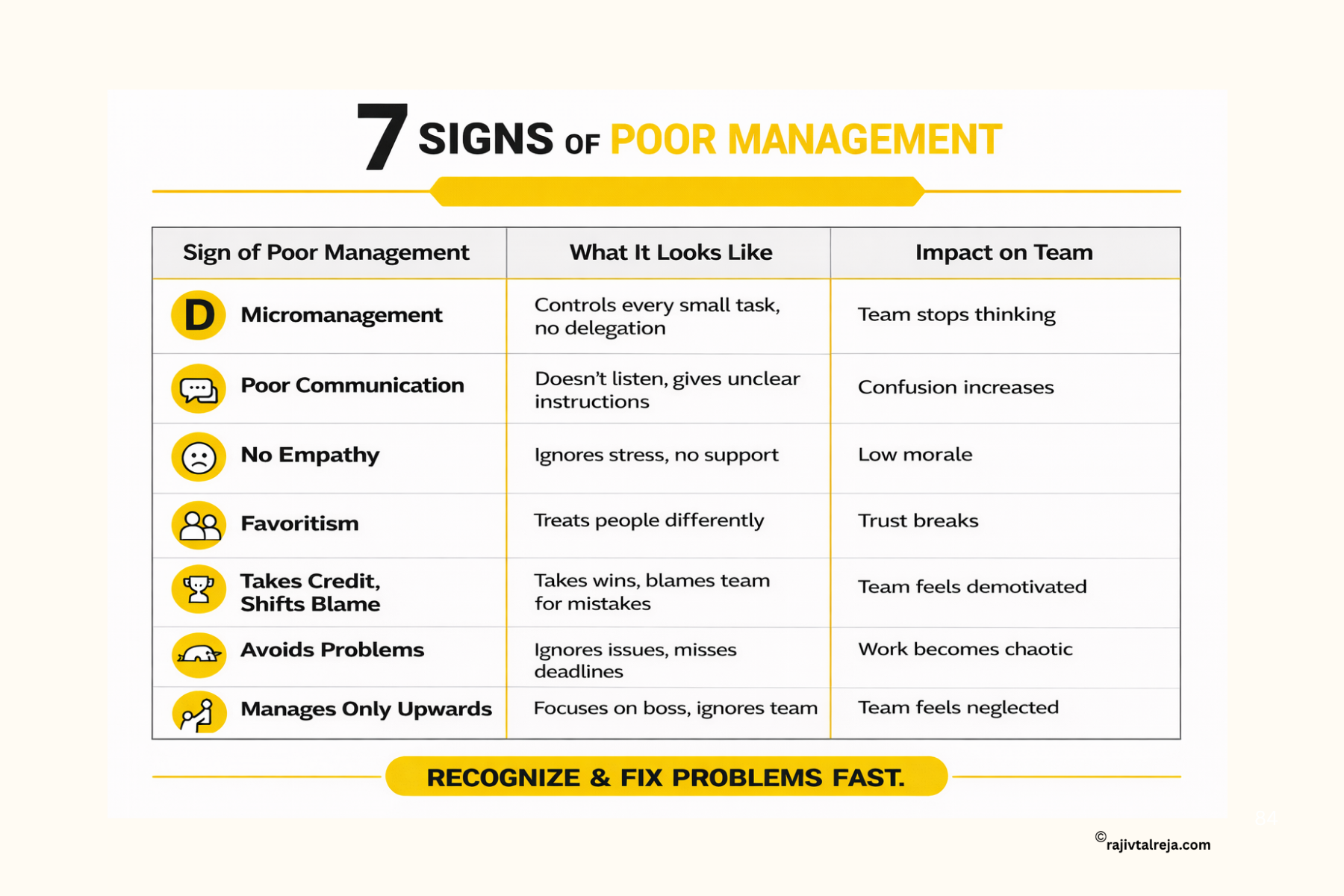
Here are 7 real poor management examples, some from businesses we’ve coached, and some from companies the whole world watched collapse.
1. The Manager Who Blocks Decisions
Every approval sits on their desk for days.
The team has learned to wait, not act.
Result? Missed opportunities, frustrated clients, and a business that moves at the speed of one person’s inbox.
This is not just a small business problem.
| Nokia had the technology to build a touchscreen smartphone years before Apple. But rigid hierarchies and management that feared cannibalising their own products delayed the decision… until it was too late. Their market share collapsed. |
2. The Manager Who Creates Silos
They guard information like a fortress.
Their team doesn’t talk to other departments.
This is classic poor management in business. It fragments operations and creates a blame culture.
| Kodak actually invented the digital camera in 1975. But siloed departments and a management team that ignored the digital shift meant the innovation never saw the light of day. The company filed for bankruptcy in 2012. |
3. The Manager Who Looks Busy But Produces Nothing
Always in meetings. Always “working on something.”
But when you ask for outcomes like reports, numbers, and results, there’s nothing concrete.
This poor management persona drains resources silently.
We call this “PRODUCTIVITY PARANOIA.”
The manager confuses activity with output.
And the business pays the price in wasted salaries and stalled projects.
4. The Micromanager
Checks every email. Hovers over every task.
The team stops thinking for themselves. Creativity dies. Productivity tanks.
And the manager burns out trying to control everything.
| Remember Yahoo’s remote work ban in 2013? Instead of fixing management systems, leadership forced everyone back to the office. A micromanagement response to a trust problem. It didn’t save the company. |
5. The Buddy Manager
Wants to be liked, not respected. Avoids tough conversations.
Never gives honest feedback. The team likes them, but nobody grows, nobody is accountable, and results stay mediocre.
This is especially common in Indian family businesses where personal relationships blur professional boundaries.
The manager is “loyal” and “nice.” But the business is not growing.
Rules with fear. “My way or the highway.”
Good people leave. Only yes-men remain.
This creates a toxic workplace culture where innovation is impossible.
| Enron is the extreme example. A culture of fear, unethical management, and zero accountability from the top led to one of the biggest corporate collapses in history. When management operates through intimidation, fraud is never far behind. |
7. The Ghost Manager
Barely present. No check-ins. No feedback. No direction.
The team is on autopilot, which sounds fine until you realise autopilot means nobody is improving, innovating, or pushing for better.
| Blockbuster had chances to buy Netflix. Twice. But management was absent from the strategic conversation. They ignored streaming, stuck to their old model, and disappeared. That’s what “ghost management” looks like at scale. |
A DDI study found that 57% of employees have left a job specifically because of their manager.
The negative effects of poor management go deeper than attrition.
They hit every part of your business and your people:
| Business Area | With Poor Management | With Good Management |
| Employee Retention | High attrition, rehiring costs Rs 50,000–2,00,000 per person | Stable team, lower hiring costs |
| Revenue | Inconsistent sales, missed monthly targets | Predictable revenue, growing pipeline |
| Productivity | Team is unproductive for 10–52% of their day | Focused output, clear priorities |
| Owner’s Time | Stuck firefighting, zero time for strategy | Free to work ON the business, not IN it |
| Customer Experience | Complaints, delays, and inconsistent service | Repeat customers, strong referrals |
| Team Mental Health | Burnout, stress, reduced creativity, loss of trust | Engaged team, high morale, innovation |
| Market Position | Loss of market share, risk of bankruptcy | Competitive edge, growing brand |
The human cost is real, too.
Poor management leads to mental health decline, chronic burnout, and a deep loss of trust within the team.
People stop bringing ideas. They stop caring.
And eventually, they stop showing up.
Here’s the truth most people won’t tell you: solutions to poor management are not about giving a motivational speech or sending your managers for a weekend workshop.
It’s about installing systems that make good management the default, not the exception.
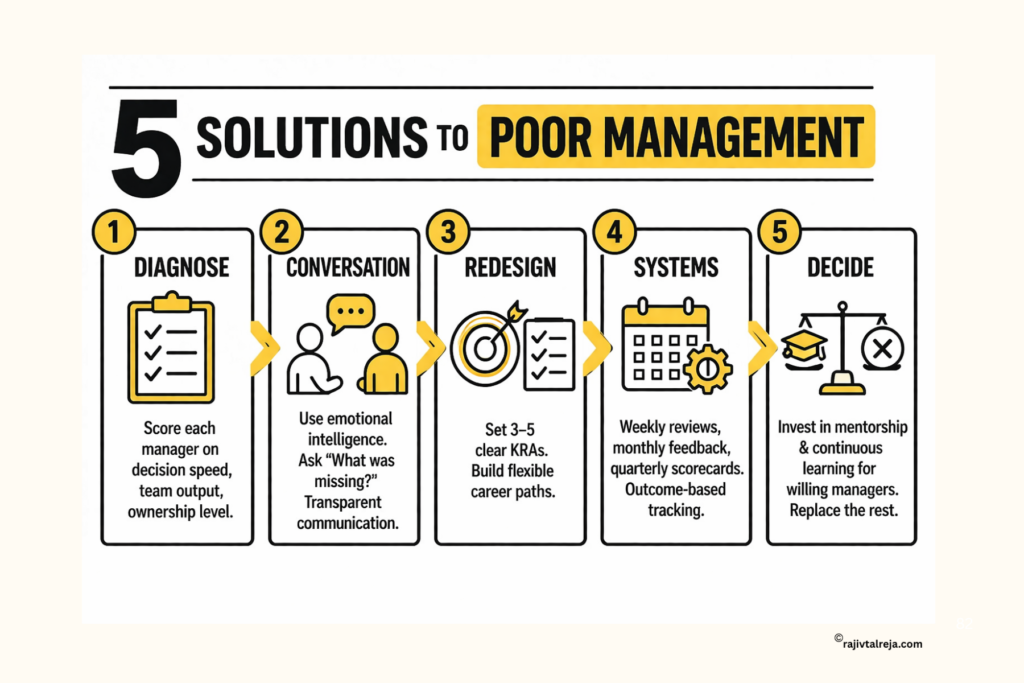
Here’s our 5-step process.
We’ve used this with hundreds of businesses across industries.
Step 1: Diagnose | Score Your Managers Objectively
Stop guessing. Use these 3 criteria to score each manager on a scale of 1–10:
How quickly do they resolve issues without escalating to you?
Is their team hitting targets consistently? What are the numbers?
Do they own problems end-to-end, or pass them upward?
A manager scoring below 5 on all three needs immediate intervention.
This diagnosis removes emotion from the equation.
Step 2: Have the Conversation | With Evidence, Not Emotion
Most business owners either avoid the conversation or explode. Neither works.
Sit down with your manager. Share the scores. Share specific examples.
Ask: “What was missing?” instead of “Why did you fail?”
This requires emotional intelligence, the ability to address problems without triggering defensiveness.
Transparent communication is the foundation of every fix.
If the manager doesn’t know what’s broken, they can’t repair it.
Step 3: Redesign the Role | Set Clear KRAs
Many managers are poor performers because their role is unclear.
They don’t know what success looks like.
Fix this by writing down 3–5 Key Result Areas (KRAs) for every manager.
For example, a sales manager’s KRAs might be:
No ambiguity. No guessing.
Build flexible career paths so managers see growth ahead, not just pressure.
Step 4: Install Systems | Reviews, Feedback, Tracking
This is where most solutions to poor management fall apart.
The conversation happens. The roles get redesigned. And then… nothing changes. Because there’s no system to sustain it.
Install these 3 non-negotiables:
15-minute check-ins on KRAs. No long meetings.
Just numbers and actions. This is outcome-based tracking in action.
Structured 1-on-1s where the manager gets honest feedback on what’s working and what’s not.
A simple performance tracker that makes results visible to everyone.
These systems create operational agility, the ability to spot poor management early and correct it before damage spreads.
Step 5: Decide | Train or Replace (No Middle Ground)
After 60–90 days of steps 1–4, you will know the answer.
Some managers will step up. Others will not.
Invest in mentorship programs and continuous learning for those who are willing.
But be honest about those who are not.
Here’s how to decide:
| Factor | Train This Manager | Replace This Manager |
| Attitude | Willing to learn, open to feedback | Defensive, blames others, resists change |
| Skill Gap | Lacks specific skills but shows effort | Lacks both skills and drive |
| Team Impact | Team respects them, just needs direction | The team is afraid or disengaged because of them |
| Track Record | Has shown improvement in the past | Repeated issues despite multiple feedback rounds |
| Cultural Fit | Aligned with company values | Creates toxicity, politics, or silos |
The hardest part? Letting go of the manager who is “loyal” but incompetent.
In our experience, cultural tolerance of poor management (“He’s been with us for 8 years”) is the single biggest reason MSME businesses stay stuck.
| Companies like Toys R Us and Sears held onto outdated management thinking for years, loyalty to old models over adaptation. Both filed for bankruptcy. The scale is different, but the lesson is the same: keeping a poor manager is not loyalty. It’s a business risk. |
Want a fast way to check how deep the problem runs before starting the 5 steps above?
We created the D.E.A.D. Framework. A simple, memorable diagnostic tool.
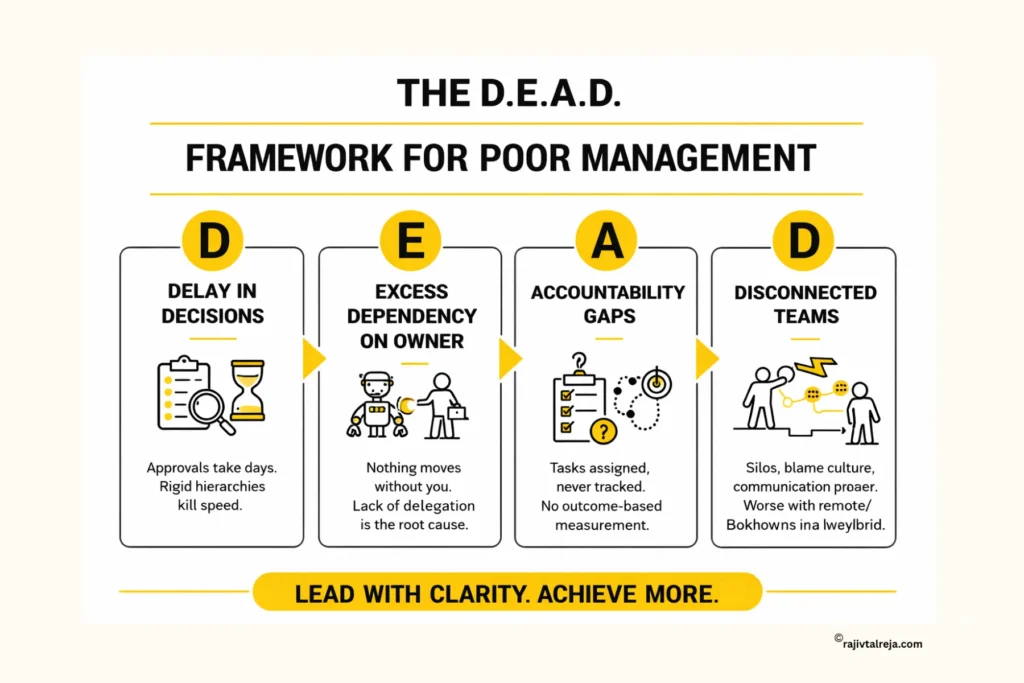
If your business shows 3 or more of these signs of poor management, you need to act now.
D – Delay in Decisions
Slow decisions = lost opportunities
Business runs only because of you
Work is done, but no result
No teamwork = slow growth
Score your business 1 (no problem) to 5 (severe) on each letter.
A total score above 12 means poor management is actively hurting your growth.
Go back to Step 1 and begin the fix.
Poor management doesn’t announce itself.
It creeps in quietly through delayed decisions, excess dependency, accountability gaps, and disconnected teams.
The fix is not complicated. Diagnose objectively. Have honest conversations. Set clear roles. Install simple systems.
And make the tough call when it’s needed.
Your business deserves managers who drive it forward, not ones who hold it back.
Learned from this?
Head to our blog for more practical insights on business growth, leadership, and building a business that actually works for you.
Poor management means no results, slow decisions, and no team control.
Delays, micromanaging, silos, no feedback, and depending on the owner.
Slow decisions, owner dependency, no ownership, and poor teamwork.
Low sales, high costs, poor output, and slow business growth.
No delegation, poor communication, no tracking, and avoiding tough talks.
Use data, talk calmly, set clear roles, and review work regularly.
Train if they are willing to improve. Replace if negative and not changing.
Management runs the work. Leadership sets direction and motivates people.
Weekly reviews, feedback, scorecards, and continuous learning.


