


A business owner we worked with once said something that stuck with us.
“I have 40 people on the floor. I know 3 of their names.”
He was not a bad person. He was a busy person. Running operations, chasing payments, solving customer complaints… and his blue-collar team? They showed up, did the work, and went home. No conversations. No check-ins. No one asks, “How are things going?”
That is the invisible workforce problem. And it is quietly destroying blue-collar employee engagement in thousands of Indian MSMEs.
Blue-collar employee engagement is the emotional investment a worker has in their job, their team, and your business. It is not about salary alone. It is about whether your blue-collar employee feels seen, valued, and motivated to give their best or whether they are just surviving until payday.
And here is the uncomfortable truth: according to ADP Research’s People at Work report, employee engagement in India dropped to just 19%, the steepest decline globally. On a factory floor, that means 8 out of 10 people are just going through the motions.
Let’s keep it simple.
An engaged blue-collar employee is the guy who notices a machine making an odd noise and reports it before it breaks down. The delivery driver who double-checks an address because she knows a wrong delivery costs the business. The helper who trains the new joiner without being asked.
A disengaged one? Clocks in. Does the minimum. Clocks out. And starts looking for the next job that pays Rs 500 more.
Globally, the numbers are just as stark. Gallup’s report found that only 21% of employees worldwide were engaged at work. The remaining 79%? Either sleepwalking through the day or actively pulling things down.
For MSME owners, this is not an HR problem. It is a profit problem. A growth problem. A “why can’t I take a single day off” problem.
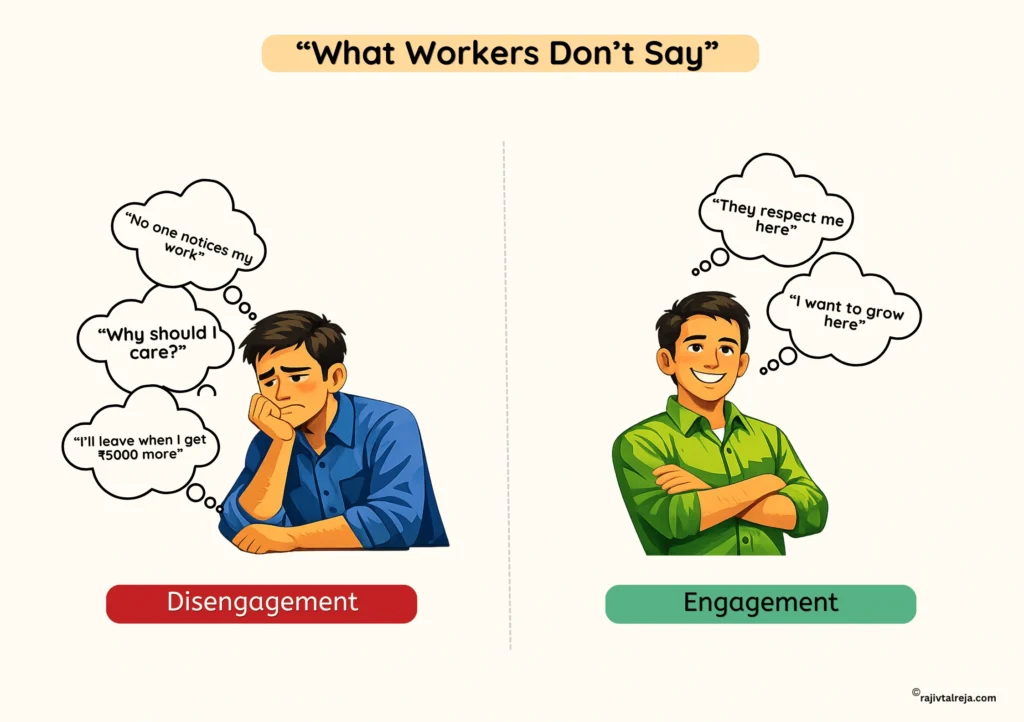
Before we talk about solutions, let’s look at what is actually going wrong. Because here is what we have seen working with hundreds of businesses, the root cause is almost never “lazy workers.” It is almost always a broken system.
Society tells your floor workers their job is “less than” desk jobs.
When that attitude leaks into your workplace through how supervisors talk, who gets invited to meetings, who eats where workers absorb the message, and they stop trying.
Ask your floor supervisor what his next role is. If he cannot answer, neither can anyone below him.
When there is no growth path, people treat the job as a temporary stop. Career advancement does not always mean a promotion.
Sometimes it is a new skill, a new responsibility, a new title.
When was the last time you walked to the floor and said “great job” to someone? Not via WhatsApp. In person.
Most blue-collar workers go months without hearing a single word of appreciation. That erodes engagement faster than low pay.
Double shifts. Cancelled leaves. No predictability. Your worker’s child has a school function, but the shift cannot be swapped.
That moment when he chooses work over his kid and resents you for it, that is when you lose him. Even if he shows up tomorrow.
Decisions about their work, their shifts, and their tools were all made without consulting them.
The message is clear: “Your hands matter, your brain does not.” That is not engagement. That is extraction.
A broken fan. A dirty restroom. Missing safety gear. These are not minor issues. They signal to your blue-collar employee that their comfort and safety are not worth spending on.
Tired of rebuilding your team every few months?
Here is the best part about blue-collar employee engagement. The most powerful strategies are free.
They do not require software, consultants, or a big HR budget. They require a shift in how you see your people.
Let’s break this down.
Culture is not a poster. It is what happens when the owner is not watching. Does the supervisor yell? Is the canteen shared equally? Are safety complaints acted on?
Write a simple 5-line “team code” for how people treat each other. Print it. Stick it on the wall. Hold everyone accountable, especially supervisors. That is where a real workplace culture for blue-collar teams begins.
Even without formal promotions, you can create levels. Helper → Skilled Worker → Technician → Shift Lead → Supervisor. Map it. Print it. Show your team where they can go if they stay and grow.
Career advancement does not need to mean a corner office. For a blue-collar employee, it can mean a new badge, a new skill, or the trust to train others.
Annual award functions are nice. But a worker who did great work in January should not wait until December to hear about it.
Start a 2-minute shout-out during the morning briefing. Name the person. Say what they did. Let the team clap. That is recognition programs done right, free, fast, and unforgettable.
Safety workshops that are a manager reading rules from a sheet? Nobody listens. But a session where workers share real near-miss stories and discuss what to do differently? That gets attention.
Reward teams with zero incidents. Make safety a source of pride, not a compliance tick-box. When workers feel safe, they feel cared for. And care is the foundation of engagement.
You do not need a training department. Even a senior worker teaching a new technique for 30 minutes every Friday counts as skill development classes. It says to your team: “We want you to get better.”
The business impact? Workers who learn new skills feel more capable, more confident, and far less likely to leave for a slightly higher salary elsewhere.
Not formal meetings. Not performance reviews. Just a 10-minute weekly huddle with your team leads where you ask two questions: “What is working?” and “What is one thing we should fix?”
Then, this is critical to actually fix it. Feedback sessions without follow-through are worse than no feedback at all. They teach your team that speaking up is pointless.
Work-life balance for blue-collar workers is not remote work. It is a predictable shift. It is leave that gets approved without drama. It is not calling someone on their day off unless it is truly urgent.
Small changes here have an outsized impact. A rested worker is a present worker. A resentful worker is already halfway out the door.
Your experienced workers carry years of knowledge in their hands. Mentorship programs channel that knowledge into faster onboarding for new hires and give senior workers a sense of purpose and respect.
It costs nothing. It builds loyalty on both sides. And it creates a culture where learning is the norm, not the exception.
Policy changes. New client requirements. Business challenges. Share them with your floor team. Not everything, but enough. A 5-minute daily huddle before the shift can replace rumours with trust.
When you engage the blue-collar workers as insiders, not just as labour, they start thinking like stakeholders. And that changes everything.
Here is what changes when you start treating engagement as a business system, not an afterthought…
| Your Reality | Without Engagement | With Engagement |
| Your mornings | Firefighting: who’s absent, what’s broken | Team runs the first hour without you |
| Your weekends | Calls from the floor, problems piling up | Phone stays quiet, team handles it |
| Team output | Bare minimum, constant rework | Ownership, fewer defects, better quality |
| Safety on the floor | Near-misses ignored, accidents rising | Workers report hazards proactively |
| Hiring headaches | 8–24% monthly attrition, constant rehiring | People stay 2–3x longer, training actually sticks |
Strategies are great. But what do you actually do starting this Monday? Here is a ready-to-use checklist, every activity costs ₹0 and can be started this week.
| # | Activity | Frequency | What It Looks Like |
| 1 | Safety workshops | Monthly | Workers share near-miss stories. The team discusses solutions together. |
| 2 | Skill development classes | Fortnightly | The senior worker teaches one new technique for 30 mins on Friday. |
| 3 | Recognition programs | Weekly | 2-minute shout-out during morning briefing. Name + what they did. |
| 4 | Team building exercises | Monthly | Sports day, group problem-solving, or a shared team meal. |
| 5 | Team competitions | Quarterly | Inter-team challenge on quality, safety, or output. Small prize. |
| 6 | Health and wellness programs | Quarterly | Free health check-up camp. Stretching before shifts. Mental health talk. |
| 7 | Feedback sessions | Weekly | 10-min check-in: What’s working? What needs fixing? Then act on it. |
| 8 | Mentorship programs | Ongoing | Pair every new joiner with a senior worker for 90 days. |
| 9 | Daily team huddles | Daily | 5-min pre-shift briefing: updates, priorities, and one quick appreciation. |
Print this. Stick it in the supervisor’s cabin. Review it every month. That is how you build a real workplace culture for blue-collar teams one week at a time.
Will every worker suddenly become passionate about your business after reading this blog?
The honest answer is no.
But will your best people stay longer? Will your floor run smoother? Will you finally stop being the person who has to solve every small problem?
Yes.
That is what blue-collar employee engagement does. It gives you your business back.
Start with one thing from the checklist. Run it for 90 days. Then add another. Your invisible workforce is waiting to be seen.
For more such insights, explore our blog page and stay ahead in leadership, workplace culture, and employee engagement.
Ready to build a business that runs without you being on the floor all day?
It involves motivating and involving frontline workers in the workplace.
It improves productivity, safety, and employee retention.
Through recognition, career growth, and better work-life balance.
Safety workshops, team building, and recognition programs.
Stigma, communication gaps, and limited growth opportunities.
By promoting respect, communication, and inclusivity.
Yes, engaged employees are more productive and committed.


