If your business gets leads but not enough sales, don’t worry. Most MSME owners struggle here because they don’t have a clear sales funnel that guides people from “I’m interested” to “I’m ready to buy.”
In 2026, with more online businesses, new competitors, and customers constantly comparing brands, a strong funnel is your growth engine.
So let’s start simple… What a sales funnel is, and how can it help your business convert more customers without increasing effort?
Let’s get started!
A sales funnel is the step-by-step path your customer takes… from hearing about your business to finally buying from you. It’s the bridge between interest and income.
Every entrepreneur already has a funnel (even if you haven’t intentionally built one).
The question is… “Is it working… or leaking leads?”
A funnel helps you…
Sales Funnel vs Marketing Funnel
A sales funnel is different from a marketing funnel, though they work together. Marketing grabs attention. The sales funnel closes the deal, whether you’re a retail store, service provider, or running an online business.
In 2026, with so many business names, brands, and choices floating around, a strong funnel is what helps you stand out and grow consistently.
Now that you know what it means, let’s break it down even further…
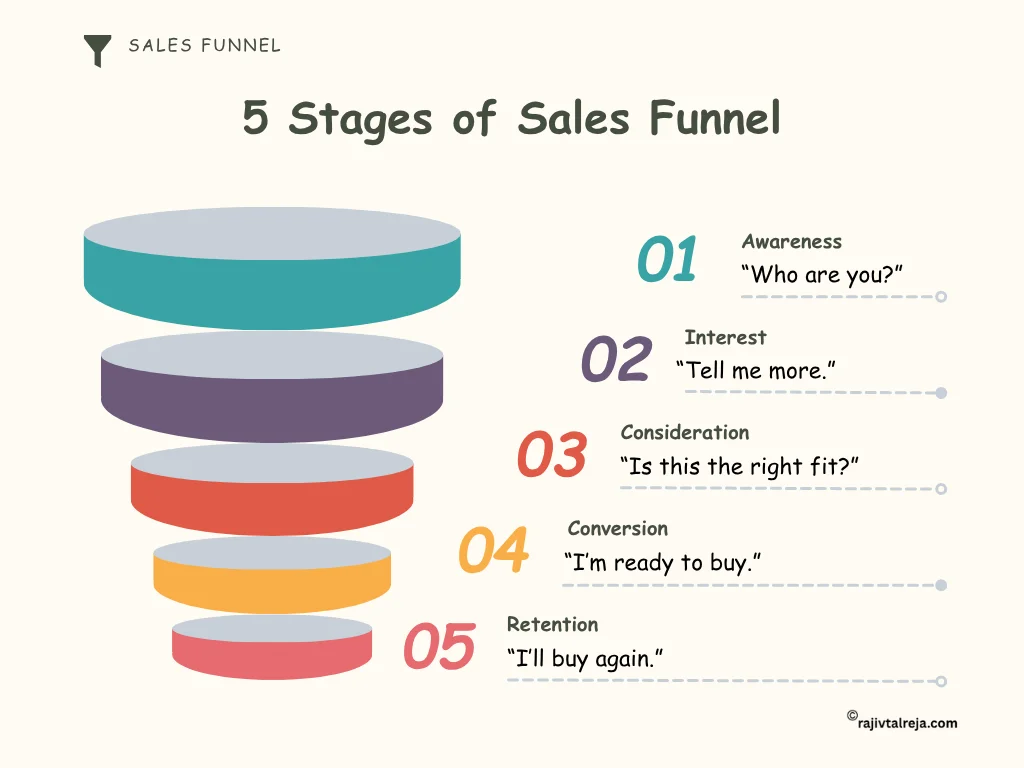
Every successful business follows these five simple sales funnel stages.
Even if you haven’t built one intentionally, your customers already move through this path.
Let’s make it clear, simple, and useful for you!
This is where people first discover your business.
Maybe through social media, Google, referrals, or even a business partner recommending you.
Your goal here: grab attention fast.
Now they’re curious.
They check your website, offers, reviews, or compare your business with competitors.
Your role: give them value. Not pressure.
Here, they start evaluating options.
This is where sales funnel examples, testimonials, case studies, and FAQs help them trust you.
Your job: answer objections before they even ask.
This is where your sales funnel management matters.
Smooth checkout, follow-ups, and clear pricing. All of these influence the final decision.
Your goal: make buying feel effortless.
A strong funnel doesn’t end at the sale.
This is where you build long-term loyalty, referrals, and repeat purchases.
Your job: deliver consistently and follow up meaningfully.
A good funnel guides your customer naturally through these stages.
But before we build your own funnel, let me show you some real sales funnel examples for MSMEs so you can see how it works in real life.

Before you build your own funnel, it helps to see how different business types use it.
Here are quick, real-world examples for you!
| Awareness: Instagram reel → Google search Interest: Free guide/webinar Consideration: Case studies + pricing page Conversion: Discovery call → paid project Retention: Monthly retainer/upsell |
Perfect for coaches, designers, agencies, or anyone selling expertise.
| Awareness: Walk-in, Instagram ads, local SEO Interest: Product videos or reviews Consideration: Discounts, comparisons, customer photos Conversion: In-store purchase or WhatsApp order Retention: Loyalty points + festival offers |
Ideal for MSME shops with offline + online buyers.
| Awareness: Google Maps + local ads Interest: Menu, pricing, before/after photos Consideration: Reviews + recommendations from a business partner Conversion: Booking/table reservation/membership Retention: Coupons, monthly plans, repeat-visit offers |
This is the simplest sales funnel template for small local businesses.
| Awareness: Meta/Google ads, influencer shoutouts Interest: Product pages, social proof Consideration: Add to cart, checkout reminders Conversion: Online purchase Retention: Email flows, subscription plans, remarketing |
Works for any online store and is especially strong for b2b sales funnel models, too.
These examples show that a good funnel doesn’t depend on business size. It depends on customer clarity.
Now, let’s make it practical for you.
Now that you’ve seen how funnels work, let’s build one for your business. Here’s the simplest version any MSME can start using today.
Who are you really trying to sell to?
This one step affects your entire funnel.
Knowing their needs helps you choose the right marketing funnel channels.
Example…
If you run an online business, your customer might discover you through reels or Google.
If you’re a local store, it might be Maps or walk-ins.
This is where people first meet your business.
It could be:
A clear, attention-grabbing entry point = more people entering the funnel.
Your job here is simple: give value, don’t sell.
This could be:
This builds trust and moves customers deeper into your sales funnel.
A messy purchase process will kill your funnel.
Make buying easy by improving your sales funnel management:
Make it so simple that they want to buy.
Most MSMEs focus on getting the sale, but the real profit is in retention.
Add simple follow-ups:
This is where sales funnel optimization begins.
Here are the most important sales funnel metrics and how to calculate them…
| Sales Funnel Metric | What It Is | Formula |
| Lead Conversion Rate | Measures how many leads turn into customers. | (No. of Customers/No. of Leads) x 100 |
| Cost Per Lead (CPL) | Shows how much you spend to get one lead. | Total Marketing Spend/Number of Leads |
| Customer Acquisition Cost (CAC) | How much it costs to acquire one customer. | Total Sales + Marketing Cost/Number of New Customers |
| Average Order Value (AOV) | Tracks the average revenue per order. | Total Revenue/Number of Orders |
| Funnel Drop-Off Rate | Shows where leads are exiting your sales funnel. | (Leads at Stage A – Leads at Stage B)/Leads at Stage A × 100 |
| Customer Lifetime Value (CLV) | Predicts total revenue you earn from one customer. | Average Order Value x Purchase Frequency x Retention Duration |
| Sales Cycle Length | How long it takes to convert a lead into a customer. | Total Days to Convert All Leads/Number of Leads Converted |
| ROI on Funnel Activities | Shows if your funnel efforts are profitable. | (Revenue – Cost)/Cost x 100 |
A good sales funnel helps you grow with clarity, confidence, and consistency.
And the best part?
You don’t need a big budget or a big team to build one. Just small, simple steps done right.
Start with one template, track a few key metrics, and improve as you go. When you think strategically, like a business owner who knows their numbers, your funnel starts working for you, not the other way around.
For more business lessons, insights, and case studies, visit our blog page.
Yes! A sales funnel gives small businesses a clear path to attract leads, build trust, and convert customers consistently, even with limited time and budget.
Most MSMEs start seeing improvements in 30-60 days, depending on traffic, follow-ups, and how well each funnel stage is optimized.
A basic 3-step funnel… Awareness → Offer → Follow-up.
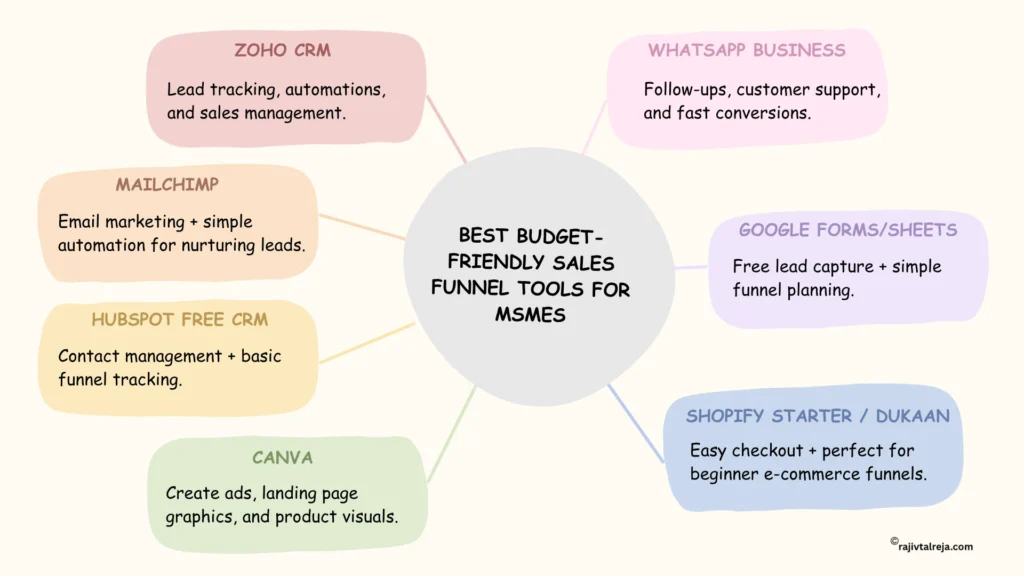
Use simple tools like WhatsApp Business, Google Forms, Sheets, and social media posts. Even a manual funnel works if the steps are clear and consistent.