Many business owners think a performance review is just about “judging the past.”
IT’S NOT TRUE.
Here’s the REALITY: skipping the end-of-year review doesn’t save you time.
It ensures that 2025’s issues will tag along into 2026.
For an MSME owner with a turnover between ₹5 crore and ₹50 crore, this process is more like a deep audit – not of what happened, but of what’s coming next.
The end-of-year review is your diagnostic tool for future profitability.
In this blog, you’ll learn how to turn this task into a powerful strategic tool.
Let’s start.
“We are a small family. We talk every day. Why do we need a formal meeting?”
I hear this all the time.
But the numbers tell a different story.
Understanding the importance of year-end review sessions is critical for future growth.
In a corporation of 5,000, one lazy employee is 0.02%. In your team of 15, one poor hire becomes 7%.
You simply can’t afford someone who isn’t pulling their weight.
A proper year-end review for employees catches these issues early.
Many think osmosis works. It doesn’t.
Informal feedback usually appears when you’re upset or ends with vague lines like “Great job.”
You need a clear system, like an end-of-the-year performance review, to spot the quiet achievers.
Your Accounts person is probably also handling admin tasks.
Conducting a year-end review for employees is the only way to check how the role has evolved and prevent burnout.
It’s hard to critique someone you’ve known for 10 years.
A formal end-of-the-year performance review system depersonalizes the feedback, shifting it from “I don’t like you” to “The business needs X.”
You have a tight budget.
Realizing the importance of year-end review meetings helps you decide whether to invest in sales training or new software based on data.
Now, let’s see how to create a review format that fits your busy schedule.
| You can’t scale a business on “casual” feedback. Moving from a “family” dynamic to a professional, high-performance team is exactly what an MSME business coach helps you achieve. |
You don’t have time for complicated processes.
You need a “framework” – short, structured, and easy to repeat.
This creates a focused end-of-year review.
Prepare by asking for a “One-Pager” 48 hours before the meeting (Wins, Blockers, Support Needed).
This is standard practice in a good year-end performance review.
| Time | Part | What You Say (The Script) |
| 0–5 Minutes | Appreciate Wins | “I read your note. Great job on the Diwali order. I also noticed how you handled that upset vendor.” |
| 5–10 Minutes | Discuss the Gaps & Problems they faced | “Let’s look at what didn’t work. The inventory count was delayed twice. What’s the root cause?” (Honesty is key for a year-end performance review.) |
| 10–15 Minutes | Forward Goals and Future Targets | “Our target for 2025 is ₹10 Cr. Your role in this is X. Does that feel achievable?” |
| 15–20 Minutes | Set Support | “What resources or training do you need from me to hit that goal? I promise to get you X.” |
| Don’t go into your meetings empty-handed. We have turned this 20-minute framework into a Printable PDF Cheat Sheet that you can keep on your desk during reviews. [Download the “20-Minute Review Template” PDF Here] |
This approach works because it’s low admin, conversational, and focused on the future.
Below are year-end performance review examples tailored for the most common roles in your office.
Use these year-end review feedback examples scripts.
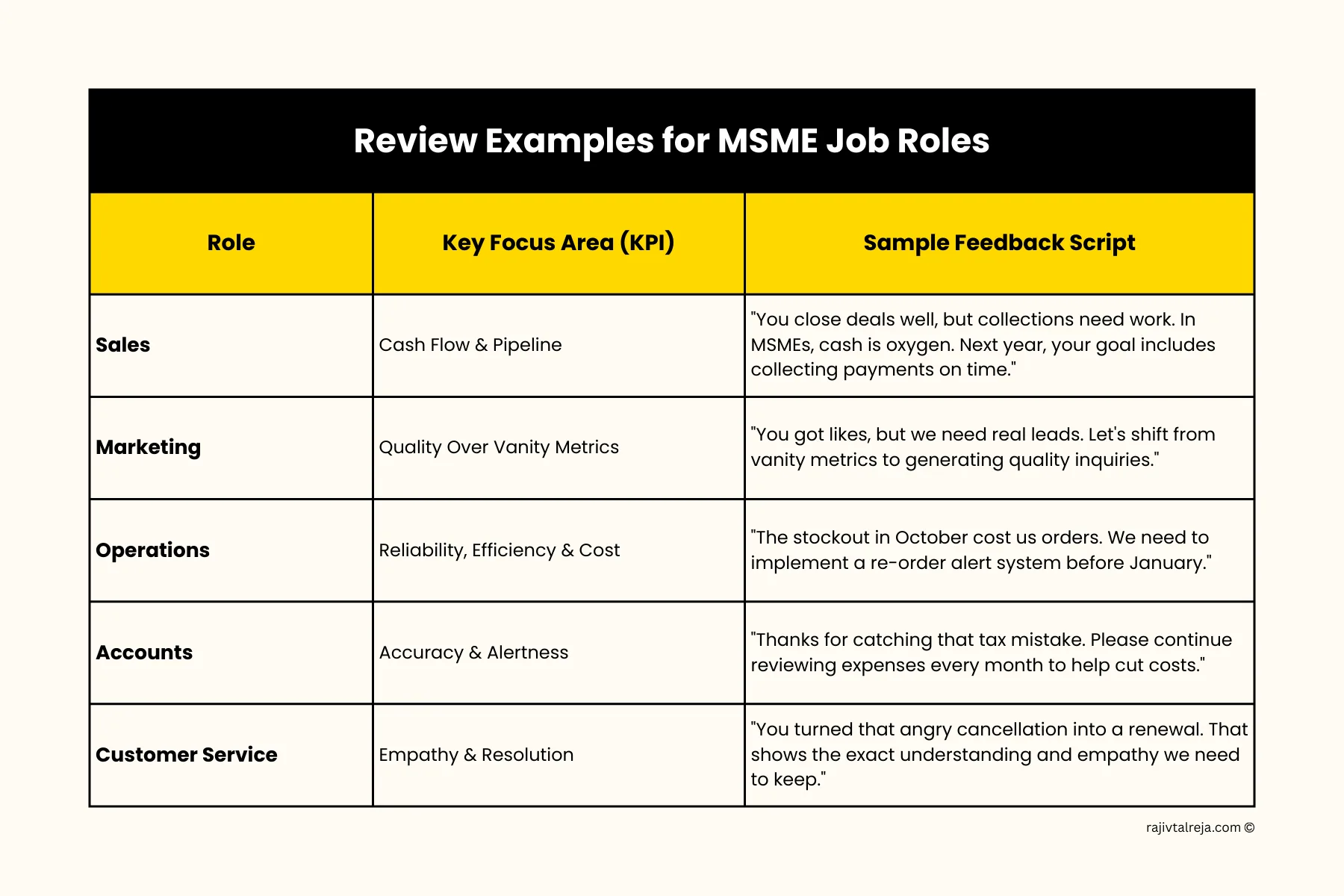
In India, people often see feedback as a personal attack.
Here’s how to use “Care + Candour” to keep the conversation respectful.
Good year-end feedback is a skill you can learn.
“In the meeting (Situation), you didn’t bring the data (Behaviour), which delayed the deal (Impact).” Stick to facts.
This is one of the best year-end review feedback examples you can use.
Show that you care, then address the issue directly.
Start with the “3 Fs” (Family, Food, Festivals) to build a human connection.
Check specific end-of-year performance review examples for how to phrase this warmly.
Don’t stay stuck in the past. Focus on “How can we get this right next time?”
This transforms negative comments into positive year-end feedback.
Never criticize an employee in front of others. It can destroy morale.
“I noticed some things that might help you. Is this a good time to chat?”
This keeps feedback two-way. Look for other year-end review examples online to practice this tone.
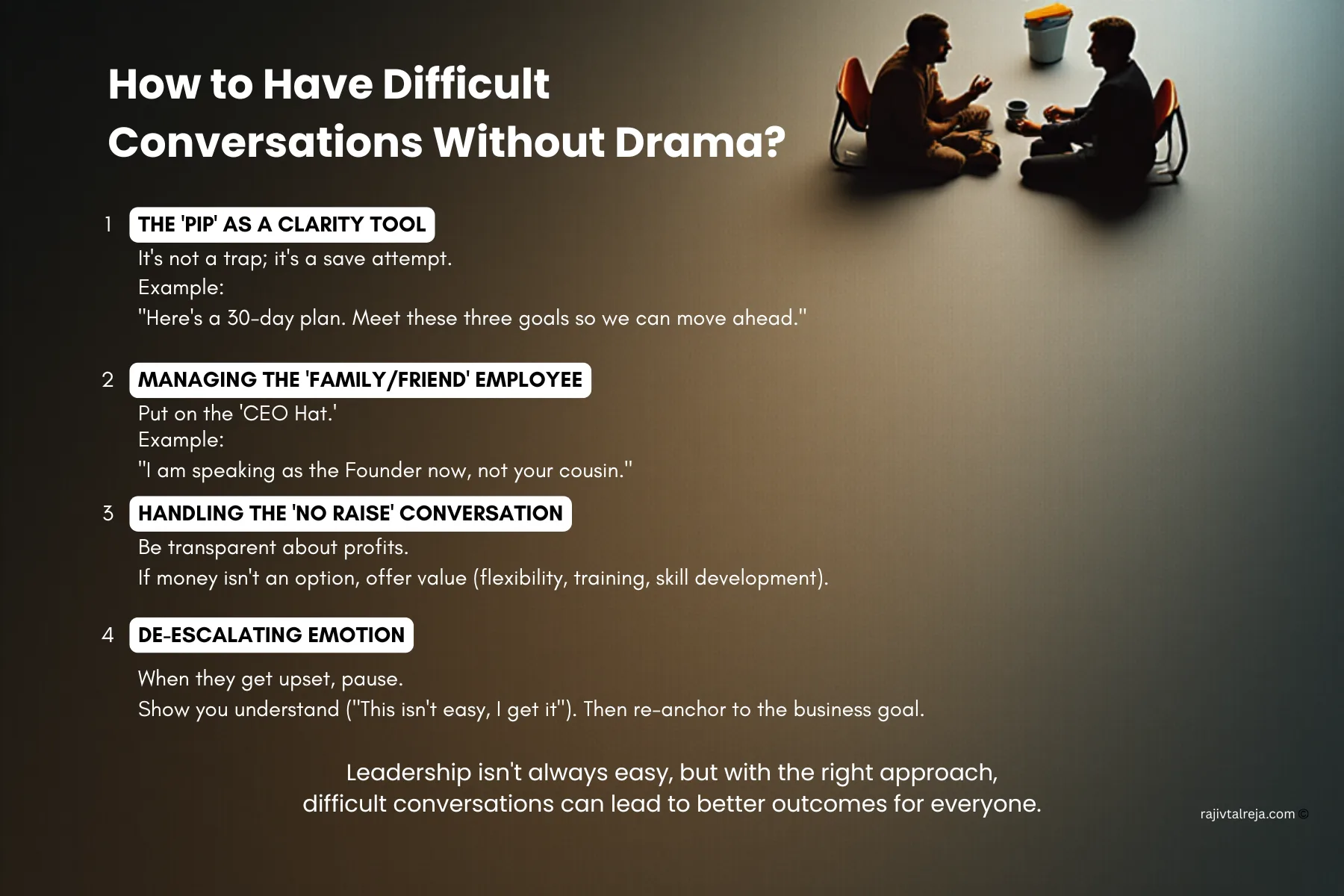
| If you struggle to implement frameworks like this on your own, our one-on-one business coaching is designed to help you systematise your entire company. |

Don’t set 10 goals during your end-of-year review. If you do, your team won’t achieve any.
Keep it focused and realistic.
Instead of chasing only results, focus on the PACT method – Purposeful, Actionable, Continuous, Trackable.
Build daily habits like “10 calls every day.”
Create simple, sharp objectives.
For example, Objective: “Win the Diwali Season.” Key Results: “₹50L Pre-orders.”
Give your team one massive goal that defines success.
Everything else can run as business as usual.
Don’t just assign targets.
Explain how achieving them helps your team – better equipment or new branch openings.
Plan a weekly pulse check-in.
Without consistent reviews, even the best goals fade away.
Growth begins with you. Before you assess your team, take a moment to assess yourself.
Be honest and ask these tough questions.
You can even use year-end self-evaluation examples to structure your answers:
| Self-Review Question | What You’re Measuring | Warning Sign |
| Did I delegate correctly? | How many decisions waited on your desk for more than a day? Did you delegate authority or just tasks? | Your team keeps coming back for approvals, then you’re the hold-up. |
| Did I communicate clearly? | Have you changed priorities mid-week without explaining why? | Your team looks puzzled about what matters most. |
| Did I follow through? | You promised new software in July, and it’s still missing in December. | Why should they follow your goals if you don’t keep your word? |
| Strategic vs. Tactical time | Did you work on ₹100 tasks (like fixing a printer) or ₹10,000 tasks (like closing new deals)? | If you’re buried in operations, it’s time to get support. |
| The “What If You’re Not There” Factor | If you took a 2-week vacation, would the business still run smoothly? | If everything depends on you, your business is fragile. |
Take a Brave Step
Ask your core team, “What’s one thing I should stop doing to make your job easier?”
Then – don’t defend yourself. Just say, “Thank you.”
After observing hundreds of year-end review meetings, it’s clear that many MSME founders fall into the same traps again and again.
A poor year-end evaluation can actually hurt morale.
| The Mistake | Why It Hurts Your Business |
| Recency Bias | You focus on a small mistake in November and forget their strong performance in March. This discourages steady performers and skews the year-end evaluation. |
| The “Monologue” | You spend most of the meeting talking while they just listen. That turns the review into a lecture, not a conversation, blocking real year-end feedback and trust. |
| Busy vs. Business | You praise the person staying late (often inefficient) and overlook the one who finishes on time (super productive). Effort doesn’t always equal results. |
| Money-Only Focus | If a team member begins with “What’s my hike?”, the conversation stops being about growth. Once money dominates the discussion, skill development takes a backseat. |
| Neglecting the Middle | You focus on the Superstars and the Problem Children. But the steady middle performers often go unnoticed until they quietly leave. |
| Silent Treatment | You skip discussions about their future because you can’t offer a big title. But not talking about growth makes them feel stuck. |
| No Documentation | Relying only on verbal talks leads to confusion later. A simple written note avoids that mess and improves year-end feedback. |
The end-of-year review is the perfect time to stop firefighting and start fire-proofing your business.
It shows your team you mean business – you’re not just running a shop.
You’re building something that LASTS.
Wrap up the year with gratitude and purpose.
Celebrate the wins. Recognize the hard work.
And remind your team: “We’re not just building a business. We’re shaping a culture.”
Want more practical guides for growing your MSME? Check out our other blogs on scaling your business.
Use the 20-minute format: Appreciate Wins, Discuss Gaps, Set Future Goals, and Offer Support.
Use the SBI Model: Situation, Behaviour, Impact. Stick to facts and avoid personal insults.
It is a diagnostic tool for future profitability and fire-proofing your business, not just judging.
Submit a “One-Pager” of Wins, Blockers, and Support Needed 48 hours before the meeting.
“You hit the target, but client retention dropped.” Focus on data and specific outcomes.
Spend 5 mins on wins, 5 on gaps, 5 on goals, and 5 on support. Keep it strictly to 20 mins.
Don’t blame. Ask for root causes. Focus on “How can we get this right next time?”
No. Use a conversational framework. Complex processes waste time and block real feedback.
Recency bias, doing all the talking (monologue), and focusing only on money or “hikes.”