India’s hospitality business industry has entered a new, irreversible phase of growth.
The market is accelerating, with a projected CAGR of 5.83% from 2024 to 2035.
It seems like hospitality businesses are busy these days…
But BEING BUSY doesn’t always mean being profitable.
You might see a packed lobby and filled tables, but if your bank balance doesn’t reflect that buzz, something is off.
The focus has shifted from chasing NUMBERS to chasing VALUE.
If you’re still discounting rooms just to fill them up, you’re leaving money on the table and missing out on potential earnings.
Want to start building consistent, steady revenue?
In this blog, we’ll explore hotel revenue management strategies that can transform how you run your hotel or restaurant.
Before we talk about how to increase hotel revenue, let’s look at where it’s quietly slipping away.
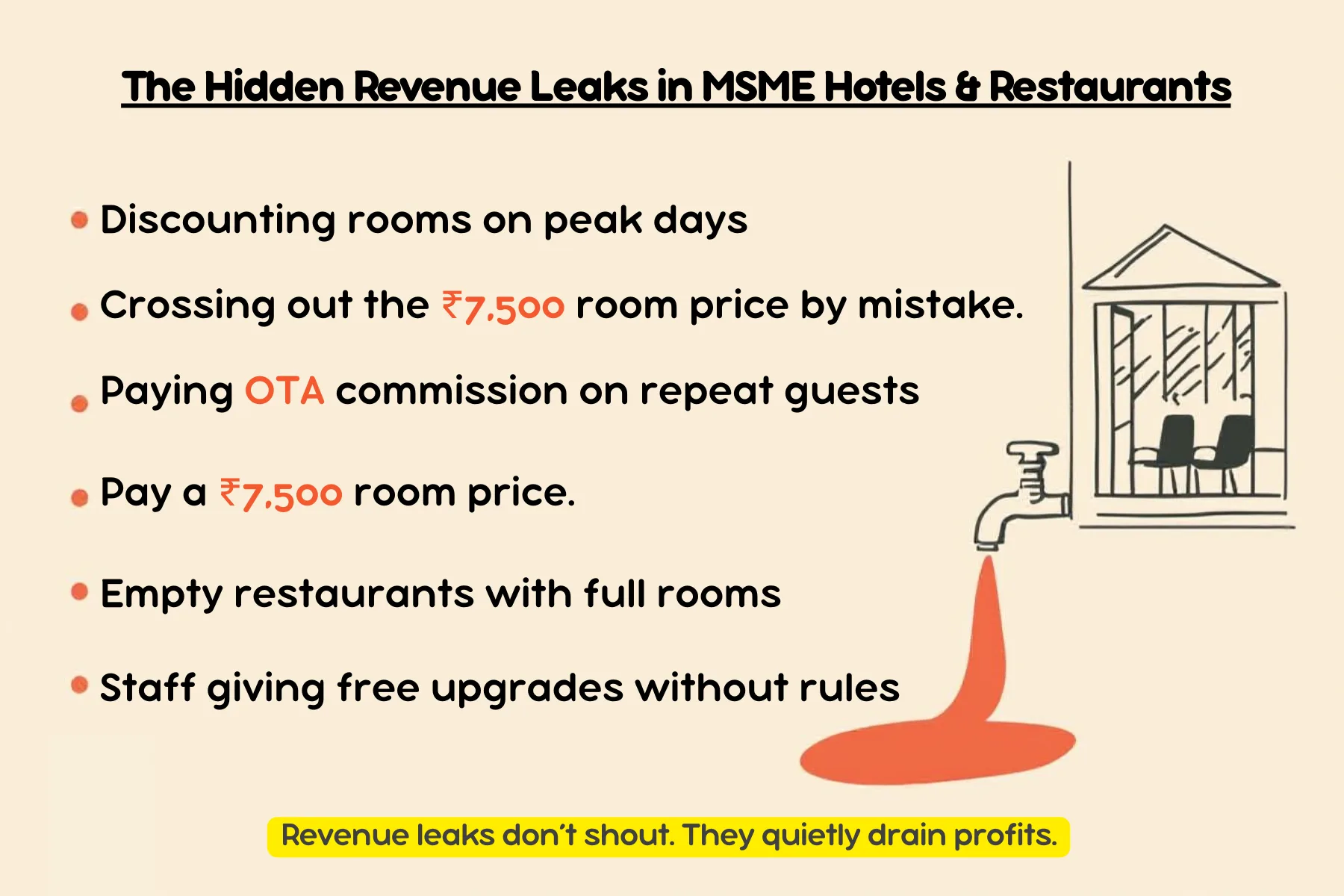
Many small hotels, B&Bs, and restaurant-led hospitality business ventures still use outdated thinking.
Here are the 7 LEAKS eating into your profits in 2025 –
| The Leak | The Old Mindset (“The Trap”) | The 2025 Reality (The Cost) |
| Chasing Occupancy | “Better to sell a room at ₹2,500 than let it sit empty.” | Busy Unprofitability. Filling rooms cheaply increases wear and tear. Real profit comes from rate integrity, not just volume. |
| The GST Threshold | “GST is just a tax. It doesn’t affect my planning.” | The Price Shock. Crossing ₹7,500 raises GST from 5% to 18%. Even a small rate hike can make prices less competitive. |
| OTA Dependence | “MakeMyTrip is my marketing team.” | Margin Loss. Depending fully on OTAs costs 18 to 25% in commissions and very less control over pricing. |
| Ignoring TRevPAR | “I only focus on room rates.” | Missed Wallet Share. You lose guests who pay less for rooms but spend more on food, drinks, and services. |
| Weak F&B Yield | “Food cost is just a percentage.” | Dead Inventory. Menus full of low-margin items lock up capital and increase wastage. |
| Staff Discounts | “Just give a discount to close the sale.” | The Discount Dispenser. Staff often take the easy route, giving discounts instead of adding value – cutting into your profits. |
| Static Pricing | “My room rate is ₹5,000 for everyone.” | Money Left on the Table. Underpricing in peak seasons and overpricing in slow periods cause revenue loss both ways. |
Now that we’ve plugged the leaks, it’s time to pick up the welding torch.
Here are 15 practical revenue generation strategies to build your profit fortress in 2025.
| Plugging these leaks is the first step. To truly maximise your revenue, you need the guidance of a business and leadership coach who can help you fix these leaks and build a scalable system. |
This is where the real money decisions are made in your hospitality business.
You don’t need a fancy degree or an expensive Revenue Manager.
What you need is discipline and the ability to stick to these four simple rules of hotel revenue management.
Decide on a minimum price, for example, ₹3,000, and never sell below it, even if rooms are empty.
If someone offers ₹2,500, say no.
Selling too cheaply sends a signal that your product isn’t worth much.
Over time, guests will hesitate to pay your normal rates.
Protect your BRAND VALUE.
Stop relying on a single “Rack Rate.”
Set up three clear pricing levels –
Regular pricing for normal days.
Base + 25% for weekends or holidays.
Base – 10%, used only for corporate bulk deals.
Keep it SIMPLE.
When future occupancy reaches 60%, automatically move prices to Level 2 pricing.
Pick your price range.
Either stay under ₹7,499 (5% GST tax) to attract budget travellers or go bold with ₹8,500 and above to attract business class/corporate clients who can claim the 18% Input Tax Credit (ITC).
Avoid the ₹7,501 to ₹8,000 range where the tax increase cancels out the value you can offer.
Don’t let a Saturday-only booking block a full weekend stay.
During peak times like Diwali/Christmas or any big festive holidays and long weekends, set a “Minimum 2 Nights” rule.
This separates single-night stays that leave your Fridays and Sundays unoccupied.
OTAs are great billboards for your marketing, but bad long-term partners.
You need them for discovery, not for loyalty.
It’s time to flip the script for your hospitality business.
By contract, you can’t price lower than Booking.com publicly. But you can offer more value.
Why it works –
Around 26% of travellers check your website after finding you on an OTA. (I’m one of them)
Give them a clear and undeniable reason to book direct.
Treat your Google Maps listing like Instagram.
Upload 50/100 high-quality photos.
Listings with images get far more attention.
Post weekly updates with food specials to show Google your business is active.
This is one of the strongest free tools you have.
Stop being GENERIC.
If you’re in an industrial hub like Surat or Coimbatore, create focused “Trader Packages” with early breakfast and free drops to industrial estates.
If you’re in a wedding hotspot, stop selling individual rooms and offer “Buyout Packages” instead.
Own your niche.
Your kitchen should do more than feed people. It should make you money.
Here’s how to increase hotel revenue through food.
Switch your booking engine setting from “Room Only” to “Room + Breakfast + One Meal” (MAP Plan).
Guests find it harder to remove something already included than to add it themselves.
Capture that wallet share before they even arrive.
Review your menu and categorize dishes –
Highlight these! Put them in a separate box.
Delete them right away. They waste stock and menu space.
These drive your volume (like Thali).
Reduce portion size slightly or swap expensive ingredients to improve profit margins.
Making money is one thing, but keeping it is key.
Operational efficiency is where you keep the money you make.
Leaks here can quietly hurt your hospitality management.
End the awkward “let me ask the owner” routine. It looks unprofessional. Set clear boundaries for your team –
Strictly enforce First-In-First-Out in the kitchen and standardise portions.
If a chef serves just 50g extra dal per plate across 50 orders a day, you lose 2.5kg daily.
Over a month, that adds up to thousands.
A repeat guest costs ₹0 to acquire.
This is the holy grail of hotel & restaurant management.
Don’t ask for a review at checkout when they’re settling the bill – that’s a moment of “pain.”
Instead, ask during breakfast when they’re relaxed and happy.
You can simply say, “Sir, if you enjoyed the Masala Dosa, a 5-star Google review would mean a lot to our chef.”
Save guest details in a basic CRM or spreadsheet.
An automated WhatsApp message like, “Happy Birthday! Stay with us for 15% off,” keeps your brand memorable.
Don’t let OTAs control your customer data.
You can’t be at the hotel all the time.
You need revenue generation strategies that keep the business running even when you’re not there.
Every Monday, hold a focused 30-minute meeting.
You don’t need a fancy presentation, just ask three simple questions –
Did we meet the budget last week? If not, what went wrong?
How does next week look? (If bookings are over 60%, increase rates immediately.)
Are nearby properties cheaper or more expensive? Adjust prices accordingly.
Write these strategies down.
The business should run on clear, written rules – not your memory.
If the Front Desk team knows exactly when to trigger the “High Season Rate,” they won’t need to call you on a Friday night asking for permission to raise prices.
Now you know, the era of passive ownership is over.
You cannot just unlock the doors and expect profit.
In this blog, we’ve covered the main leaks and shared ways to boost revenue.
You now have the toolkit to plug the leaks, reclaim your margins from OTAs, and price with confidence.
It’s time to stop just running a hotel and start mastering hospitality management.
By applying these strategies, your hospitality business can finally become the revenue engine it was meant to be.
Ready to scale your profits? Click here to read more MSME growth blogs.
It is pricing discipline, yield management, and prioritizing profit over just filling rooms.
Here are the 17 strategies: Set hard price floors, use 3-tier pricing, master GST thresholds, enforce LOS controls, apply “Parity Plus,” optimize GBP, create niche packages, switch to TRevPAR, engineer menus, empower staff, enforce FIFO, timing reviews, retain guest data, hold weekly stand-ups, and use regular operation reports.
It is not just occupancy. It is maximizing value, protecting margins, and TRevPAR.
Implement TRevPAR, use menu engineering, and apply psychological pricing to your menus.
Chasing occupancy, ignoring GST price point, and relying too heavily on OTA commissions.
Use the “Parity Plus” strategy – offer value-added services like free breakfast for direct bookings.