


A manufacturing business owner in Mumbai has Rs 15 lakhs.
She can either buy a new CNC machine or open a second showroom.
Both options look promising on paper.
But which one will actually add more cash to her business?
This is exactly the kind of decision incremental cash flow helps you make.
It shows how much additional cash a specific project will bring in or drain.
Not your total business cash. Just the change caused by that one decision.
Understanding incremental cash flow is not about learning finance theory. It is about making better decisions with your money… every single time.
Incremental cash flow is the additional operating cash flow your business earns or loses because of a specific new project or investment.
It is the difference between your cash flow with the project and your cash flow without it.
It is a filter. Before you commit money, time, and people to anything new, incremental cash flow analysis forces you to ask: Will this decision actually make my business richer in cash?
Smart businesses think incrementally.
They don’t just look at total profits and feel good.
They isolate each decision and measure its cash impact separately.
That’s the incremental decision mindset, and it changes everything about how you evaluate investments.
The incremental cash flow formula is straightforward:
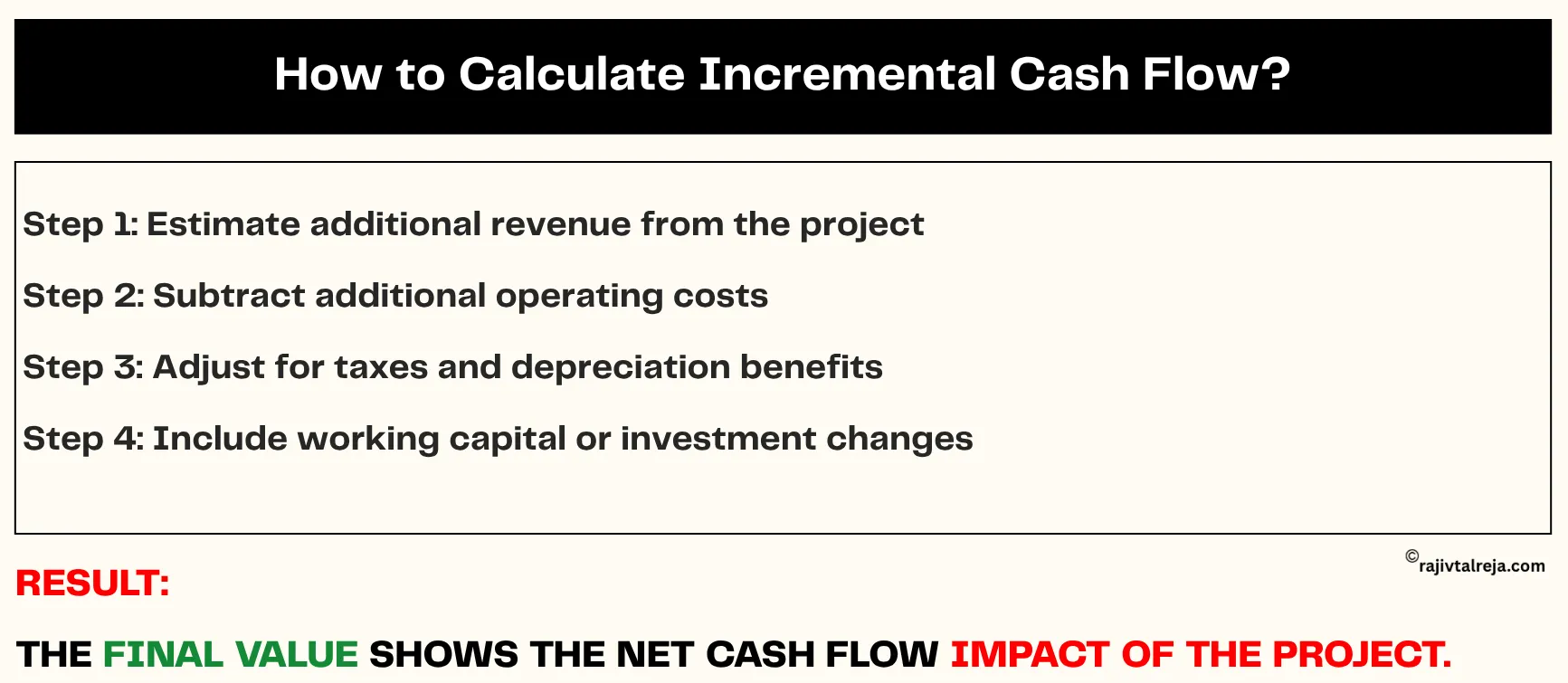
Incremental Cash Flow = (Revenue from Project – Expenses from Project) – Initial Investment
But here is the rule: never calculate this formula in isolation.
Always tie it to a real decision.
Let’s say a bakery owner in Bengaluru is considering adding a delivery vertical.
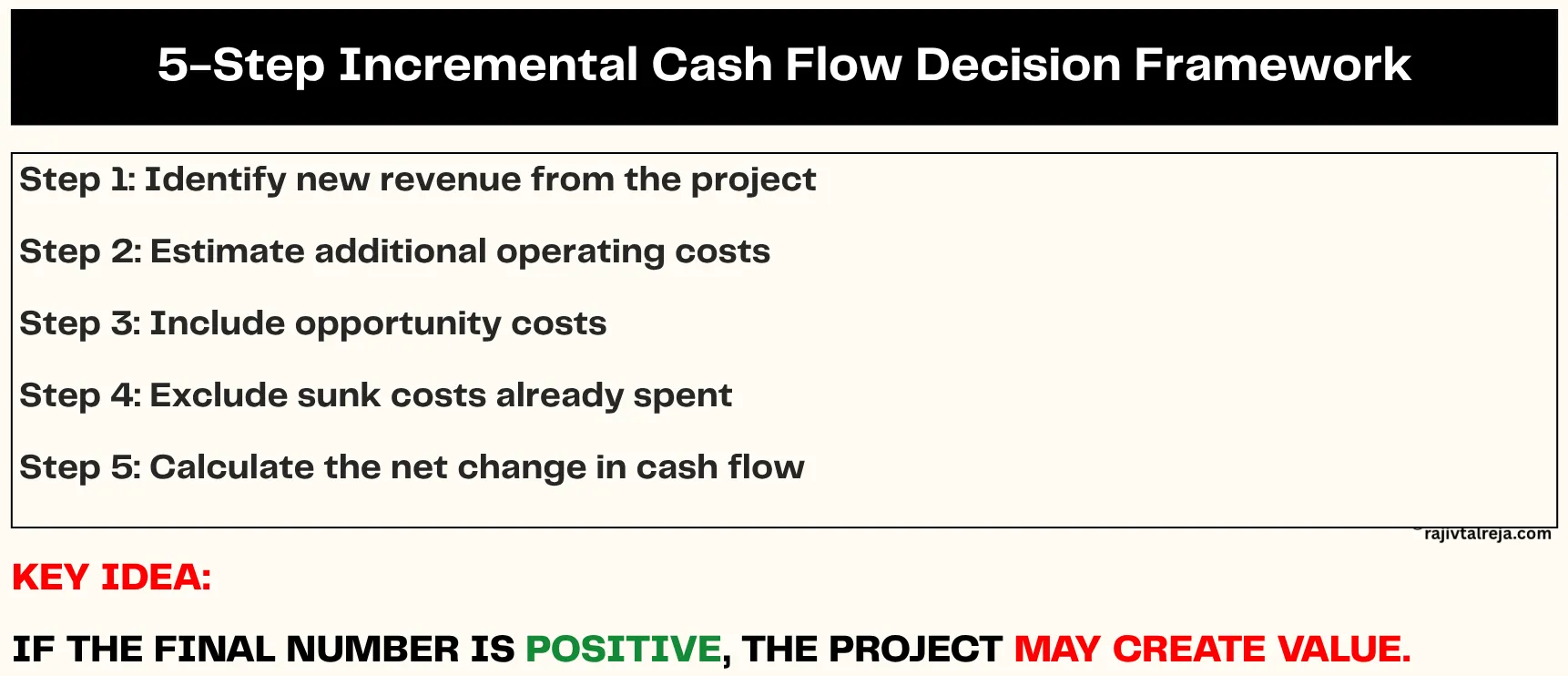
Here is how she would calculate incremental cash flow:
Result: (Rs 6,00,000 – Rs 3,50,000) – Rs 2,00,000 = Rs 50,000 positive incremental cash flow in Year 1.
From Year 2 onwards, the annual incremental cash flow jumps to Rs 2,50,000 (no initial investment repeated).
The project adds real cash. Worth pursuing.
| Want to run these numbers for your own project? Download our free Incremental Cash Flow Calculator Template, it walks you through every step, flags hidden costs, and gives you an instant verdict on whether your project is worth pursuing.” |
| Mastering this formula is just the beginning. Working with an MSME business coach ensures you apply these insights to make highly profitable investments. |
Let’s compare two real scenarios that Indian MSME owners face regularly.
Suppose you run a garment business and have Rs 15 lakhs to invest.
Option A: Open a second retail outlet.
Option B: Buy automated cutting equipment.
| Parameter | Option A: Second Outlet | Option B: New Equipment |
| Initial Investment | Rs 15,00,000 | Rs 8,00,000 |
| Annual Revenue (projected) | Rs 24,00,000 | Rs 14,00,000 |
| Annual Expenses | Rs 18,00,000 | Rs 7,50,000 |
| Cannibalization Effect | Rs 2,00,000 (existing outlet loses some customers) | Rs 0 |
| Incremental Cash Flow (Year 1) | Rs –9,00,000 (negative due to initial cost) | Rs –1,50,000 (negative due to initial cost) |
| Incremental Cash Flow (Year 2+) | Rs 4,00,000/year | Rs 6,50,000/year |
Option B wins.
It requires less capital, carries zero cannibalization risk, and produces higher annual incremental cash flow from Year 2 onwards.
This is the power of the incremental cash flow method.
It strips away the noise and shows you which decision actually puts more cash in your pocket.
Here is something most business owners miss.
A project can look profitable on paper and still destroy your cash position.
How? TIMING.
Look at this real scenario:
| What Profit Statement Shows | What Cash Flow Actually Looks Like | |
| The Scenario | You land a Rs 20 lakh order. Project cost is Rs 12 lakhs. Profit = Rs 8 lakhs. | Client pays on 90-day credit. You spend Rs 12 lakhs upfront on materials, labour & logistics. |
| Month 1 | Rs 8 lakh profit booked on paper. | Rs 12 lakhs cash goes OUT. Rs 0 comes IN. You are Rs 12 lakhs poorer. |
| Month 2 | Same. Profit still looks great. | Still Rs 0 received. Cash crunch continues. Supplier payments are due. |
| Month 3 | Profit unchanged. | Client finally pays Rs 20 lakhs. Cash normalises — after 90 days of stress. |
| The Illusion | “We made Rs 8 lakhs profit!” | “We were Rs 12 lakhs short for 3 months and almost missed payroll.” |
According to a GAME study (2023), the total value of delayed payments to Indian MSMEs was Rs 10.7 lakh crore. That is not a theory problem.
That is a cash flow crisis hiding inside profitable-looking projects.
This is why incremental cash flow analysis matters more than profit projections alone.
It forces you to look at when the cash actually arrives, not just whether it arrives.
| If you are making a profit but still struggling with cash flow, a business coach can help you identify exactly where the leak is. |

Many projects appear profitable on the surface.
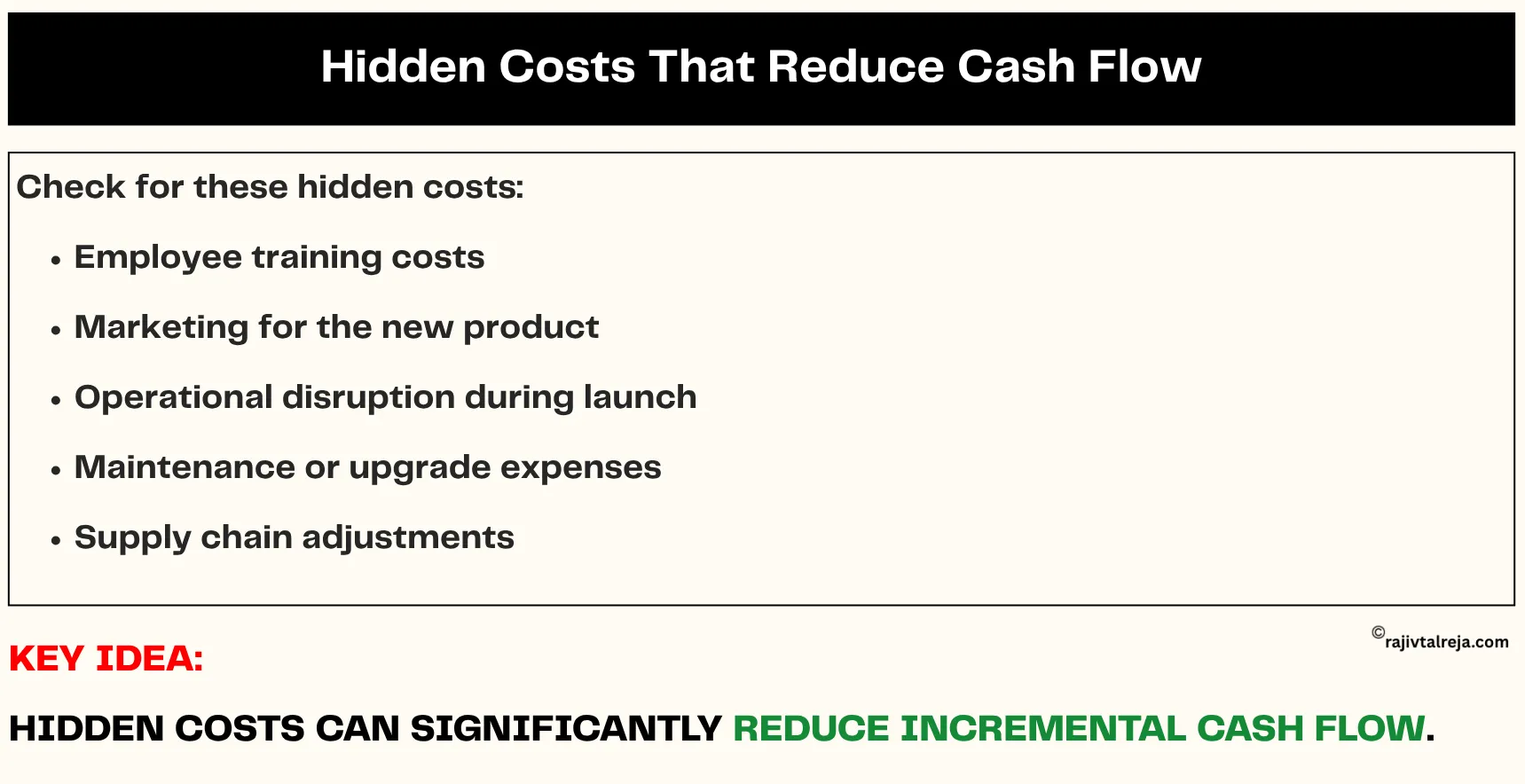
But when you dig deeper, hidden costs eat into your incremental cash flow analysis and turn a winner into a cash drain.
What are these hidden costs that most business owners forget?
A new machine or process means your team needs to learn it.
That costs time, money, and lost productivity during the learning curve.
Opening a new outlet or launching a new product?
The first 3–6 months of marketing spend is often underestimated.
When your attention shifts to a new project, existing operations suffer.
Quality dips, delivery slows, key clients feel neglected.
New vendors, new materials, new logistics, each comes with onboarding costs and teething problems.
Many business owners confuse incremental cash flow with total cash flow.
They sound similar but serve very different purposes.
Here is a clear breakdown:
| Parameter | Incremental Cash Flow | Total Cash Flow |
| What it measures | Cash impact of ONE specific project | ALL cash movement across the business |
| Time orientation | Forward-looking (a prediction) | Backwards-looking (a historical record) |
| Primary use | Deciding whether to invest in a project | Assessing overall financial health |
| Scope | Isolated — only project-specific changes | Comprehensive — entire business |
| Best for | Comparing two projects side by side | Monthly/quarterly business reviews |
Understanding incremental cash flow vs total cash flow is critical.
Total cash flow tells you how your business is doing overall.
Incremental cash flow tells you whether a specific decision is worth making.
You have already spent Rs 5 lakhs on market research for a new product line.
The research shows weak demand. Should you launch anyway because you’ve already “invested” Rs 5 lakhs?
No. That Rs 5 lakhs is a sunk cost.
It is gone regardless of what you decide next. Including sunk costs in your incremental cash flow calculation is one of the most common mistakes business owners make.
It leads to pouring more money into bad decisions just to “recover” what was already lost.
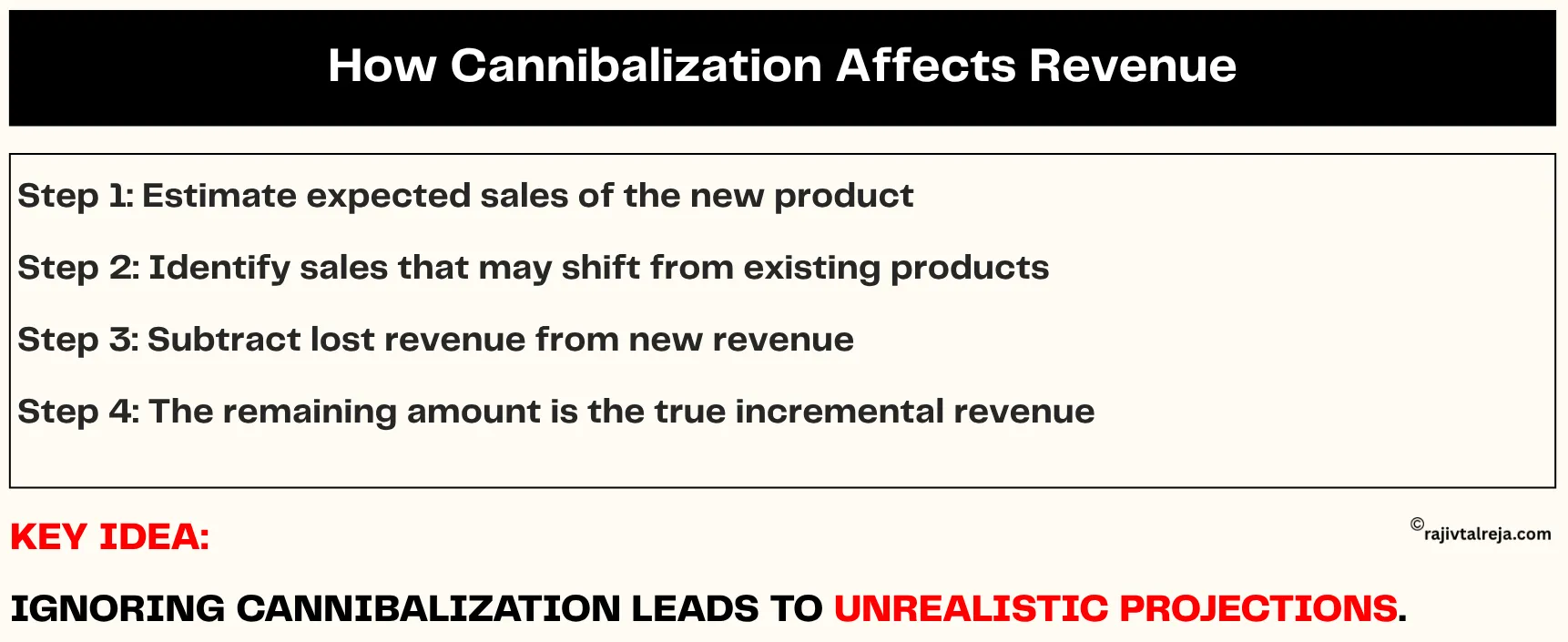
When Apple launched the iPhone, it knew the device would cannibalize iPod sales.
Netflix killed its own DVD business to build streaming.
Amazon’s marketplace undercut its own retail arm.
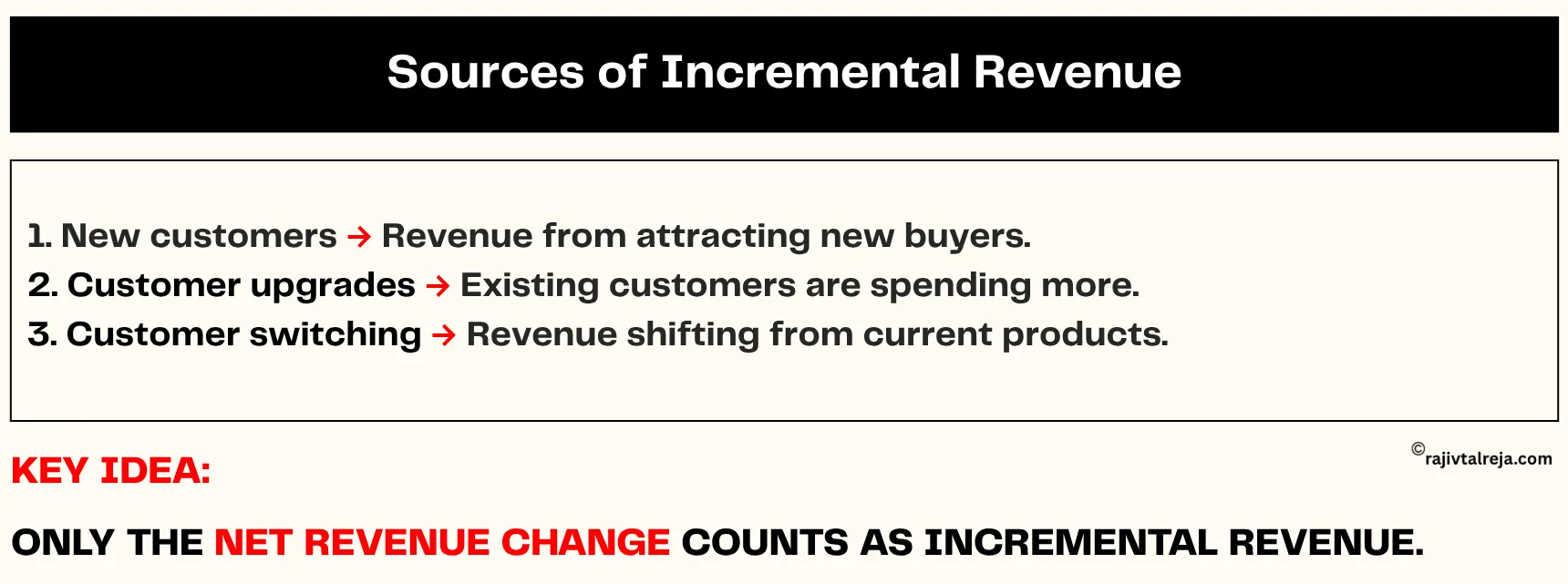
These companies accepted cannibalization strategically because the new venture had a stronger incremental cash flow than what it replaced.
For MSME owners, the lesson is simple: if you open a second outlet nearby, some customers from your first outlet will simply shift.
That lost revenue must be subtracted from your incremental cash flow projection.
Most projections fail for three reasons: unrealistic sales assumptions, ignored operational costs, and overly optimistic timelines.
The fix? Be conservative.
Use a range (best case, worst case, most likely).
And always account for the hidden costs we discussed earlier.
In our experience working with hundreds of businesses, the ones that build in a 15–20% buffer for unexpected costs are the ones that rarely get surprised.
Every business decision is a cash flow decision.
Whether you are buying equipment, opening a new branch, or launching a product, incremental cash flow is the tool that separates smart investments from expensive mistakes.
The next time someone pitches you a new project, run it through the frameworks in this blog.
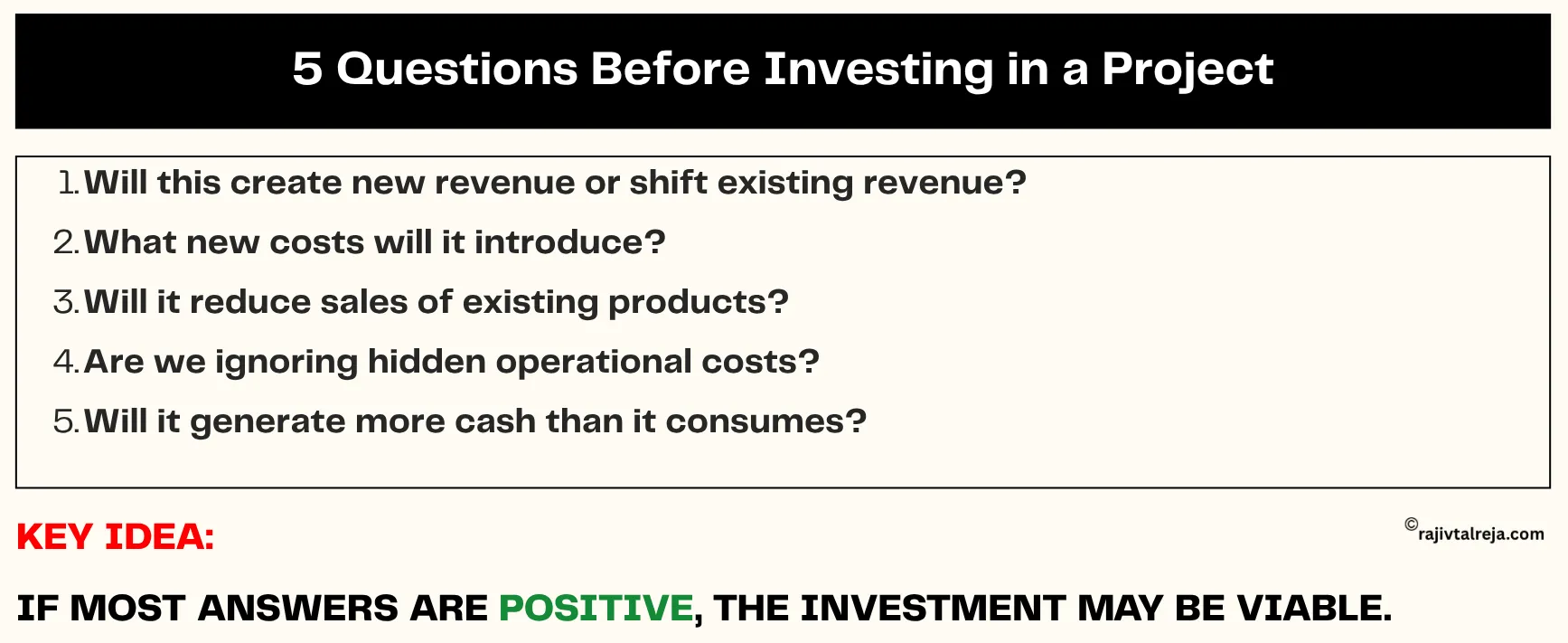
Ask the five questions. Check for hidden costs. Account for cannibalization. And trust the numbers over the excitement.
Your cash is limited. Spend it where it multiplies.
Want more practical business insights?
Click here for our blog page and get actionable strategies on business growth, leadership, and building a business that works for you.
Incremental Cash Flow = (New Revenue − New Costs) − Initial Investment.
A ₹5L system saves ₹15k/month labour cost; ₹15k is the incremental cash flow.
Incremental cash flow shows the change from a decision; total cash flow shows all business cash.
It isolates the financial impact of a project for better investment decisions.
Indirectly. It reduces taxes, creating a cash tax shield.
No. Sunk costs are past expenses and must be excluded.
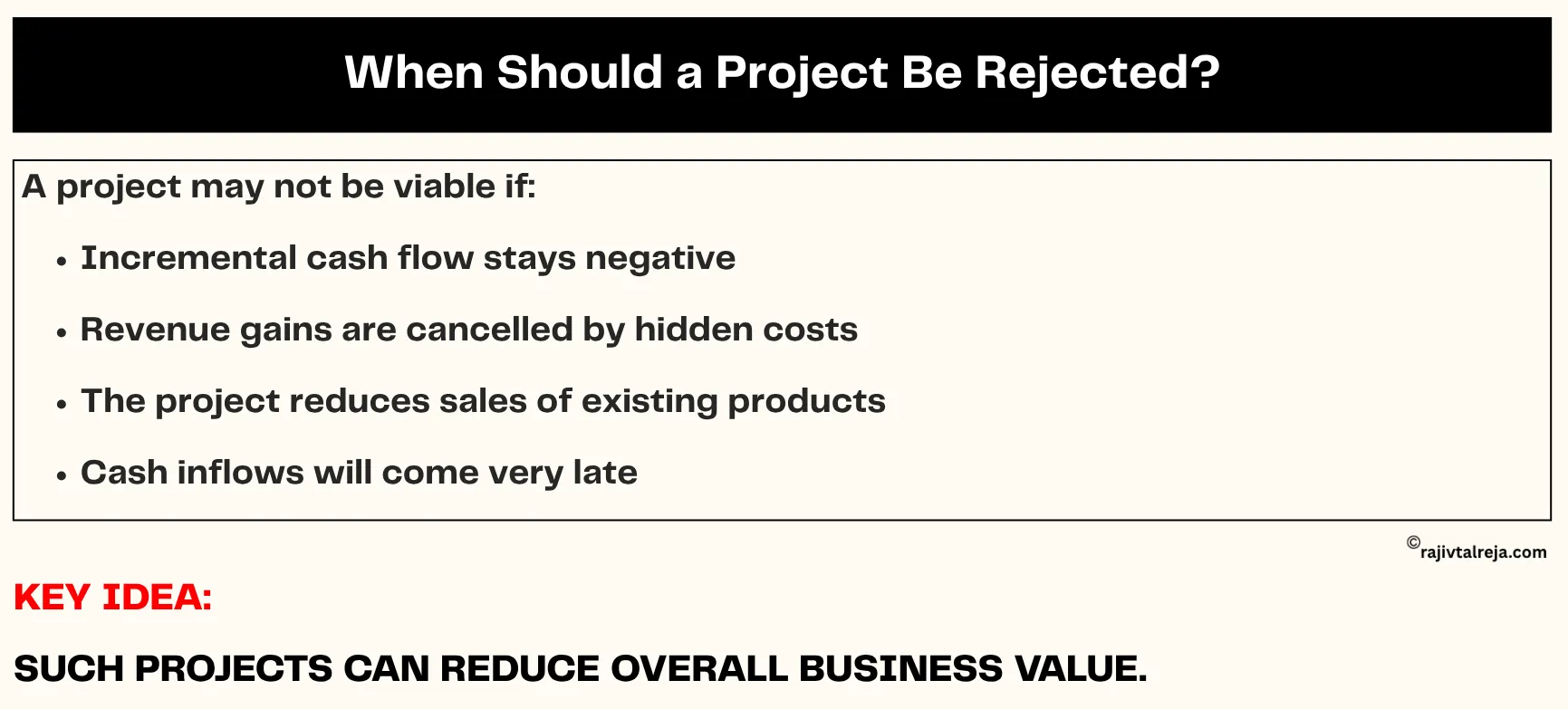
Yes. Negative incremental cash flow means the project may drain cash.
When a new product reduces sales of an existing product.
Calculate each project’s incremental cash flow and compare the results.


