


Picture this. You have a great product, but no distribution network. Another business owner has the distribution but no product.
What if you both came together?
That’s exactly what a joint venture does. Understanding joint venture advantages and disadvantages is critical before you sign on the dotted line.
Because when done right, a joint venture can transform your business. When done wrong, it can drain your time, money, and energy.
According to research by Ankura Consulting, 69% of joint venture partners are at odds on long-term strategy.
That’s a staggering number. But it also means that those who get it right have a massive competitive edge.
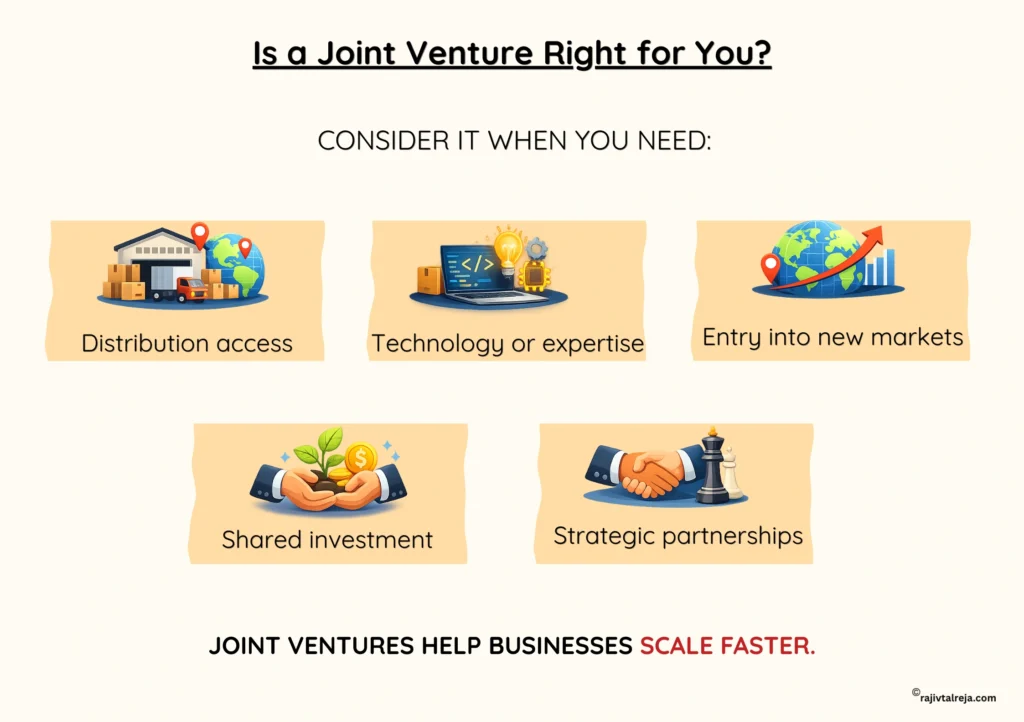
A joint venture is a business arrangement where two or more parties agree to work together on a specific project or business activity. Each party brings something to the table – money, expertise, technology, or market access.
The key difference from a partnership?
A joint venture is usually temporary and project-specific. Once the goal is achieved, the joint venture can be dissolved. Each business retains its own identity and operations outside the venture.
In India, some of the most iconic businesses started as joint ventures.
Maruti Suzuki, a collaboration between the Indian Government and Suzuki Motor Corporation, revolutionised the automobile industry. Hero Honda was another classic example of two companies combining strengths for mutual gain.
For MSME business owners, a joint venture can be a powerful way to grow without borrowing heavily or giving up ownership of your core business.
Let’s look at the real advantages of joint venture arrangements and why so many business owners explore this route.
When two businesses join forces, they pool their financial, physical, and human resources. This means increased resources and capacity without the need to build everything from scratch.
Think about it. If your business is strong in production but weak in marketing, partnering with a marketing-focused company fills that gap instantly.
The combined increased capacity allows both parties to take on bigger projects and serve larger markets.
In a joint venture, businesses split operating costs, labour expenses, advertising, and marketing budgets. This creates economies of scale that neither business could achieve alone.
The cost of raw materials, skilled workforce, and technical expertise is comparatively lower when shared.
For Indian MSMEs, this is a game-changer. You get to compete with larger players without burning through your cash reserves.
When different teams with different experiences come together, innovation happens naturally. Fresh perspectives lead to new ideas, better products, and smarter processes.
International joint venture partners often bring updated technology and global best practices.
For a local business owner, this means access to ideas that would have taken years to develop independently.
Gaining access to new markets and distribution networks is one of the biggest draws of a joint venture. When you partner with a company that already has a presence in a region or industry, you skip years of groundwork.
Instead of spending lakhs building a distribution channel from scratch, you leverage your partner’s existing retail outlets, customer base, and market knowledge.
This is especially valuable for MSMEs looking to expand beyond their home city or state.
Every new business move involves risk. With a joint venture, those shared risks and costs are split between partners. If the project doesn’t work out, you’re not carrying the entire burden alone.
This is particularly important in capital-heavy industries where a single failed project can wipe out months of profit.
Sharing the financial exposure makes it easier to experiment, test new markets, and take calculated bets.
A joint venture gives you brand exposure that money alone can’t buy. When your brand is associated with a well-known partner, it builds instant credibility with customers.
Similarly, access to technology is a major reason businesses enter joint ventures.
Instead of spending crores developing your own technology, you tap into what your partner already has. This saves time, money, and lets you focus on what you do best.
Now let’s talk about the other side. The disadvantages of joint venture arrangements are real, and ignoring them can be costly.
Aligning goals and culture is the number one challenge in any joint venture.
You and your partner may have very different visions for the business. One may want rapid expansion. The other may prioritise stability.
Add cultural differences to the mix, different work ethics, decision-making styles, and communication habits, and you have a recipe for conflict.
In our experience working with hundreds of businesses, this is where most joint ventures start to crack.
Management and operational differences can create daily friction. One partner may prefer structured processes. The other may run on instinct and informal systems.
When there’s no agreed-upon way to manage operations, decisions slow down. Teams get confused about who to report to. Projects stall.
And before you know it, the venture is bleeding money instead of making it.
Determining who owns what and who gets the final say is where equity and control issues become messy.
Shared control sounds fair in theory. In practice, it often leads to deadlocks.
What we’ve seen time and again is that when roles, responsibilities, and decision-making authority aren’t clearly defined from day one, even small disagreements can escalate into major disputes.
A lack of coordination between partners can derail even the most promising joint venture.
When communication breaks down, tasks get duplicated, deadlines are missed, and accountability disappears.
This is especially common when joint venture partners operate from different cities or countries. Without regular check-ins and clear SOPs, the venture drifts without direction.
| Advantages | Disadvantages |
| Increased resources and capacity | Aligning goals and culture can be difficult |
| Economies of scale reduce costs | Management and operational differences cause friction |
| Innovation through diverse expertise | Equity and control issues lead to disputes |
| Access to new markets and distribution | Lack of coordination slows progress |
| Shared risks and costs | Potential for cultural clashes |
| Brand exposure and access to technology | Exit strategies can be complex |
So, should you avoid joint ventures altogether? Absolutely not. The key is knowing how to overcome the challenges of joint venture arrangements before they become problems.
Here are four things every business owner needs to get right.
Everything starts with a solid agreement. Not a handshake deal. Not a verbal understanding.
A detailed, written agreement that covers roles, responsibilities, profit-sharing, decision-making authority, dispute resolution, and exit terms.
Think of the agreement as the foundation of your joint venture. Without it, everything else crumbles. Get a good lawyer involved early.
Before entering a joint venture, both parties must agree on a profitable business model.
Too many joint ventures fail because partners jump in with excitement but no financial clarity. A clear business model ensures both partners are working toward the same financial goals.
The biggest difference between joint ventures that succeed and those that don’t? Systems.
When you have documented processes for operations, communication, reporting, and decision-making, the venture runs smoothly regardless of individual personalities.
Businesses with strong systems can handle partnerships, expansions, and even crises far better than those running on the owner’s memory.
A business coach can be invaluable when navigating a joint venture.
From helping you evaluate potential partners to structuring the deal and building the right systems, a business coach brings an outside perspective grounded in real experience.
According to the Ministry of MSME Annual Report (2023-24), MSMEs contribute approximately 30% of India’s GDP.
Yet most MSME owners make critical business decisions, including joint ventures, without any external guidance. That’s a risk you don’t need to take.
Understanding joint venture advantages and disadvantages is not just an academic exercise. It’s a practical decision that can shape the future of your business.
When you get the agreement right, build a profitable business model, put systems in place, and seek guidance from a business coach… a joint venture can unlock growth you never thought possible.
The businesses that thrive are the ones that plan before they partner. Be one of them.
Enjoyed this? Head to our blog for more practical insights on business growth, leadership, and building a business that actually works for you.
A joint venture is when two or more businesses agree to work together on a specific project or goal. Each party contributes resources and shares the profits and risks. It is usually temporary and project-specific.
The main advantages include shared risks and costs, access to new markets, economies of scale, increased resources, brand exposure, and access to technology. These benefits make growth faster and less expensive.
The biggest risks include misaligned goals, cultural clashes, equity disputes, and a lack of coordination. Without a clear agreement and strong systems, these risks can lead to significant financial losses.
A partnership is a long-term business structure where partners share ongoing profits and liabilities. A joint venture is typically temporary and created for a specific project. Once the project ends, the joint venture can be dissolved.
Yes. Joint ventures are not limited to large corporations. MSME owners regularly enter joint ventures to access resources, technology, or markets they cannot reach alone.
Most joint ventures fail due to unclear agreements, misaligned goals, cultural differences, and poor communication.
Absolutely. A written agreement is essential. It should cover roles, profit-sharing, decision-making, dispute resolution, and exit terms. Verbal agreements leave too much room for misunderstanding.


