To achieve consistent msme growth, you must evolve beyond daily operations and master specific founder responsibilities.
If your business has crossed ₹5–10 Cr, you’ve already proven you can build.
But scaling beyond this point feels different.
All your essential decisions pile up, teams depend on you, and growth slows even though demand remains.
You are busy every day, yet the business feels fragile WITHOUT YOU.
This is not a market problem or a talent problem. It’s a ROLE problem.
At this stage, growth depends less on effort and more on how clearly you own your founder responsibilities.
This blog breaks down the nine responsibilities no MSME founder can delegate away if they want stable, controlled business growth.
| What is “Stagnation Trap” for MSMEs? It is a growth ceiling hit by MSMs that operate on assumptions rather than validated insights and structured roadmaps. |
Most founders believe they are responsible for EVERYTHING.
In reality, scale happens when founders take responsibility for the right things.
Founder responsibilities are NOT TASKS.
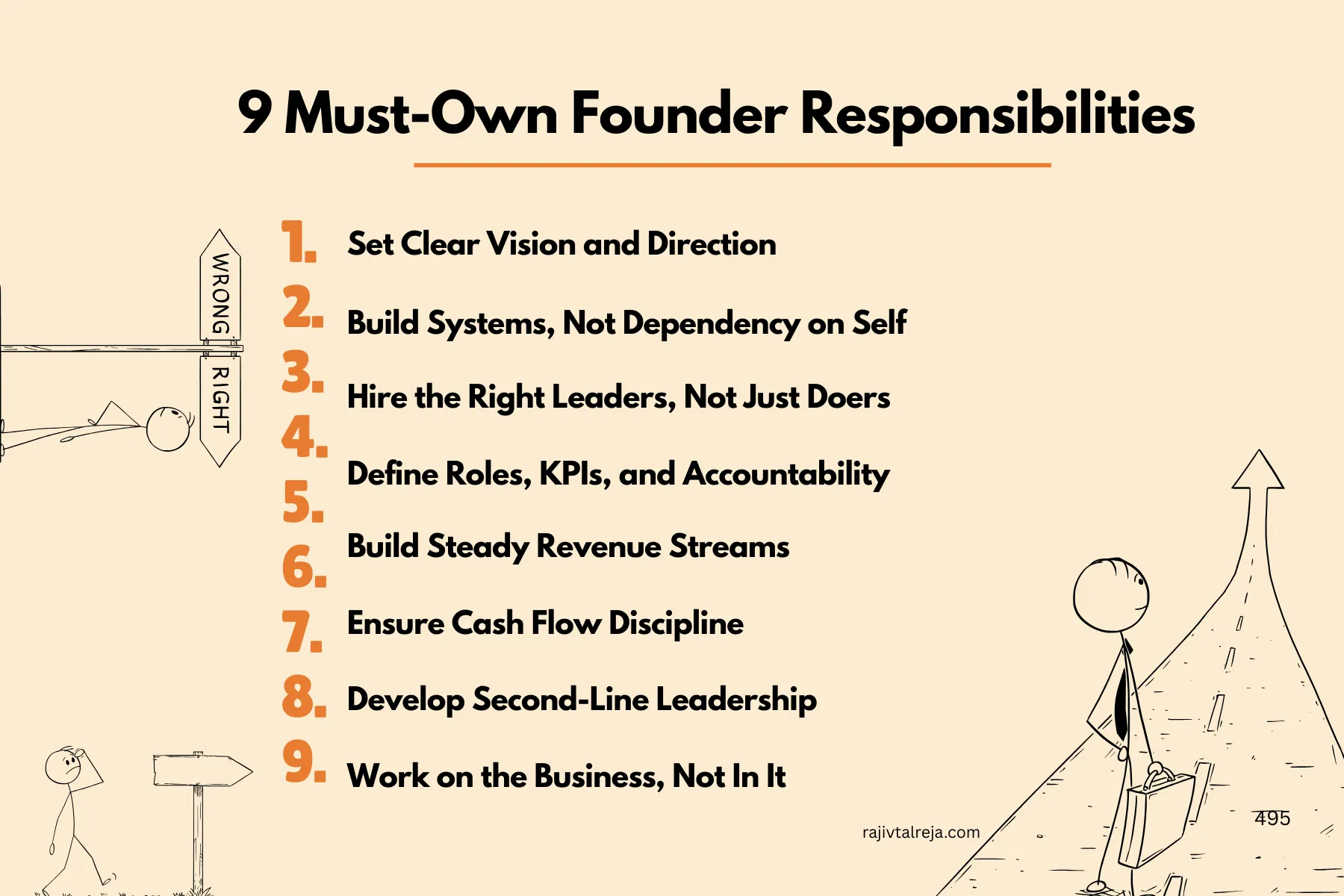
They are OUTCOMES you must own up to while building SYSTEMS, PEOPLE (Team), and PROCESSES that carry the load.
These nine founder responsibilities decide whether your business grows smoothly or stays dependent on you.
Why does my team work hard but still move in different directions for results?
Because your business lacks a clear and repeatable vision that team members can act on without you.
Most MSMEs run on intent, not clarity.
You know where the business should go, but the team only sees weekly targets, not the overall picture.
This gap creates confusion, rework, and slow execution, especially during small business growth phases.
Vision is not a motivational speech. It is decision clarity.
What to fix –
On paper, this sounds basic.
In reality, most founders skip it, and then wonder why alignment never sticks.
This is one of the primary founder responsibilities that drives msme growth.
| A clear vision is the foundation. Professional business coaching services can help you articulate your vision, so your team can run with it. |
Why does everything break the moment I step away?
Because your business depends on you instead of documented systems.
Founder-led execution works early.
It fails during the scaling of a startup.
If knowledge lives in your head, the business cannot compound. Systems are not bureaucracy.
They are free.
What to fix –
If you cannot take a 2-week break, your business processes are broken and too dependent on you.
That’s the test.
You must build better business processes to scale effectively.
Why am I surrounded by busy people but still making all decisions?
You hired helpers, not owners.
Doers execute tasks. Leaders own outcomes.
MSMEs often hire for cost and speed, then pay for it during the scaling of a startup.
At ₹10–50 Cr, you don’t need more hands. You need better judgment.
What to fix –
This is uncomfortable. Good leaders will challenge you.
That’s the point.
Implementing these business scaling strategies is what separates a small shop from a corporate giant.
Why do problems bounce around without getting solved?
No one clearly owns outcomes.
When two people are “responsible,” no one is accountable.
This kills speed and trust during msme growth.
An org chart shows reporting lines. Accountability shows ownership.
What to fix –
Data removes drama. Clarity removes excuses.
Proper business delegation ensures that everyone knows their target.
| If you’re not sure which role to hire or fix first. Our business coaching services can help you pinpoint the exact breakdown in your team structure. |

Why does money coming in feel shaky even after years of running a business?
Your income relies on hard work, not established processes.
Sales driven by the founder work at the start.
It falls apart as you grow.
A steady flow of money forms the core of a startup’s plan to expand and achieve serious business growth.
What to fix –
Money coming in should be routine. If it feels like a big deal every time, it’s not stable.
Why do I look good on paper but still worry about money?
You watch profits, not actual cash.
Most small and medium-sized businesses don’t go under because they can’t sell enough.
They crash because they mismanage their cash flow timing.
Expansion eats up money quicker than business owners think.
What to fix –
Sales numbers look good. Profits keep you sane. Cash keeps you alive.
You need to polish your business methods to guard your profits.
Why can’t I step back without things slipping?
There is no leadership layer beneath you.
If you are the most intelligent, fastest decision-maker in every area, growth will always bottleneck at you.
Effective delegation in business is not dumping work. It is developing a capability.
This is a core part of your founder responsibilities.
What to fix –
If the business collapses without you, it isn’t scalable. Use business delegation to empower your team.
Why is performance slipping even after hiring good people?
Culture is unmanaged.
Culture exists whether you define it or not. During small business growth, values dilute quickly if founders stay silent.
What to fix –
Culture problems show up as people problems first, and profit problems later. Mastering delegation in business requires a culture of trust.
Why am I always busy but not moving forward?
Your time is trapped in low-impact work.
Founders confuse activity with progress.
Fundamental business scaling strategies require ruthless prioritization.
This is where the Impact vs effort matrix helps you decide where to focus.
What to fix –
On paper, this looks simple.
In real life, this is where most founders get stuck.
Reviewing your founder responsibilities regularly is the only way out.
Ask yourself honestly –
Any weak area here will slow growth.
| The MSME Business Confidence Index reached 60.82 in Q4FY2025, signalling widespread optimism among founders. |
Scaling beyond ₹10–50 Cr is less about ambition and more about discipline.
When founders take ownership of the right founder responsibilities, businesses gain stability, clarity, and confidence.
You don’t need to do everything.
You need to own the foundations that allow others to perform.
Use a clear startup growth strategy and the Impact vs effort matrix to guide your next moves.
Fix these responsibilities one by one, and growth stops feeling chaotic.
Clarity creates control. Control creates scale.
Want more insights on scaling? Read our latest blogs on MSME growth here.
Taking charge of the vision, systems, leadership, revenue, cash flow, and business growth results.
Guided vision created systems, brought in leaders, grew revenue, and pushed steady business growth.
Stress results: growing a startup, handing off tasks in business, systems, and boosting revenue.
Founders start the business, and CEOs are responsible for running day-to-day operations. In small businesses, one person often wears both hats.
Co-founders have shared ownership, but they might control specific areas like sales or operations.
Titles do not set the social hierarchies. Ownership, decision rights in business, and responsibilities do.
Clear thoughts, strong delegation, system creation, and focus on long-term business growth.
Clear vision, people choices, revenue forecasts, and working on the company.
At first, yes. As the company grows, the roles should be split to help the business grow.
Put your energy into the 20% of actions that lead to 80% of company growth and results.
Just decisions, taking responsibility, openness, and guarding culture and principles.
Processes handling off tasks, steady income, and strong leadership.