


Marketing budget allocation is the strategic action of dividing your financial resources across different channels, teams, and tools to achieve a predicted revenue outcome.
For Indian MSMEs, this isn’t just about expense management.
It is about shifting your mindset from “spending” to “predicting” returns.
For many Indian MSME founders, marketing creates anxiety.
You know growth is needed, but spending on ads often feels like feeding a slot machine.
True marketing budget allocation replaces hope with control.
This blog is written for business owners managing a turnover between ₹1 Cr and ₹100 Cr.
I’ve focused on the real challenge of balancing cash flow while pushing for growth.
You need a clear budget because running a business without a structured marketing budget breakdown means your actions become reactive.
You start spending only when sales drop, and by then, it’s often too late to make a real difference.
Here is why having defined marketing budget allocation best practices is essential for scaling your business.
Without a proper plan, it’s easy to burn ₹20,000 on a random agency promise or a “hot” platform that doesn’t actually fit your business or industry.
When you manage your advertising budget allocation on proven channels, you can calculate next month’s revenue with much more confidence.
A clear budget ensures your Customer Acquisition Cost (CAC) doesn’t grow faster than your profit margins.
It helps maintain control as you scale.
The biggest risk isn’t OVERSPENDING.
It’s UNDER-SPENDING on what’s working and OVERSPENDING on what’s not, simply because you aren’t tracking the difference.
| A healthy marketing machine is expected to generate ₹5 in revenue for every ₹1 spent |
| Moving from “founder-led” to “team-led” marketing is a challenge. A business and leadership coach helps you delegate marketing execution effectively. |
To execute marketing budget allocation correctly, you need a framework that looks at your entire business engine, not just running “ads.”
This is where the C.L.A.R.I.T.Y. Marketing Framework helps.
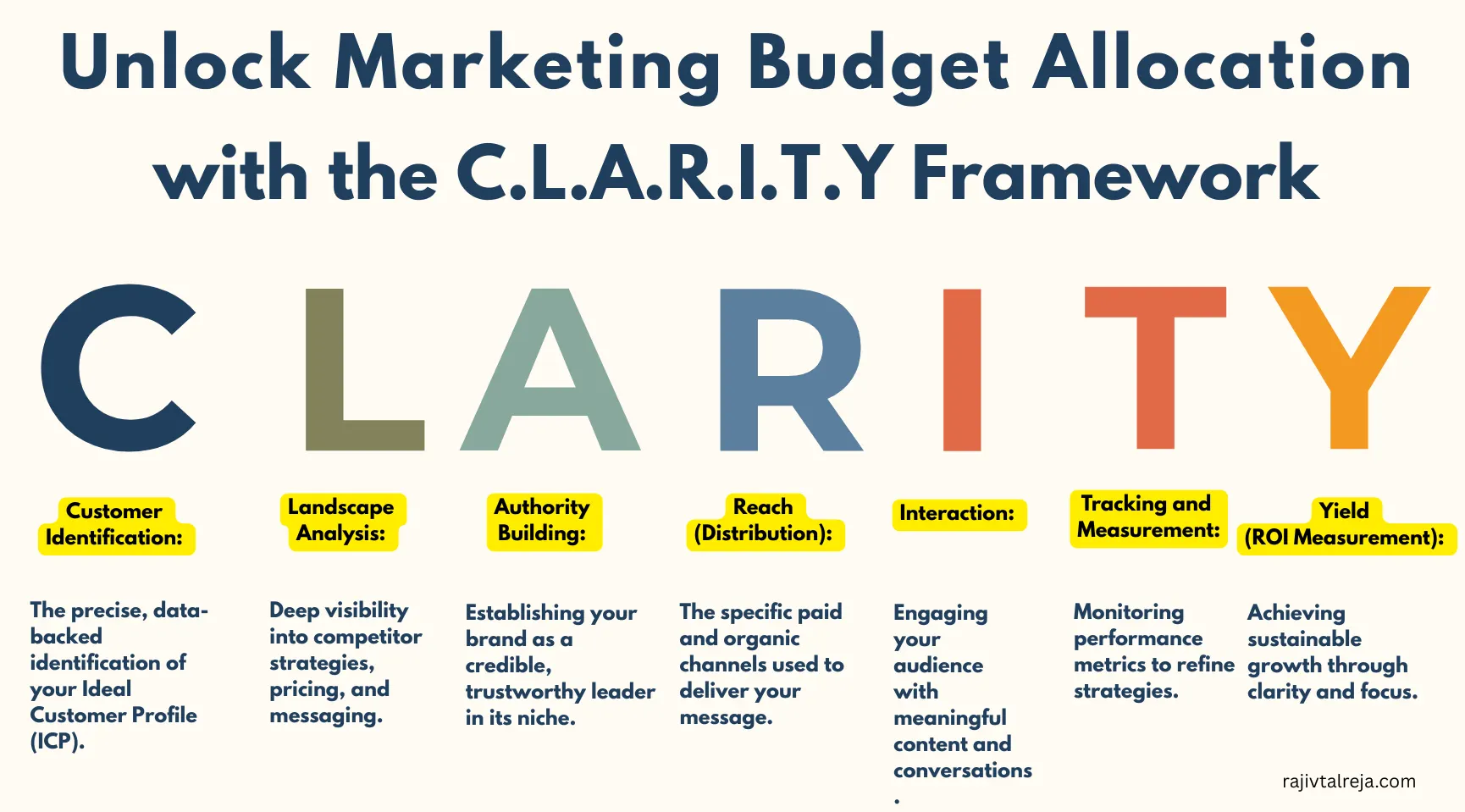
A solid marketing budget allocation example always starts with the customer, not the wallet.
The Issue – Most MSMEs go wrong here, not inside the ads manager.
What Business Owners Usually Do – They target “anyone who needs our product,” “B2B clients,” or “mid-size companies.”
The Outcome – Messaging becomes weak and unclear. It speaks to no one and pushes ad costs up.
Go Deeper – What Clarity Really Means?
Stop depending on demographics alone.
Define your ONE primary buyer using these five filters –
Stage-Wise Depth
The Issue – Leads don’t fail. Definitions do.
What Founders Usually Do – Count every inquiry as a lead, then blame marketing when sales don’t close.
Go Deeper – Real Lead Qualification
A name and a phone number alone don’t make a lead.
That’s just contact information.
A lead becomes qualified only when it meets these criteria –
The Issue – More channels don’t automatically mean more growth.
Most times, they just create more confusion and chaos.
What Founders Usually Do – They run ads everywhere because that’s what everyone else seems to be doing.
Go Deeper – Channel Roles
Good marketing budget allocation by channel requires that every channel has ONE clear job.
Your budget should follow the job you want done.
Channel Discipline
| Choosing the right channel for your revenue stage is tricky. Our business coaching programs can help you build a roadmap to stop burning cash. |



The Issue – Revenue surprises can destroy MSMEs.
What Founders Usually Do – Track sales only after invoices are raised. Then panic when the numbers dip at month-end.
Go Deeper – Visibility Metrics
Set aside a budget to track these four numbers weekly.
This creates a clear “windshield” view of your business –
The Issue – Budgets leak silently through unclear goals.
What Founders Usually Do – “Let’s try this for ₹10k.” “My competitor has billboards, so I should too.”
Go Deeper – Spend Logic
Every single rupee in your marketing budget breakdown must answer three questions –
Simple Budget Split
The Issue – Execution without responsibility hurts ROI and stalls results.
What Founders Usually Do – The founder approves every ad copy and creative, while agencies run without clear checks or direction.
Go Deeper – Clear Accountability
You need names attached to outcomes.
The Issue – Growth comes from learning, not just spending.
What Founders Usually Do – Ignore past campaigns, repeat old mistakes, and constantly chase “new” ideas.
Go Deeper – Build a Learning System
Proper marketing budget allocation requires a review loop. Every three months, write down –
| Strategic benchmarks dictate that CAC should never exceed 30% of a customer’s Lifetime Value (LTV) |
How you handle marketing budget allocation depends heavily on who you are selling to.
B2B marketing budget allocation requires patience and education, while B2C demands speed and volume.
Here is the difference at a glance –
| Feature | B2B Marketing Budget (Manufacturing, SaaS) | B2C Marketing Budget (Retail, D2C) |
| Buying Cycle | Long (months). The budget must support continuous nurturing. | Short (minutes or days). Budget focuses on impulse decisions. |
| Primary Spend | Lead quality matters more. Higher cost per lead is acceptable if the deal value is high. | Volume matters most. Low cost per acquisition (CPA) is critical. |
| Channel Focus | LinkedIn, email campaigns, trade shows, and Google Search. | Meta (Facebook/Instagram), Google Shopping, influencers. |
| Content Budget | Higher spend on whitepapers, specifications, and case studies. | Moderate spend on visuals, videos, and user reviews. |
| Core Difference | Money is spent to build relationships and trust. | Money is spent to capture attention quickly. |
When planning a B2B marketing budget allocation, remember that you are buying trust over time, not just clicks.
Your marketing budget allocation is not about competing with giants like Tatas or Reliances.
It’s about building a predictable and reliable growth engine for your business.
When you use the C.L.A.R.I.T.Y. framework, you stop guessing. You stop blaming the agency.
You start seeing marketing as a dial you can turn up or down based on your ability to deliver.
Following marketing budget allocation best practices ensures you survive the lean months and thrive in the peak seasons.
If you don’t master marketing budget allocation by channel, you will always be at the mercy of platform algorithm changes.
Take control of your advertising budget allocation today.
Want more actionable advice on scaling your MSME? Check out our other blogs on MSME marketing strategies.
It is dividing funds across channels to achieve predicted revenue, not just spending.
Breakdown marketing budget into 60-70% for Growth, 20% for Efficiency, and 10% for Insurance.
A marketing budget, a split of 70% on proven leads, 20% on tools, and 10% on brand safety is perfect.
B2B marketing budget allocation focuses on trust and long cycles. B2C focuses on impulse.
Capture (Search), Create (Social), or Convert (Retargeting).
A method to align customers, leads, and revenue for better advertising budget allocation.
Stop guessing. Use the C.L.A.R.I.T.Y. framework to track ROI and control growth costs.


