


Running a business with someone else sounds like a great idea… More hands on deck, shared responsibility, and combined strengths.
But before you bring in a partner, it’s worth understanding the partnership business advantages and disadvantages clearly.
In our experience working with thousands of MSME owners across India, partnership businesses are often built on trust and enthusiasm but break down because of unclear roles, poor communication, or a lack of systems.
The good news is, most of those problems are preventable.
This blog covers everything you need to know…
The real advantages of a partnership business, the disadvantages you must watch out for, and most importantly, how to overcome the challenges so your partnership stays profitable and strong.
A partnership business is when two or more people come together to run a business, share profits and losses, and jointly make decisions.
It is one of the oldest and most common business structures in India, especially among MSMEs.
According to the SIDBI MSME Report, over 6.2 crore MSMEs are registered in India.
A significant portion of these are partnership firms because the structure is easy to set up, flexible, and requires minimal paperwork.
There are different types: general partnerships (all partners share equal liability), limited partnerships (some partners have limited liability), and limited liability partnerships or LLPs (partners are protected from each other’s individual actions).
For most Indian MSMEs, the general partnership is the most common starting point.
Let’s start with the positives. Here’s why many MSME owners in India choose the partnership model.
A partner brings a second perspective. Two minds spot blind spots faster, stress-test ideas better, and make fewer costly calls than one person bearing all the pressure alone.
A partner brings their own capital into the business. Combined financial capacity means you can take on bigger orders, invest in growth, and handle slow months without scrambling for debt.
Market downturns, delayed payments, big bets in a partnership, the impact is shared. Risk sharing makes it easier to take calculated growth decisions that a solo owner might avoid out of fear.
No one is equally strong at everything. The best partnerships pair someone who excels at sales with someone who excels at operations; each partner’s strength covers the other’s gap.
Unlike a private limited company, a partnership is not required to file public financial reports. Your revenue, margins, and business structure stay private, away from competitors and the public eye.
Now, for the side most people don’t talk about enough. The partnership business disadvantages are real, and if you go in unprepared, they can derail your business and your relationship.
In a general partnership, every partner is personally on the hook for business debts. If the business owes Rs 50 lakh and your partner can’t pay, you could be liable for the full amount including personal savings and property.
Two partners can pool more than one, but a partnership still can’t issue shares or attract large institutional capital the way a company can. For businesses that need significant funds to scale fast, this becomes a real ceiling.
This is the one that ends most partnerships. Disagreements over strategy, unequal effort, or different risk appetites can spiral quickly. We’ve seen profitable businesses collapse not because of the market, but because partners stopped trusting each other.
Profits are split based on ownership ratios. If you’re putting in more effort than your partner but taking home the same share, resentment builds and that’s one of the quietest ways a partnership falls apart.
In many general partnerships, if a partner exits, the business may legally have to dissolve. Without a clear exit clause, one person’s departure can disrupt operations, shake supplier confidence, and create messy legal complications.
| Partnership Business Advantages | Partnership Business Disadvantages |
| Better Decision Making- two perspectives reduce costly mistakes | Unlimited Liability- personal assets at risk for business debts |
| Availability of Funds- combined capital increases business power | Limited Resources- harder to raise large institutional capital |
| Risk Sharing- financial and operational burdens are distributed | Conflicts Between Partners- disagreements can paralyse the business |
| Complementary Skills- each partner fills the other’s gaps | Shared Profits- income split can create resentment over time |
| Secrecy- no public financial disclosure required | Instability on Exit- no exit plan can dissolve the business |
The good news is that every single disadvantage listed above can be managed or eliminated with the right preparation. Here’s how.
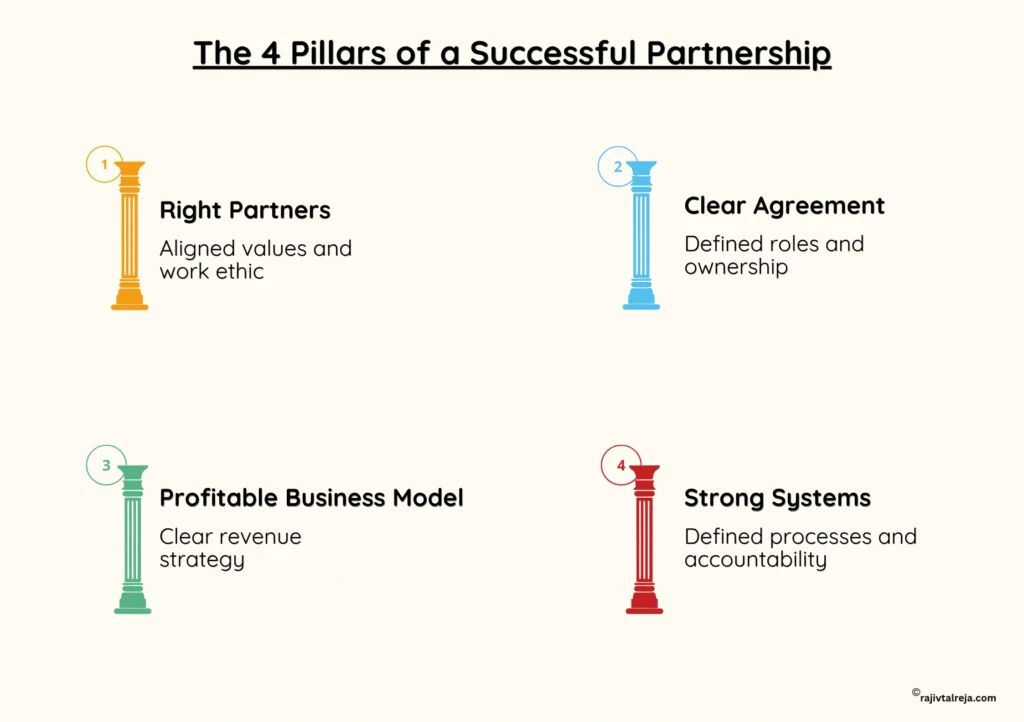
Most partnership disasters start with choosing the wrong person. Shared enthusiasm is not enough. Before entering a partnership, evaluate your potential partner’s work style, values, financial habits, and long-term goals.
Ask: Do they bring complementary skills? Do they share your risk appetite? Have they shown consistent follow-through in their past work? A partnership is like a business marriage and choosing the right partner is the most important decision you’ll make.
A verbal understanding is not enough. A formal partnership agreement must define: ownership percentages, profit-sharing ratios, decision-making authority, each partner’s roles and responsibilities, and a clear exit clause.
The agreement should also include a dispute resolution process for what happens if partners disagree, and who has the final call on which decisions. Businesses that draft a strong partnership agreement early almost always avoid the major conflicts that break undocumented partnerships.
One of the biggest sources of partner conflict is an unclear or unprofitable business model. When revenue is unpredictable, partners start blaming each other. When margins are thin, tensions rise fast.
Build a profitable business model that clearly defines your target customers, your pricing strategy, and your revenue streams. When both partners understand how the business makes money and agree on the model, decision-making becomes faster and conflict reduces significantly.
Most MSME partnerships break down because everything runs on the owners’ memories. There are no SOPs, no clear processes, and no way to track who is doing what. Without systems, accountability disappears, and accountability is the foundation of a healthy partnership.
Implement systems for sales, operations, finance, and team management. When the business has clear processes, both partners know their lane, performance is measurable, and neither partner has to guess what the other is doing. Systems are what separate a chaotic partnership from a profitable one.
If you’re not sure where to start, working with a business coach can help you and your partner align on strategy, build systems, and navigate the structural decisions that make or break partnerships.
The partnership business advantages and disadvantages are two sides of the same coin. Done right, a partnership can double your capacity, sharpen your decisions, and help you build a business that’s bigger than what either of you could achieve alone.
Done wrong, it becomes a source of conflict, liability, and missed opportunity. The difference almost always comes down to preparation, choosing the right partners, drafting a strong agreement, building a profitable business model, and implementing systems that keep accountability clear.
Enjoyed this? Head to our blog for more practical insights on business growth, leadership, and building a business that actually works for you.
Shared risks, better decision-making, and easier access to funds.
Unlimited liability, conflicts between partners, and limited resources.
To combine skills, capital, and expertise for faster growth.
Partners are personally responsible for business debts.
By drafting clear agreements and maintaining open communication.
It can be beneficial due to shared resources and decision-making.
Yes, they help align goals, improve communication, and resolve conflicts.


