


Most interviews follow a predictable script.
“Tell me about yourself.”
“What are your strengths?”
“Why should we hire you?”
Candidates rehearse answers. Interviewers nod politely. And everyone leaves without learning anything meaningful.
If you want to hire people who think well, adapt fast, and grow with your company, you need better questions.
Using strategic interview questions to ask candidates helps you understand how someone solves problems, handles pressure, collaborates with others, and plans their future.
Because hiring isn’t about filling a role.
It’s about choosing a future teammate.
Strategic interview questions go beyond qualifications and experience. They help you understand how a candidate thinks and behaves in real situations.
They reveal:
Instead of memorized answers, you get authentic insight.
A strong hiring procedure isn’t about asking more questions. It’s about asking the right ones.
Structured interviews are 2x more predictive of job performance than unstructured ones.
Strategic questions help you:
Simply put: better questions lead to better hires.
Understanding these categories helps you ask strategic interview questions to candidates and answers that go beyond rehearsed responses and reveal real thinking patterns.
These focus on past experiences to predict future behavior.
These explore how candidates would respond to hypothetical challenges.
These reveal mindset, motivation, and long-term alignment.
A strong interview blends all three.
The goal isn’t to ask tricky questions.
It’s to understand how a candidate thinks, works, and grows.
Below are some of the top strategic interview questions hiring managers use to uncover mindset, adaptability, and long-term potential.
Why ask:
This reveals ambition, clarity, and whether the role fits their future plans.
Strong answers show: realistic growth plans, alignment with the role, and desire to learn and advance.
Red flag: vague or generic ambitions.
Why ask:
Great professionals are always improving something.
Strong answers show: self-awareness, active learning habits, and commitment to growth.
Red flag: “Nothing right now.”
Why ask:
This helps you understand motivation and direction.
Strong answers show: curiosity and ambition, desire for responsibility, and a growth mindset.
Red flag: lack of direction or unrealistic expectations.
Why ask:
Real workplaces rarely offer perfect clarity.
Strong answers show: logical thinking, comfort with uncertainty, and accountability.
Red flag: avoidance of responsibility.
Why ask:
This reveals analytical thinking and persistence.
Strong answers show: structured approach, creativity, and measurable results.
Red flag: focusing on effort rather than outcome.
Why ask:
Adaptability is critical in fast-changing workplaces.
Strong answers show: research and learning, seeking guidance when needed, and structured experimentation.
Red flag: panic or avoidance.
Why ask:
Conflict is inevitable. Handling it well is essential.
Strong answers show: emotional intelligence, communication skills, and a collaborative mindset.
Red flag: blaming others.
Why ask:
Mistakes happen. Growth matters.
Strong answers show: ownership, reflection, and improvement steps.
Red flag: claiming they never make mistakes.
Why ask:
Initiative separates average performers from exceptional ones.
Strong answers show: proactive behavior, ownership, and measurable impact.
Red flag: waiting for instructions.
Why ask:
Feedback response predicts growth.
Strong answers show: openness, maturity, and behavioral improvement.
Red flag: defensiveness.
Why ask:
Work environments shift constantly.
Strong answers show: flexibility, reprioritization skills, and communication with stakeholders.
Red flag: rigidity.
Why ask:
Evaluates leadership and communication.
Strong answers show: empathy, direct communication, and a solution-oriented mindset.
Red flag: complaining without action.
Why ask:
Tests negotiation and time management.
Strong answers show: prioritization, stakeholder communication, and realistic planning.
Red flag: agreeing blindly.
Why ask:
Healthy disagreement is part of strong teams.
Strong answers show: respectful communication, data-backed reasoning, and professionalism.
Red flag: passive compliance or confrontation.
Why ask:
Trust drives performance.
Strong answers show: reliability, transparency, and consistency.
Red flag: vague responses.
Why ask:
Team success matters more than individual success.
Strong answers show: collaboration, empathy, and a shared success mindset.
Red flag: overly self-focused responses.
Why ask:
Workplaces are diverse.
Strong answers show: adaptability, communication flexibility, and emotional intelligence.
Red flag: preference for only similar personalities.
Why ask:
Prioritization determines productivity.
Strong answers show: impact-based decision-making, planning systems, and clarity under pressure.
Red flag: reactive workflow.
Why ask:
Reveals preparation and initiative.
Strong answers show: research about the company, understanding of role priorities, and proactive thinking.
Red flag: lack of preparation.
Why ask:
Align expectations early.
Strong answers show: outcome-focused thinking, understanding of role impact, and clarity on performance.
Red flag: focus only on tasks, not results.



Why ask:
This reveals alignment and genuine interest.
Strong answers show: research about the company, alignment with values, and enthusiasm and purpose.
Red flag: generic answers.
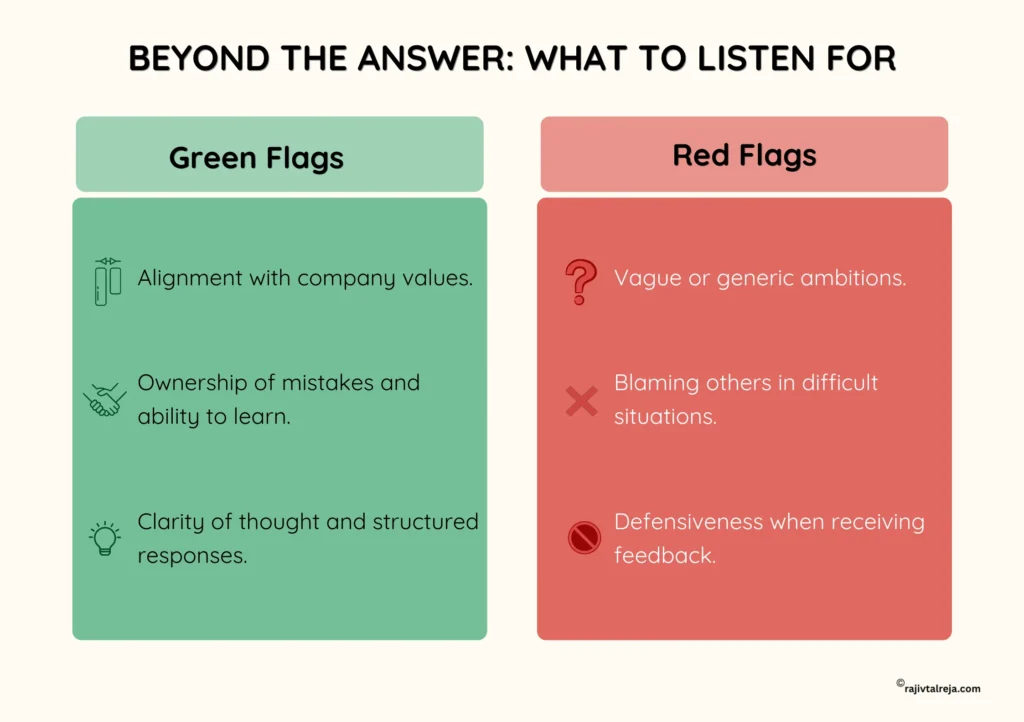
When evaluating interview candidates, pay attention to:
Great candidates don’t give perfect answers.
They give honest, thoughtful ones.
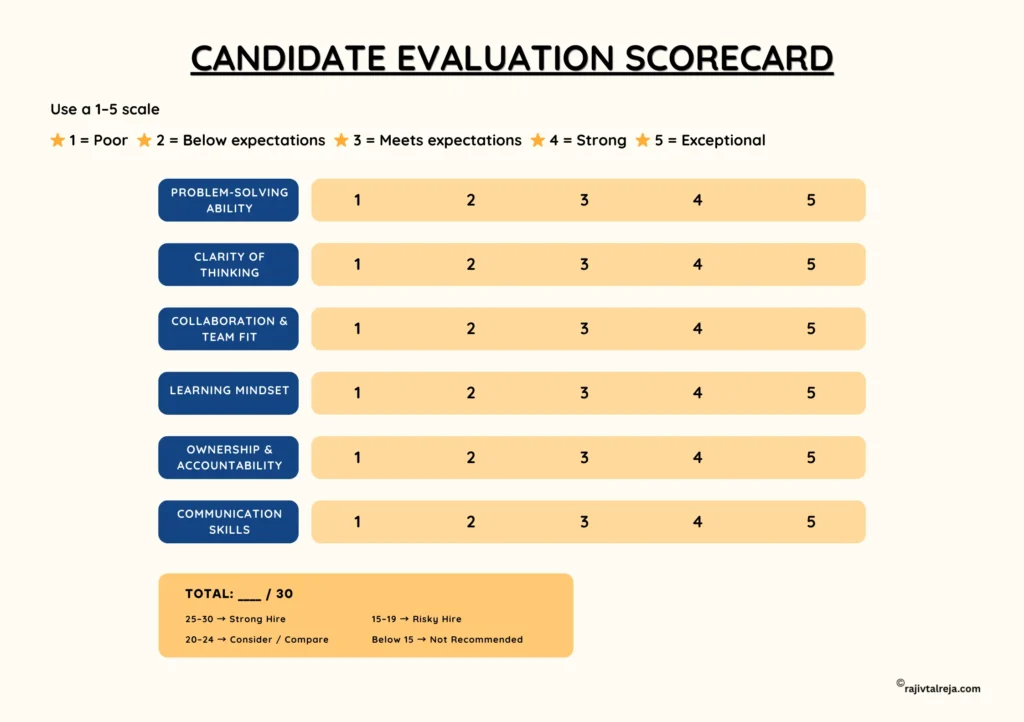
Even great questions need structure.
Questions like “Tell me about yourself” or “What are your strengths?” They invite rehearsed answers and reveal little about real thinking.
Ask context-based questions instead. “Tell me about a time you solved a problem with limited information.”
The interviewer dominates the conversation. You miss insight into how candidates think, communicate, and problem-solve.
Use the 70/30 rule. The candidate speaks 70%, the interviewer 30%.
Pause. Let silence work in your favour.
Evaluating technical ability but ignoring mindset and adaptability. Skills can be trained. Attitude, ownership, and resilience are harder to teach.
Include behavioral questions like- “Tell me about a failure and what you changed afterward” to avoid this mistake.
Moving to the next question without probing deeper. Surface answers hide true thinking patterns.
To fix this mistake, use layered follow-ups like:
Choosing candidates you “like” over those who challenge thinking. Comfort doesn’t build high-performing teams. Diversity of thought does.
To avoid this mistake, ask questions that reveal perspective.
“Tell me about a time you disagreed with your manager.”
Great hiring doesn’t happen by chance.
It happens when you ask questions that reveal how someone thinks, grows, collaborates, and adapts.
Using these 21 strategic interview questions to ask candidates will help you move beyond rehearsed answers and identify people who will truly contribute to your team’s future.
Because the right hire doesn’t just fill a position, they strengthen the organization.
For more such insights, explore our blog page and stay ahead in leadership and hiring excellence.
They reveal how candidates think, behave, and adapt.
Past behavior is the best predictor of future performance.
Behavioral questions focus on past actions; situational questions explore hypothetical responses.
6–10 core questions plus follow-ups work well.
Both matter, but mindset predicts long-term success.
Use structured questions and consistent scoring.
It improves collaboration, retention, and performance.


