


As a business owner, you have probably spent years seeing your customer service team as a necessary cost.
But for an Indian MSME in 2026, that thinking is risky.
While you are hunting for new leads, you are sitting on a hidden goldmine of customer service revenue right in front of you.
With the MSME credit gap touching ₹30 lakh crore, ignoring internal revenue is no longer an option.
This blog will show you how to change your approach, stop the cost-centre drain, and turn everyday customer conversations, from the first hello onward, into real, profitable opportunities.
Customer service revenue is a high-intent sales channel, with every interaction an opportunity to drive sales.
Research shows that companies treating service as a key part of their startup growth strategy earn up to 60% more profits.
In today’s economy, value has shifted from producing goods to delivering great service.
When you hurry customers off the phone to reduce Average Handling Time, you are hanging up on your most reliable source of cash flow.
Your support team is not just managing complaints. It is leading customer success.
By 2026, customers will value service sensitivity more than getting the lowest price in the market.
This shift requires a total customer service transformation in how you view your help desk.
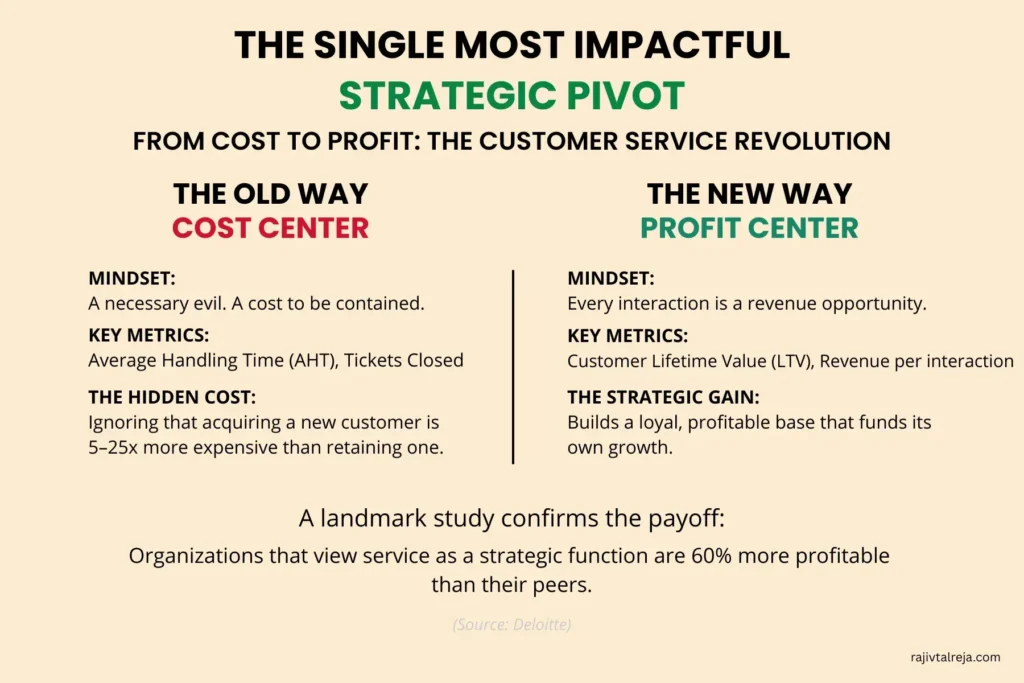
Building customer service revenue allows MSMEs to achieve startup growth without the heavy burden of high marketing costs.
By focusing on existing clients, you can boost turnover without spending a rupee on new lead generation.
This approach also improves liquidity by generating steady, upfront cash through AMC sales, which helps bridge the common ₹30 lakh crore MSME credit gap.
Key benefits include –
Sell more to current customers and lower your acquisition costs.
Boosting customer retention by even 5% can increase your profits.
Upfront cash flow from maintenance contracts improves your bank balance.
After-sales services often carry 50% more profit than the main product sale.
Shift from one-time sales to subscription-based services for financial stability.
By implementing these customer service strategies.
You ensure your scaling startup remains resilient even during market fluctuations.
| Understanding the potential is step one, and capturing it is the focus for many founders seeking structured guidance from business coaching programs in India. |
Your customer service makes money by identifying unmet needs during the support process and offering relevant solutions like upgrades, spare parts, or annual contracts.
This process, often called customer service upselling techniques, works best during the Golden Hour, the moment immediately after a problem is solved, and customer trust is highest.
To maximise customer service revenue, your team should focus on –
Train staff to catch words like growth, slowness, or expansion as clues for upgrades.
Recommend genuine spare parts that prevent future breakdowns.
Encourage customers to move to AMCs once the free service period ends.
Use clear entitlement checks to ensure every visit and part provided is billed correctly.
Effective customer success management makes sure that these offers feel like helpful recommendations instead of pushy and robotic sales pitches.
The SUPPORT framework is a seven-step system designed to help MSME support teams generate customer service revenue without breaking customer trust.
It shifts your focus from hard selling to helpfulness, turning technicians into revenue contributors.
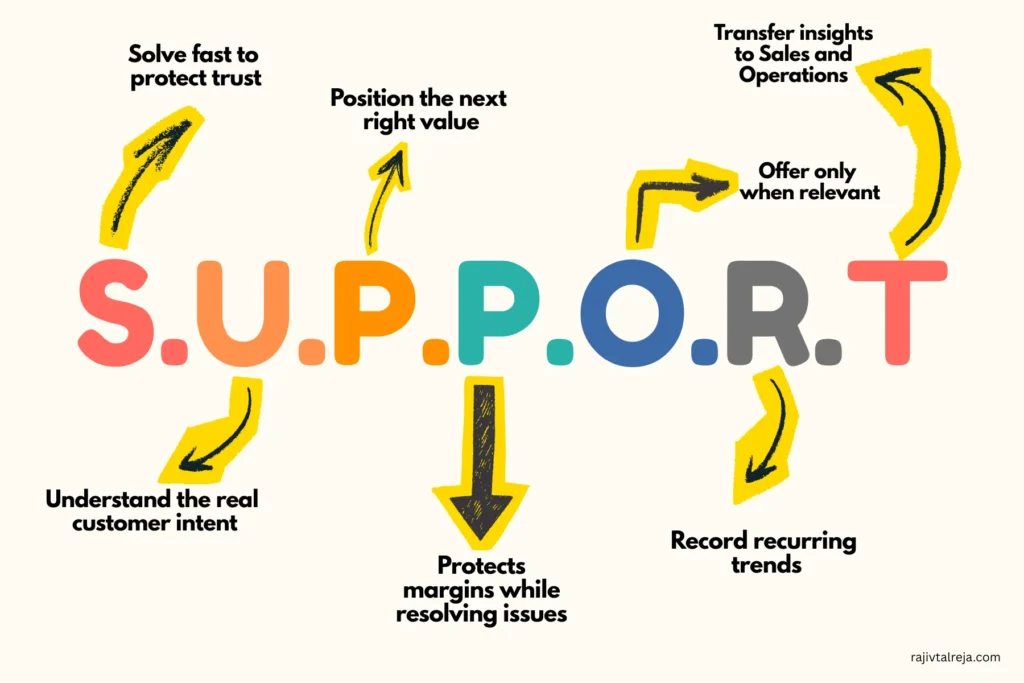
This framework is important for any scaling startup looking to professionalise its post-sales operations.
S – Solve fast to protect trust
You cannot sell to an angry customer.
Resolution always comes first. In India, being on time is a huge differentiator.
Use tools like WhatsApp Business API to handle basic queries so your team can focus on complex, revenue-driving conversations.
U – Understand the real customer intent
Listen for signals like capacity or moving office.
These indicate growth pain points.
Your team must learn whether a price objection is a lack of money or a lack of perceived value.
P – Position the next right value
Offer what genuinely solves the problem.
For example, if a repair costs ₹18,000 but an AMC costs ₹25,000, the AMC is the better value for the customer.
P – Protects margins while resolving issues
Avoid the discount trap.
When customers bargain, offer extras like a free service visit instead of cutting the price.
Ensure all small favours done by field technicians are recorded in a CRM.
O – Offer only when relevant
Timing is everything.
Selling after fixing an issue is proactive.
Use customer service upselling techniques, such as suggesting high-yield toners during a printer repair, to save the customer money later.
R – Record recurring trends
Use your CRM tool to track failure patterns.
This helps you create targeted Aftermarket campaigns and upgrade offers for specific customer groups.
T – Transfer insights to Sales and Operations
Your support team is your first warning system. Support team catches problems early.
A Service-to-Sales handoff is one of your best lead sources because trust is already built.
This improves the overall startup customer experience by providing a seamless transition from support to growth.
| Every support team is unique. If you aren’t sure how to train your team on this new approach, one-on-one business coaching helps you adapt this framework to your specific product and customer base. |



The biggest mistake MSMEs make is selling before solving, which damages the startup customer experience and destroys long-term trust.
When agents prioritise an upsell over a fix, the customer feels exploited rather than supported in their issue.
Another common mistake is the discount trap, where your teams reduce prices to close complaints immediately, which hurts margins and devalues the service overall.
Other frequent mistakes include –
You are avoiding better service systems out of fear of losing MSME benefits.
Team uses cold, automated scripts that ignore India’s need for local language and personalized help.
Team chasing speed (Average Handling Time) instead of building customer retention and lifetime value.
To fix these mistakes, you need a complete customer service transformation for your team and business that aligns incentives with long-term profit rather than short-term speed.
To manage customer service revenue, you must track metrics that reflect both financial gain and the health of your customer success management efforts.
Monitoring these numbers ensures your customer service strategies are actually working.
| Metric | Why It Matters | Target Benchmark |
| Repeat Purchase Rate | Tells you if your service is building real customer loyalty. | More than 20% |
| AMC Conversion Rate | Shows how well your Warranty to AMC push is performing. | Between 10% and 15% |
| % Resolved without Discounts | Reveals if agents are adding value or just lowering prices. | Over 80% |
| Revenue from Spares | Shows if technicians are identifying wear and tear early. | 25% of Total Revenue |
Turning customer service into a profit centre is not about being pushy.
It is about being SMART and STRATEGIC.
When you stop treating support as a cost-centre and start using the S.U.P.P.O.R.T framework, you unlock growth that already exists within your current customers.
Small improvements in how you handle issues today can create steady, predictable income that helps your MSME grow into a market leader.
Pause the chase for new leads and look closely at the opportunity you already own.
Read more – Check out our other blogs on MSME growth and scaling strategies.
It is income from customer success activities like AMCs, spares, and upgrades during support.
In a scaling startup, it is the total money earned from products and customer retention deals.
Divide your total customer service revenue by the number of active clients you serve.
Yes. High-margin customer service strategies often yield 50% more profit than product sales.
Speed, empathy, startup customer experience quality, technical accuracy, and proactive help.
Top MSMEs aim for a 4-hour response to boost customer retention and protect trust.
It takes 10 good experiences to help a customer forget one bad startup customer experience incident.


