


You pay salaries on time. You give bonuses.
And still, your best people leave without warning. Sound familiar?
A workplace engagement survey is a structured set of questions that measures how connected, motivated, and committed your team feels about their work, their manager, and your business.
It is your simplest tool to find out what your team really thinks before they start looking elsewhere.
According to ADP Research’s People at Work 2025 report, employee engagement in India dropped to just 19% in 2025, down from 24% the year before.
That’s the steepest decline globally.
If 8 out of 10 people in your team are just going through the motions, no amount of hiring will fix it. You need to listen first.
A workplace engagement survey is a set of structured questions that helps you understand how your team truly feels about working in your business.
It goes beyond asking “Are you happy?”
It measures things like role clarity, trust in leadership, recognition, growth opportunities, and whether your team would recommend your business as a good place to work.
Think of it as a workplace survey questionnaire that gives you real data instead of guesswork.
Here’s the key difference most business owners miss:
Here’s the key difference most business owners miss: an employee engagement survey is not the same as a satisfaction survey.
| Factor | Employee Satisfaction Survey | Employee Engagement Survey |
| What it measures | Is the employee happy with the job? | Is the employee motivated to give their best? |
| Focus | Comfort, pay, perks, work conditions | Purpose, ownership, growth, connection to goals |
| What does it tell you | Whether people will stay | Whether people will stay AND perform |
| Typical question | “Are you satisfied with your salary?” | “Do you feel your work makes a difference?” |
| Risk if ignored | Quiet dissatisfaction builds up | Silent disengagement drains productivity |
| Best for MSMEs | Useful as a starting point | More actionable for business growth |
A workplace morale survey that only asks about satisfaction will tell you if your team is comfortable.
A workplace engagement survey tells you if they actually care.
For a business owner, that difference is everything.
Let’s put it in rupees.
Every time a team member leaves, you spend Rs 50,000 to Rs 2,00,000 on hiring, training, and lost productivity, depending on the role.
Multiply that across 3–4 exits a year, and you’re bleeding lakhs without even realising it.
Globally, employee engagement fell to 21% in 2024, costing the world economy $438 billion in lost productivity.
The benefits of an employee engagement survey are simple: you stop guessing and start knowing.
You catch problems before they become resignations.
You find out what actually matters to your people, and it is rarely just money.
| Factor | Without Survey | With Regular Survey |
| Attrition | High, unexpected exits | Predictable, reduced over time |
| Team morale | Unknown, assumed to be fine | Measured and tracked quarterly |
| Owner’s role | Firefighting daily | Strategic, system-driven |
| Employee trust | Low – based on guesswork | High – team feels heard |
| Hiring costs | Rs 50K–2L per unexpected exit | Reduced significantly over time |
| High turnover is a systems problem, not just bad luck. Quantum leap business coaching helps you build the systems to keep your team engaged and productive. |

We have worked with thousands of business owners on people management.
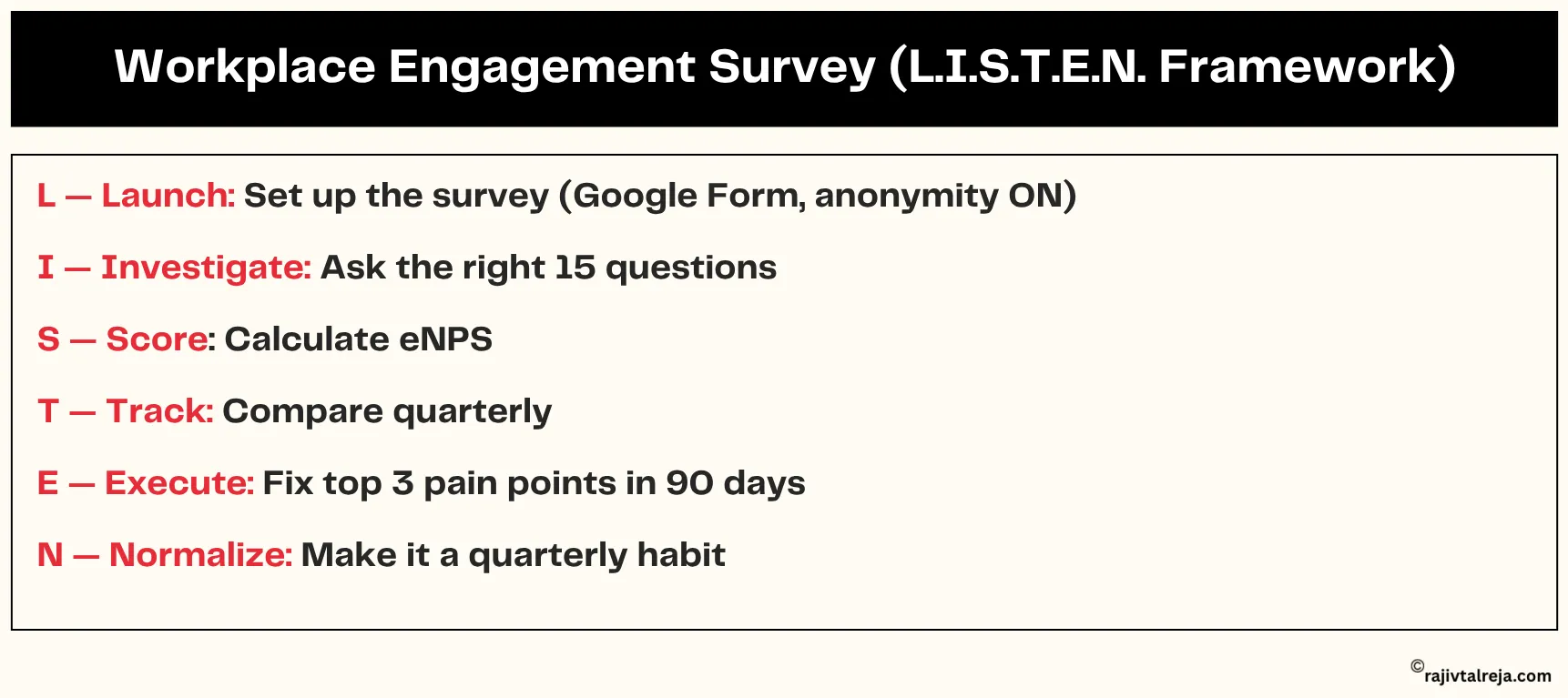
From that experience, we built a simple 6-step system called the L.I.S.T.E.N. Framework specifically for business owners who do not have an HR department.
Here is how it works:
| Step | What It Means | What You Do |
| L – Launch | Set up the survey right | Create a Google Form. Turn off email collection. Share via WhatsApp. Give a 3-day deadline. |
| I – Investigate | Ask the right workplace engagement questions | Use the 15 questions in the next section. Cover recognition, growth, manager, culture, and workload. |
| S – Score | Calculate your engagement score | Use eNPS: ask “Would you recommend this workplace?” Scores 9–10 = Promoters. 0–6 = Detractors. Subtract Detractors from Promoters. |
| T – Track | Compare over time | Run the survey every quarter. Track whether scores improve. One survey tells you nothing — the trend tells you everything. |
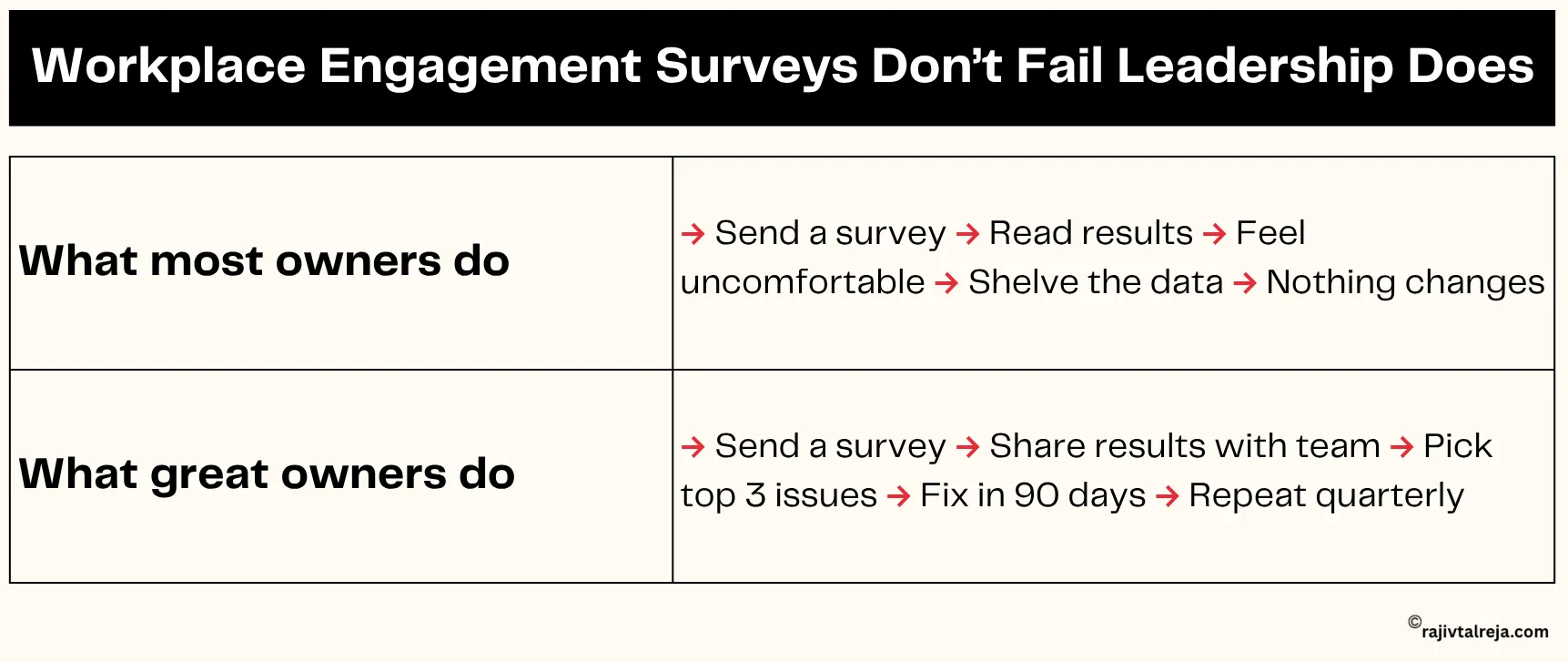
| E – Execute | Take action on the top 3 findings | Do not try to fix everything. Pick the 3 biggest pain points and fix them in 90 days. Tell your team what you are fixing. |
| N – Normalize | Make this a habit | Announce a recurring quarterly survey. Your team should expect it, not be surprised by it. |
| If you’re unsure how your team will react to this, our one-on-one business coaching can guide you through the rollout process step-by-step. |



These questions are designed for Indian MSMEs.
They are simple, direct, and cover the 5 areas that matter most.
You can copy-paste them into a Google Form today.
Rate each on a scale of 1–5 (Strongly Disagree to Strongly Agree).
These are also solid employee engagement survey examples you can adapt to your business.
| Category | Question | What It Reveals |
| Recognition | I feel valued and appreciated for my work. | Whether your employee recognition survey signals are healthy |
| Recognition | My contributions are acknowledged by my manager. | Manager-level recognition gaps |
| Recognition | Good work is celebrated in our team. | Team culture around appreciation |
| Growth | I see a future for myself at this company. | Retention risk level |
| Growth | I have opportunities to learn and grow here. | Whether growth paths exist or are just promises |
| Growth | My skills are being fully utilised in my role. | Role-fit and underutilisation risk |
| Manager | My manager gives me clear direction on what is expected. | Leadership clarity |
| Manager | I feel comfortable sharing feedback with my manager. | Psychological safety |
| Manager | My manager supports my professional development. | Manager as coach vs just supervisor |
| Culture | I would recommend this company as a great place to work. | eNPS — your headline engagement score |
| Culture | I feel respected by my colleagues. | Team dynamics and workplace morale |
| Culture | The company’s values are reflected in daily decisions. | Whether values are lived or just on the wall |
| Workload | My workload is manageable and reasonable. | Burnout risk |
| Workload | I have the tools and resources to do my job well. | Operational gaps |
| Open-ended | What is one thing we could do better as a workplace? | The gold mine — real, unfiltered insights |
The last question is the most important.
It turns your workplace satisfaction survey questions from a rating exercise into a real conversation.
Before you write a single question, get these two things right: your mindset and your team’s trust.
Without them, the best workplace survey questionnaire in the world will collect dust.
| Download this free template with all 15 questions, a 1–5 rating scale, and a scoring guide. Print it or use it to set up your Google Form in 10 minutes. Download here |
Running the survey is step one.
The real value of employee engagement survey analysis is what you do next. Here’s a simple process:
Look at question 10 (“I would recommend this company”).
Scores of 4–5 are Promoters. Score of 3 is Neutral. Scores of 1–2 are Detractors.
eNPS = % Promoters − % Detractors. A positive score is okay.
Above +30 is excellent. Below zero? You have urgent work to do.
Sort your questions by average score.
The 3 lowest scores are your priority action items.
Do not try to fix 15 things. Fix 3 things well.
This is where most business owners get scared.
But transparency builds trust.
Share the overall scores in a Monday meeting.
Say: “Here is what you told us. Here is what we are going to do about it.”
Pick 3 actions. Assign owners. Set a 90-day deadline.
At the next survey, your team will see whether things have changed.
That loop feedback to action to results is what builds real employee engagement in the workplace.
A workplace engagement survey is not an HR exercise.
It is a leadership tool.
It tells you what your team cannot say to your face and gives you the chance to fix it before it becomes an exit interview.
You do not need expensive software.
You do not need a 50-question assessment. You need 15 good questions, a Google Form, and the courage to listen and act.
Start this quarter. Your team is waiting to be heard.
Learned from this?
Head to our blog for more practical insights on business growth, leadership, and building a business and team that actually works for you.
Satisfaction = happy employees; engagement = motivated, committed performers.
Run quarterly surveys to track team sentiment and act faster.
Keep 12–20 questions to balance depth and response quality.
Yes, anonymity ensures honest feedback, especially in small teams.
Above 0 is OK, +20 good, +50 excellent; focus on improving trends.
Only if you act on feedback with clear and visible changes.
Yes, Google Forms works well for small teams under 100 employees.
Pick the top 3 issues, act fast, and communicate a 90-day plan.
Ensure anonymity, explain purpose, and act on past feedback.


