On December 3rd, the world marks the International Day of Persons with Disabilities. On this day, people usually talk about rights and the well-being of the community. That is important, but it is not enough.
More than that, I want to talk about how so many of you are already building incredible lives as business owners and inspiring others.
In this blog, I want to guide you on how disabled entrepreneurs can build businesses from scratch and scale them effectively.
Let’s start with the status of Indian disabled entrepreneurs…
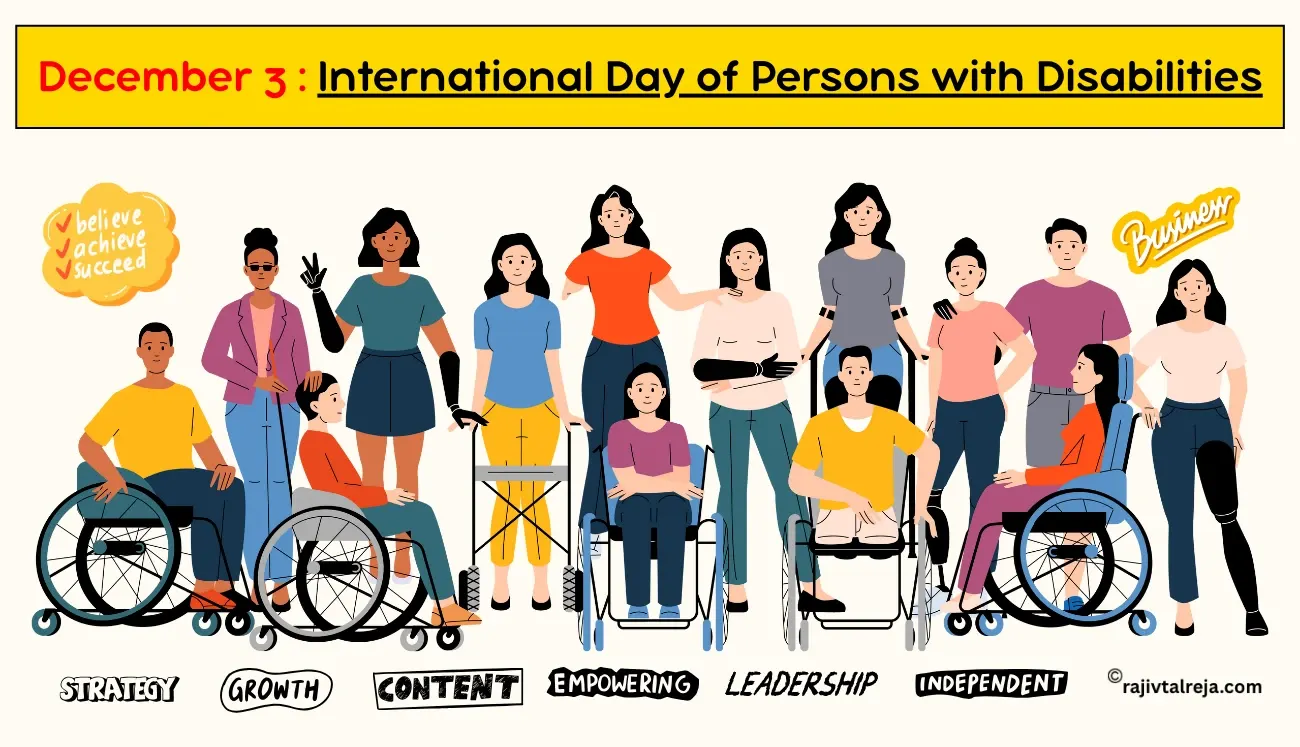
You are stepping into the world of disability entrepreneurship, managing physical, sensory, or cognitive challenges in a world that wasn’t designed with you in mind.
But the story is changing.
With over 6,35,378 Udyam-registered MSMEs run by Divyangjan, this isn’t a niche. It’s a movement.
It’s frustrating, isn’t it?
You have the dream, but the system feels stacked against you.
Most guides gloss over this, but we need to face the “soft bigotry” of low expectations head-on.
Many affordable office spaces do not include ramps or accessible restrooms.
Start with remote-first or digital business models instead.
Government websites with unreadable CAPTCHAs create headaches.
Use “assistive tech” to get around poor design.
Banks often see “disability” as “risky.”
Apply through Nationalized Banks for schemes like NHFDC instead of slow state agencies.
The biggest obstacle is often people expecting you to fail.
Let your revenue speak for itself and silence the doubters.
Now that we’ve spotted the challenges, let’s talk about the people tackling them.
We need to normalize entrepreneurs with disabilities taking charge.
| Overcoming these challenges makes you resilient. A business coach for small businesses can help you navigate these hurdles and focus on pure growth. |
Disabled entrepreneurs are diverse and unique, each with their own experiences and journeys.
Successful disabled entrepreneurs come from vast backgrounds.
Knowing your category helps you find suitable support.
Often facing mobility issues. Many deal with challenges like limited mobility. Example – Wheelchair users running e-commerce empires from home.
They excel at voice technology and sound. Masters of voice tech and sound. Example – Srikanth Bolla, founder of Bollant Industries.
Visual thinkers often excel in design or coding. They often shine in areas like design or programming.
Those with ADHD or Autism who turn “hyper-focus” into a business superpower.
People living with conditions like ADHD or Autism can channel their intense focus into successful ventures.
Entrepreneurs manage energy-limiting conditions by building automated income streams.
These individuals handle energy-draining conditions by creating systems for passive income.
Now, let’s create your plan for disability entrepreneurship.
Follow this straightforward step-by-step path tailored for MSME owners with disabilities.
Don’t start with what you can do.
Focus on what the market needs that you’re good at.
This lean approach matches your strengths to real demand, saving time and energy.
This is how disabled business owners stay competitive.
Build an easy-to-use business plan that prioritizes money coming in over vanity metrics.
Keep it accessible and focused on sustainability to avoid burnout.
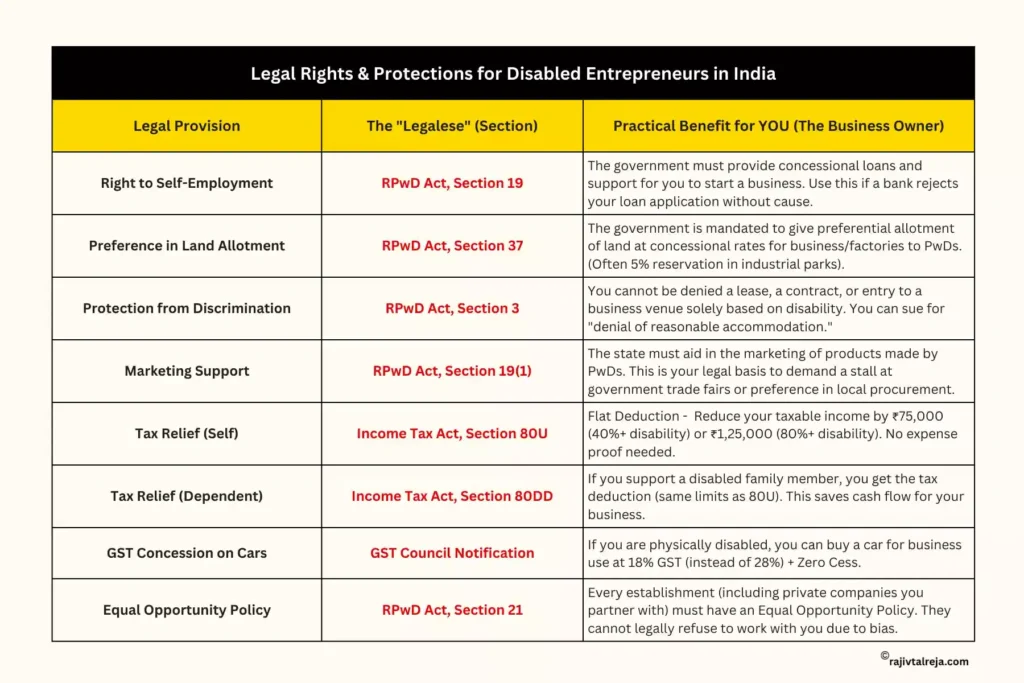
Get your UDID Card. It is your key to exclusive benefits like schemes and funding.
Register for Udyam to gain MSME status.
It is free, paperless and opens government tenders plus subsidies.
This unlocks priority lending and tax perks essential for growth.
Set up a WCAG-compliant website as your accessible storefront to reach customers easily.
Share your authentic story to attract buyers because realness sells.
Automate repetitive tasks that drain your energy for sustainable growth without exhaustion.
But remember, you need cash as the foundation.
Next, let’s explore funding options for disabled business owners.
| Every entrepreneur’s journey is unique. The business coaching process helps you execute these steps in the right order to avoid burnout. |

Money keeps the wheels turning.
Luckily, the government has specific pipelines for disabled small business owners.
Loans up to ₹50 Lakhs at concessional interest rates (5–9%).
Visit the NHFDC website to check if you’re eligible.
Perfect to get quick working capital up to ₹10 Lakhs.
No collateral needed.
Banks must lend to at least one SC/ST borrower and one woman borrower.
If you are a woman with a disability, claim this.
Receive support to buy tools like laptops with screen readers or motorized wheelchairs to help with business tasks.
Here’s a tip –
Don’t just show up at a bank empty-handed.
Walk in with your UDID card, your Udyam registration and a printed project report.
Prove that disabled small business owners mean business.
Money doesn’t do much good if you can’t execute. That’s where technology comes in.
Technology levels the playing field so well that large competitors often don’t realize they’re up against a business owner with disabilities.
It allows you to build a virtual disabled entrepreneurs network without leaving home.
| Category | Tool / Startup | What It Does? | Cost / Accessibility |
| Visual Impairment | NVDA (NonVisual Desktop Access) | A free, open-source screen reader for Windows. It allows you to use a PC entirely via audio feedback. | Free (Global Standard) |
| Envision AI / Be My Eyes | OCR apps that read printed invoices, handwritten notes, or restaurant menus aloud via your phone camera. | Freemium Models | |
| Annie (by Thinkerbell Labs) | India’s own “self-learning” Braille device. Great if you are learning Braille to manage physical documents. | Paid (Indian Innovation) | |
| Hearing Impairment | SignAble | An Indian app that provides live sign language interpretation on video calls for client meetings. | Subscription-based |
| Otter.ai | Generates real-time captions for Zoom/Google Meet calls. Never miss a detail in a negotiation again. | Free & Paid tiers | |
| Mobility / Motor | Dragon NaturallySpeaking | The gold standard for voice dictation. You can write emails, code, or draft contracts 3x faster than typing. | Paid Software |
| Glassouse / Tobii | Assistive mice that let you control a computer using head movements or eye tracking. | Hardware (One-time cost) | |
| Neurodiversity(ADHD/Autism) | Notion + AI | An “external brain” to organize scattered thoughts. The AI can rewrite “blunt” emails into “polite” corporate speak. | Free & Paid tiers |
| Focusmate | Virtual co-working. You pair with a stranger for 50 mins to ensure you finish a task (Body Doubling). | Free & Paid | |
| Physical Navigation | TorchIt (Saarthi) | An Indian sonar-based device for blind entrepreneurs to navigate unfamiliar venues/meetings safely. | Low Cost (Indian) |
Technology is cool, but what really matters are the results.
Let’s look at the disabled entrepreneurs in India who are actually winning.
The best way to kill doubt is with evidence. You might be thinking, “Sure, the theory is nice, but who is actually doing this?”
The answer – People just like you.
These aren’t just “feel-good” stories. These are case studies of fierce business acumen. Let’s break down their models so you can steal their strategies.
Visual Impairment (Blind since birth).
A ₹500+ Crore manufacturing giant producing eco-friendly packaging (plates, cups) from areca leaves and recycled paper.
Srikanth didn’t ask for charity; he built a supply chain.
He intentionally hired “unskilled” and uneducated people with disabilities, customizing his machinery with tactile markings and audio cues so they could operate it safely.
Srikanth turned a “hard-to-employ” workforce into a loyal, high-retention manufacturing team.
Down Syndrome.
A D2C (Direct-to-Consumer) beverage brand selling homemade mint coolers.
During the lockdown, Swasti started small from her kitchen. She leveraged Instagram Reels to show the process, washing, sorting, and bottling.
Her authenticity built a cult following, turning a home kitchen into a micro-enterprise handling 20+ orders daily.
You don’t need a factory. You need a product, a smartphone, and the courage to hit “Post.”
Deafblindness.
A high-end consulting firm helping tech giants (like Lenovo and Microsoft) design accessible products.
She positioned her disability as a “hacking” skill.
She teaches companies that if you design for the most marginalized (deafblind), you end up innovating for everyone (like how text-to-speech benefits drivers).
Position your unique perspective not as a medical condition, but as a specialized insight that big companies/VCs will pay to learn.
Disability entrepreneurship is not just about survival.
It is about innovation.
Disabled entrepreneurs like you see the world differently, and that perspective is your competitive advantage.
The government has the funds, the tech exists, and the market is ready.
You’re the only piece missing. Start today or share this blog with your disabled business owner friend.
Click here to read more MSME growth strategies for entrepreneurs.
Srikanth Bolla (Bollant) and Alina Alam (Mitti Café) are iconic leaders.
Try accessibility testing, content creation, dropshipping, or eco-manufacturing.
Yes, use NHFDC loans (5–9% interest) or MUDRA schemes. Get your UDID card first.
Yes, Srikanth Bolla is a blind CEO who built a ₹500 Cr eco-packaging empire.
Absolutely. Remote teams are naturally inclusive and eliminate travel barriers.
Yes, under Section 80U, you can claim a deduction of ₹75,000 to ₹1,25,000.