


India’s manufacturing sector contributes about 15-17% to GDP and employs over 27 million workers, underlining how critical understanding manufacturing workflows is for business success in 2026.
If you strip it down, how a manufacturing company works is not complicated. It’s simply how an order moves from promise to product to payment.
At a high level, every manufacturing business works through 6 connected stages:
Sales → Planning → Materials → Production → Quality → Dispatch
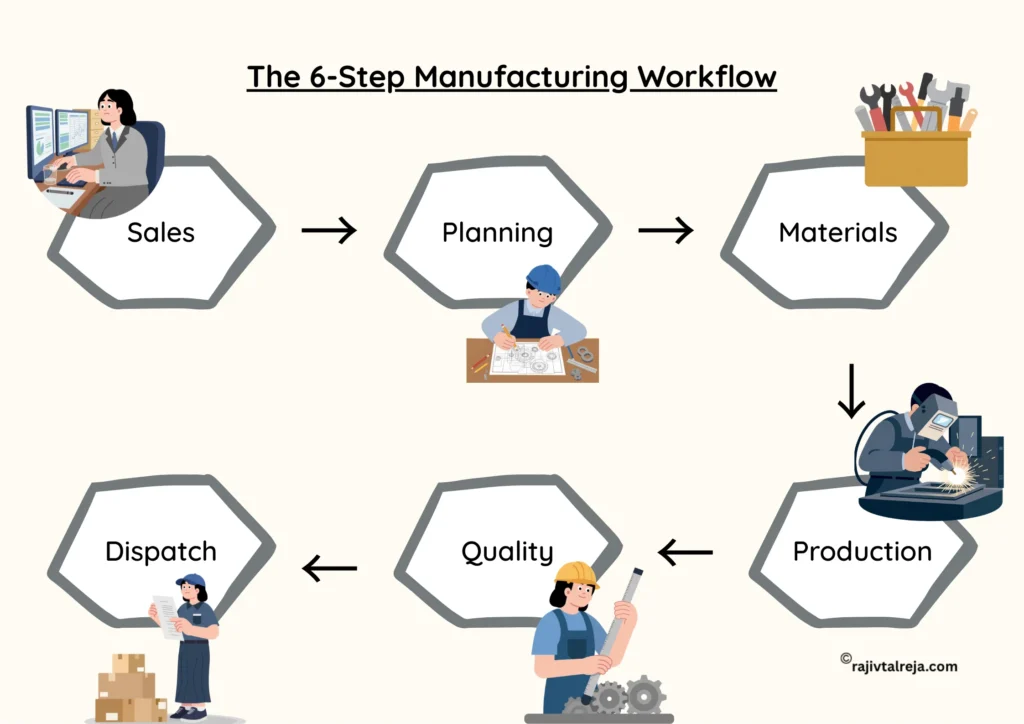
When these stages talk to each other, orders flow.
When they don’t, delays, blame, and chaos happen.
This is where most manufacturing business processes quietly break.
Now let’s see how this actually works step by step inside a real manufacturing company.
Think of this as the manufacturing company workflow that runs behind the scenes after a customer says “yes”.
Here’s the simple manufacturing company working process flow:
Each step depends on the previous one. Miss clarity in step 1 and step 6 suffers.
Now let’s break each stage down…
This is where everything begins, and where many problems start.
What actually happens:
What usually goes wrong:
If this step is weak, the entire manufacturing process suffers later.
This step decides when and how the order will be produced.
What production planning does:
This production planning process is the brain of how a manufacturing business works.
Common MSME issue –
Planning lives only in the owner’s head. When they’re absent, production slows.

Here, the company checks one simple thing: “Do we have what we need to make this order?”
What happens here:
This step connects manufacturing business processes with cash flow.
Typical gap:
Materials arrive late → production waits → dispatch gets delayed.
This is where the product is actually made.
What the manufacturing process includes:
This stage depends heavily on:
When people ask, “How manufacturing business works?”, this is what they imagine, but it’s only one part of the whole system.
Quality is not an afterthought. It’s a gate.
What happens here:
Where MSMEs struggle:
This causes last-minute stress and customer complaints.
The final step in how a manufacturing company works, and the only step the customer sees.
What happens:
A smooth dispatch means:
A delayed dispatch usually means something broke earlier, not here.
Most orders get stuck in three places:
These are handoff points, where responsibility changes.
You don’t need new software first. You need clarity.
Simple fixes that work:
This is how you stabilize manufacturing company’s workflow without complexity.
If you truly understand how a manufacturing company works, you stop firefighting.
Orders don’t fail in production. They fail in handoffs, assumptions, and silence.
Fix the flow, not the people, and your manufacturing business processes will start working for you, not against you.
For more practical business insights, real-life case studies, and simple frameworks for MSME owners, explore our blog page…



Lack of coordination between sales, production planning, and inventory teams is the most common issue.
Because production planning is often done without real-time material availability or clear priority rules.
By using simple tools like shared spreadsheets, daily production boards, and clear handoff checklists between teams.
Usually neither alone. Delays happen when ownership of the order is unclear after sales confirmation.
For MSMEs, starting production within 24-72 hours after confirmation is considered healthy, depending on material readiness.
They track orders by stage (order received, planned, in production, QC, dispatched) instead of by departments.
Incomplete quality checks, missing documents, or production finishing later than the committed date.
Weekly planning with daily micro-adjustments works best for small and mid-sized manufacturers.
Short-term growth is possible, but long-term scaling becomes painful without a clear manufacturing process flow.


