


Here’s an honest thought!
Most businesses don’t fail because their product is bad. They struggle because their revenue model is unclear, inconsistent, or unsustainable.
In 2026, rising costs, tighter competition, and changing customer behaviour mean you can’t rely on guesswork.
You need a business revenue model that generates predictable income, supports growth, and fits how your customers actually buy.
In this blog, I’ll help you break down revenue model types, real examples, and a simple framework so you can confidently pick the right one for your business.
Let’s get started!
A revenue model defines how a business earns money from its products or services. It shows how value created by a business is converted into income.
It explains… who pays you, what they pay for, and how often they pay.
Common examples include one-time sales, subscriptions, commissions, or usage-based pricing.
A well-designed model helps businesses plan cash flow, set pricing, and build predictable income.
For any business plan, choosing the right one in business is critical because it directly impacts profitability and long-term sustainability.
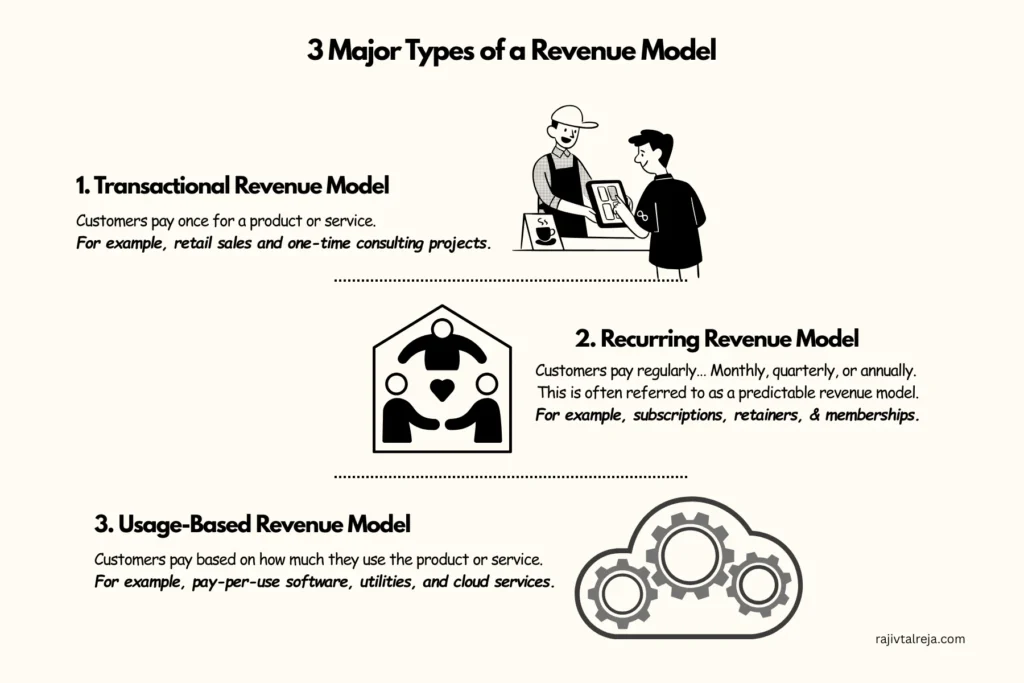
The three major types most businesses use are transactional, recurring, and usage-based.
Nearly every type fits into one of these categories.
For many businesses in 2026, combining these revenue streams into a hybrid model helps balance stability and growth.
Here are the key differences…
| Aspect | Revenue Model | Business Model |
| Definition | Explains how a business makes money | Explains how a business operates and delivers value |
| Focus | Pricing, payments, income streams | Value creation, customers, operations, costs |
| Key Question | How do we earn revenue? | How does the entire business work? |
| Examples | Subscription, commission, usage-based | D2C, marketplace, SaaS, franchise |
| Role in Planning | Helps forecast cash flow and profits | Guides the overall business strategy |
| Relationship | Part of the business model | Includes the revenue model |
In simple terms…
Your business model explains what you do and how you operate, while your revenue model explains how you get paid.
Next, let’s answer an important question every business owner asks…
A revenue model is important because it determines how stable, scalable, and profitable your business can become.
Even a great product can fail if the model doesn’t generate consistent or predictable income.
In 2026, businesses face higher costs and more competition.
A strong business revenue model helps you forecast…
Research shows that companies with recurring or predictable revenue models are more resilient during market slowdowns.
Simply put, the right model gives you control over profits, planning, & long-term growth, rather than leaving revenue to chance.
Think of this section as a menu. You don’t need all 11… You need the ones that match how your customers buy.
Customers pay once per purchase.
Example: Retail sales, one-time services, workshops.
When does this work best?
Revenue can be unpredictable unless volume is high.
Customers pay at regular intervals.
Example: Monthly retainers, memberships, maintenance contracts.
When does this work best?
This creates a predictable model, which investors and founders both prefer.
A structured recurring model with tiered access.
Example – SaaS tools, OTT platforms, learning portals.
When does this work best?
This is easier revenue forecasting and customer retention.
Basic version is free; premium features are paid.
Example: Free tools with paid upgrades.
When does this work best?
Only a small % converts. Volume matters.
You earn by showing ads to your audience.
Example: Blogs, free apps, media platforms.
When does this work best?
In this model, revenue relies heavily on audience size & engagement.
You earn a cut from every transaction.
Example: Marketplaces, brokers, aggregators.
When does this work best?
In this model, there is low upfront cost, scalable income.

Your customers pay to use your intellectual property.
Example: Software licenses, patented designs, brand usage.
When does this work best?
Upside – High margins with minimal operational effort.
You earn by promoting others’ products.
Example: Blogs, influencers, comparison websites.
When does this work best?
This model is limited control over pricing and customer experience.
Customers pay based on consumption.
Example: Pay-per-use software, utilities, APIs.
When does this work best?
Challenge – Revenue forecasting can fluctuate.
You monetise interactions on your platform.
Example: E-commerce or service marketplaces.
When does this work best?
Reality check – Needs strong execution early on.
A combination of two or more models.
Example: Subscription + ads, product sales + services.
When does this work best?
Most scalable option – Many successful businesses evolve into hybrids over time.
There is no “best” model in general. There is only the right one for your customer, product, and growth stage.


Ask yourself, “Do customers want to pay once, monthly, or based on usage?”
Your revenue model should match buying behaviour, not your convenience.
If you deliver value once, a transaction model works. If you deliver value continuously, a recurring or subscription model will fit better.
If your cash flow feels unpredictable, then move toward a predictable model like subscriptions or retainers…
Before locking in, test pricing with a small customer group. Even a simple pilot tells you more than assumptions.
You don’t need a perfect model on day one. Many successful businesses start transactional and evolve into hybrid revenue models.
The right revenue model balances customer comfort, business sustainability, and growth goals.
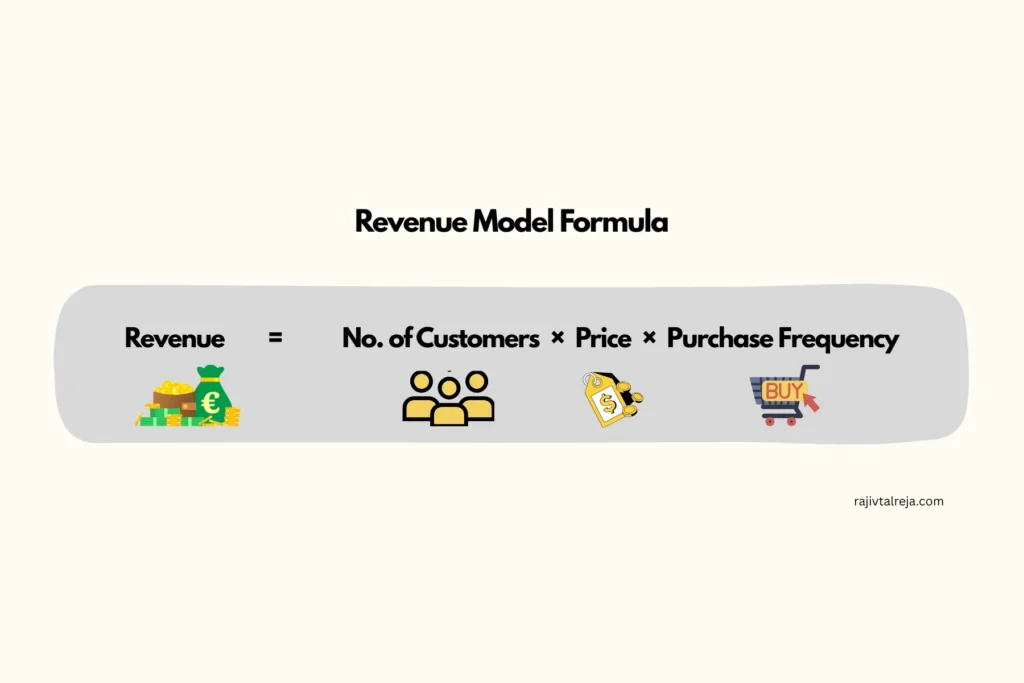
At its core, every revenue model comes down to one simple formula…
Revenue = Number of Customers × Price × Purchase Frequency
This formula works for almost all revenue model types.
You run a retail business.
Monthly Revenue = 300 × ₹1,000 = ₹3,00,000
You offer a monthly service.
Monthly Recurring Revenue (MRR) = 120 × ₹2,000 = ₹2,40,000
This is why recurring models are called predictable revenue models.
You charge per usage.
Monthly Revenue = 80 × ₹1,500 = ₹1,20,000
If you want to increase revenue, you only have three levers…
Your revenue model should evolve as your business grows. The goal isn’t to get it perfect on day one. It’s to improve it continuously.
Monitor how stable your monthly income is. If revenue fluctuates too much, consider adding a recurring model alongside one-time sales.
Change the prices/packages for a small customer segment before rolling it out fully. This will reduce risk and gives real data.
If customers keep asking for ongoing support, upgrades, or bundles… then it’s your signal to evolve your revenue model in business plans.
Ensure your model covers fixed & variable costs comfortably.
A model that grows revenue but squeezes margins isn’t sustainable.
Instead of switching models overnight, layer new revenue streams. Many successful businesses move toward hybrid models over time.
Choosing the right revenue model is about fit. The best model is the one that aligns with,
Start simple, test often, & don’t be afraid to evolve. A strong model gives you clarity, confidence, and control over your business future.
If you’d like more practical frameworks and real-world business insights like this… visit our blog page for more useful content for business owners!
Most Indian e-commerce platforms use a hybrid revenue model, combining commission on sales, seller subscriptions, advertising fees, & logistics or fulfilment charges.
They earn revenue by charging users a recurring monthly/annual fee for access to content, often offering multiple pricing tiers based on features or usage.
Many Indian tech companies use the freemium model, where basic features are free and advanced tools are paid, especially in SaaS, productivity, & mobile app platforms.
They typically use a commission-based revenue model. This helps them earn a percentage from each ride, along with additional income from surge pricing and service fees.
Food delivery platforms usually rely on a multi-stream revenue model, combining restaurant commissions, delivery fees, advertising placements, & subscription programs for users.
Online marketplaces monetise users through seller commissions, listing fees, premium subscriptions, advertising, & value-added services, creating multiple revenue streams.
Most online education platforms earn revenue through course fees, subscriptions, certifications, corporate training programs, and premium learning features.
To create a revenue model, identify who pays you, what they pay for, how often they pay, and how much it costs you to deliver value, then test and refine based on customer behaviour.
No, B2C is a business model, not a revenue model. It describes who you sell to, while a revenue model explains how you earn money from those customers.


