


Did you know that 87% of executives believe innovation is essential for growth?
And honestly, they’re right.
Because in 2026, if you’re not improving, adapting, or thinking creatively… Your competitors definitely are.
But innovation in entrepreneurship isn’t about inventing something huge. It’s about small, smart changes that help you work better, solve problems faster, and serve customers in a way that makes you unforgettable.
That mindset alone can turn you into a creative and innovative entrepreneur, even if you run a small team or a local MSME.
So let’s break it down… What does innovative entrepreneurship actually mean for your business?
Innovative entrepreneurship means running your business with fresh ideas and smarter ways of doing things, and improving what you already do.
In simple terms…
It’s using creativity, technology, and better thinking to solve problems, serve customers, and grow faster.
This mindset turns you into a creative, innovative entrepreneur who adapts quickly and stays ahead in 2026.
Now, let’s see why innovation matters so much for your MSME.

If you want your MSME to grow in 2026, you can’t depend on the same old methods.
That’s why innovation in business becomes your biggest advantage. Even small changes can transform the way you work and compete.
Here’s why innovation matters so much…
When everyone sells the same thing, entrepreneurship and business innovation are what make your business stand out.
Better ideas → better value → happier customers.
A small process improvement or simple digital tool can save hours each week.
New markets, new products, new collaborations… Innovation creates growth you didn’t even plan for.
In fast-changing markets, the importance of innovation in business is simple… Adapt or fall behind.
Now that you know why innovation matters, let’s explore the different types of innovative entrepreneurs and see where you fit.

Before you start applying innovation in your business, it helps to know what kind of innovative entrepreneur you naturally are.
Everyone thinks and innovates differently, and understanding your style makes it easier to improve, grow, and use your strengths in 2026.
Here’s a simple breakdown!
| Type of Innovative Entrepreneur | What They Do | Where They Excel |
| Creative Innovator | Uses imagination, design thinking, and fresh ideas to solve problems. | Branding, new product ideas, and unique customer experiences. |
| Technological Innovator | Uses tools, automation, software, and AI to improve efficiency. | Digital adoption, automation, streamlining operations. |
| Process Innovator | Finds smarter ways to run daily operations and systems. | Workflow improvements, cost savings, better productivity. |
| Social Innovator | Digital adoption, automation, streamlining operations. | Sustainability, impact-driven businesses, purpose-led brands. |
| Market Innovator | Introduces new models, pricing strategies, or niche offerings. | Market disruption, new revenue streams, competitive positioning. |
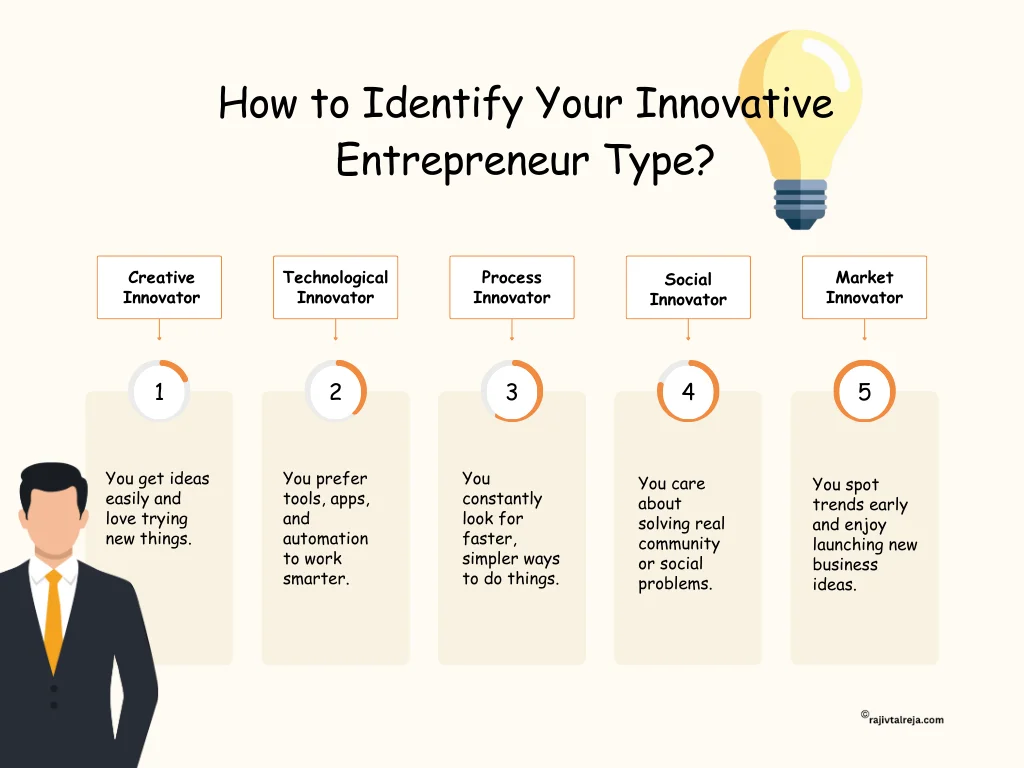
Here’s a quick way to know which type you are… Just notice which statements feel most like YOU!
| You get excited by new ideas. You enjoy brainstorming and imagining possibilities. You often think, “What if we try this?” |
| You love to explore and use tools to save time. You automate tasks whenever it’s possible. You like exploring apps, AI, & software. |
| You constantly improve how things operate. You really hate inefficiency. You enjoy simplifying workflows or reducing steps. |
| You want your business to make a difference. You drive by impact, not profit. You think about solving community problems. |
| You are fast to spot trends before others. You enjoy trying new models or pricing strategies. You think differently about how to sell your products. |
Most entrepreneurs are a mix of these types, and that’s completely normal.
The goal isn’t to choose one… It’s to recognize how you naturally innovate so you can strengthen it even more.
Let’s look at the most-needed skills of innovative entrepreneurs and how to develop them by simple tips and habits!
Every successful MSME owner who practices innovation in entrepreneurship develops these simple but powerful skills.
Each one can be learned with small daily habits…
What it means – Seeing new possibilities and thinking beyond routine.
How to develop it?
This is what shapes a creative and innovative entrepreneur.
What it means – Finding quick, practical solutions.
How to develop it?
This mindset fuels entrepreneurship and business innovation.
What it means – Adjusting quickly when markets change.
How to develop it?
Adaptability keeps your business future-ready.
What it means – Using tools to save time and improve efficiency.
How to develop it?
You don’t need to be tech-savvy, just tech-aware.
What it means – Noticing trends, needs, and gaps early.
You can develop it by,
What it means – Looking beyond daily operations.
How to develop it?
This makes innovation intentional, not accidental.
What it means – Learning and innovating through relationships.
How to develop it?
Collaboration unlocks fresh ideas and confidence.
Innovation in entrepreneurship is staying curious, being open-minded, and willing to try new things.
When you start thinking like an innovative entrepreneur, your business becomes more adaptable, more competitive, and more future-ready.
Start small. Improve one thing at a time. Those simple steps are what lead to real entrepreneurship and business innovation.
For more business articles, examples, and business lessons, visit our blog page.
The biggest barriers are limited budgets, lack of skilled staff, resistance to change, and not having a clear direction or process for testing new ideas.
Use free digital tools, improve existing processes, learn from customer feedback, and experiment with small, low-risk ideas instead of big changes.
No. Innovation can come from better processes, smarter decisions, technology adoption, or customer insights, not just creativity.
Ask for ideas regularly, reward small improvements, remove the fear of failure, and give your team the freedom to test simple solutions.
Identify one recurring customer or operational problem, create a small improvement around it, and test it immediately. Start small, then scale.


