Let me be blunt… If you’re doing everything in your business, nothing is scaling. You’re exhausted, decisions pile up, and the small stuff eats the big stuff (strategy, growth, family time).
This blog is about one skill that fixes most of that… how to delegate effectively.
No theory. No corporate speak.
Just simple, practical steps that help you get work off your plate, build trust with your team, and reclaim time to grow your MSME.
Let’s get started!
Delegation isn’t handing off tasks. It’s about…
So the result happens without you FIREFIGHTING every step…
Examples…

When you delegate like this, you don’t lose control. Instead, you scale your control.
Your business delivers consistent results without you doing every small step.
Your problem isn’t delegation. Your problem is letting go.
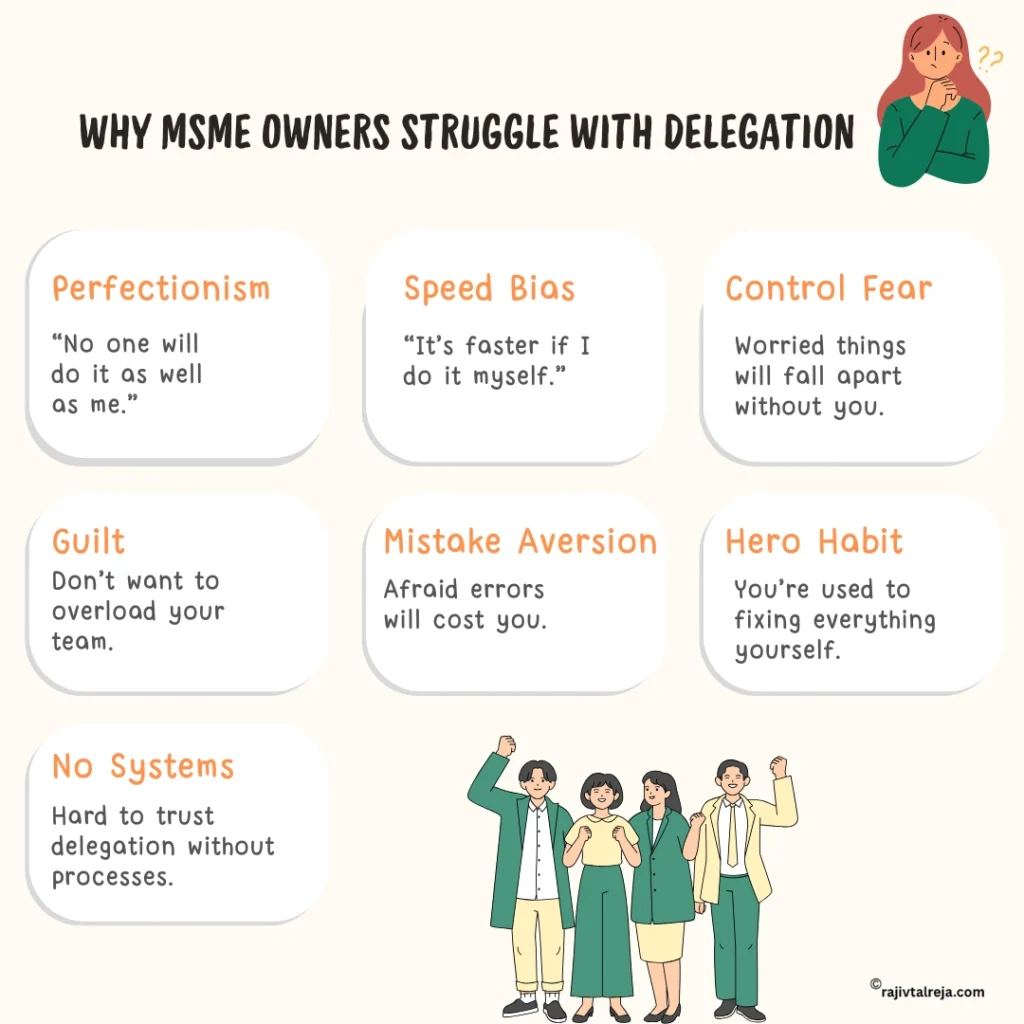
And that’s not your fault. Every MSME owner carries invisible psychological habits that make delegation feel risky, uncomfortable, or even pointless.
Here’s what’s actually happening in your mind (and why it’s normal)…
This comes from the perfectionism trap.
Your brain is wired to believe your method is the safest method, even if it’s not scalable.
The truth is that 80% done by someone else is better than 0% done because you’re overloaded.
This is your short-term brain talking. You focus on today’s speed, not tomorrow’s freedom.
Delegation is an investment, not a time-saving hack.
This is rooted in the founder identity loop. Your business feels like an extension of you.
Letting go will feel like losing a piece of yourself.
But leadership is not control… it’s direction.
This comes from the caretaker mindset, especially common in family-run or small teams.
But people grow only when they’re trusted with real responsibility.
Your brain is wired to avoid risk. It overestimates the cost of errors and underestimates the benefit of team ownership.
Mistakes aren’t failures. They’re training data.
Before you became a business owner, you were the one solving problems.
Your mind still thinks… “If there’s a fire, only I can put it out.”
That identity keeps you stuck in operations instead of leadership.
Not your people, but your systems. Because systems are what actually make delegation work.
If you’re delegating without processes, of course it feels scary.
Delegation isn’t about losing control.
It’s about moving your energy from doing the work → growing the business.
Once you understand these patterns, you’ll start delegating from confidence instead of fear.
Before you learn how to delegate effectively, it helps to know where you currently stand.
Most MSME owners think they’re delegating… but they’re actually stuck at the lowest levels of the delegation process in management. This simple ladder helps you see your true stage and what the next step looks like.
You handle everything, sales, operations, customers, payments, etc., because delegation feels risky & time-consuming…
Start delegating small & low-risk tasks.
In this stage, you assign tasks but still check every detail. You haven’t shifted authority, but the responsibility.
Delegate outcomes, not instructions.
You assign goals clearly and let your team decide the “how.”
You review progress at set checkpoints.
Team members make day-to-day decisions within defined limits. You’re no longer a bottleneck.
Delegate responsibilities that directly impact growth.
Your team owns outcomes.
You focus on strategy, growth, partnerships, and innovation instead of daily tasks.
Develop a leadership pipeline within your team.
This isn’t just about reducing stress. It’s about accelerating growth.
Research shows that businesses led by founders who delegate effectively experience well over 140% revenue growth, while those run by “do-it-yourself” owners grow closer to 80%.
The better you delegate, the faster your MSME grows.
Now you know where you stand, and here are 11 ways to delegate effectively…
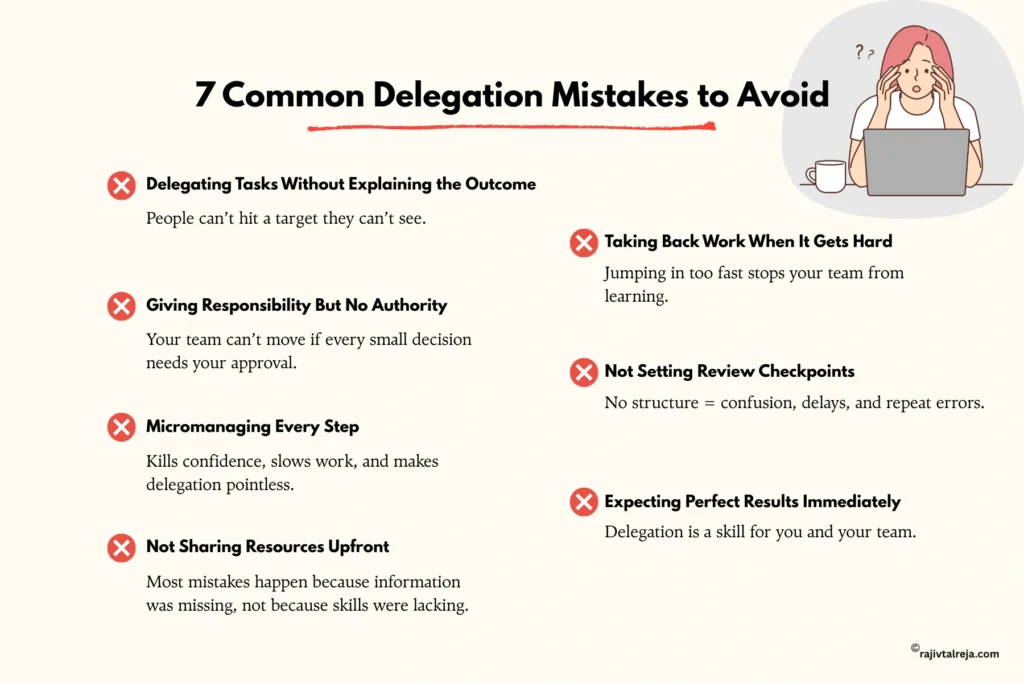
Most delegation fails because employees know what to do, but not why it matters or what the final result should look like.
Explain the outcome, quality level, timeline, and “definition of done.”
Example,
Instead of “Make a brochure,” say, “Create a 2-page brochure that explains our pricing clearly and is ready for printing by Friday.”
If delegation scares you, start with tasks that don’t impact your business heavily…
It builds trust slowly for you and your team.
If someone can perform a task 70% as well as you, you should delegate it.
The remaining 30% can be improved through guidance, but you cannot grow if everything depends on your 100%.
This works for you because most MSME owners wait for “perfect,” and perfection delays growth.
Your team members have hidden strengths, such as creativity, communication, analytics, & customer empathy.
Delegate based on natural abilities, not their position on paper.
Example – Your quiet accountant might be brilliant at designing SOPs.
People perform 2.5x better when tasks align with strengths.
Delegation fails when employees have the task but not the power to make decisions.
Define clearly:
It removes bottlenecks and reduces interrupt-driven work for you.
Most mistakes happen not due to incompetence but due to missing information.
Before delegating, give them:
Missing resources cause of delegation failures…
Micromanagement destroys initiative.
Instead, set predictable review checkpoints:
Clear review cycles promote accountability without any stress…
Record your training once and save it as…
Next time you delegate the same task, the system will train the person.
If you see someone taking full responsibility, celebrate that.
Because ownership is rare. Once it’s developed in the team, it becomes your biggest asset.
When an employee struggles, don’t step in instantly.
Ask:
Your team becomes problem-solvers, not task-doers. This is true leadership delegation.
Many MSME owners stay overwhelmed because their personal to-do list mixes with business.
You can outsource or delegate…
When your mind is free, your business grows.
If you’ve ever wondered how to delegate effectively without losing control, this simple 5-step delegation process in management is all you need.
Use it for any task, any team member, any business…
Before delegating, explain exactly what success looks like.
Include…
Give your team the tools they need to succeed…
Templates, logins, examples, SOPs, budgets, vendor contacts, everything.
Tell them:
This is the core of the process of delegation of authority.
Avoid “update me every minute.” Instead, use predictable review cycles like…
After the task is done… give feedback, elebrate ownership & improve the system (SOPs, checklists).
Before delegating, you need to confirm…
“Here’s the outcome I need, the deadline, and the resources. Message me at the review time if you need support.”
| Done: _________________ Pending: _________________ Blocked/Need help: _________________ Next steps: _________________ |
If a task can be… repeated often, explained once, or done 70% as well by someone else… delegate it.
If you’re overwhelmed, overworked, or constantly running behind in your business, delegation isn’t a luxury. It’s your lifeline.
When you learn how to delegate effectively, you stop being the engine of your MSME… and start being its leader.
Your job isn’t to do everything. Your job is to build the people and systems that help everything get done.
Start small. Delegate one task today. Over time, you’ll see that every successful MSME owner eventually realizes that delegation doesn’t take control away from you… It gives your freedom back.
And if you want more MSME-friendly business strategies like this, visit our blog page for practical insights that actually help you grow.
To free the business owner from daily operations so they can focus on growth, strategy, and leadership, not repetitive tasks.
Anything related to vision, strategy, money decisions, hiring key roles, and brand reputation should stay with the owner.
Start with micro-tasks, use SOPs, outsource small functions, or hire part-time/freelancers. Even with two people, you can delegate effectively.
Mistakes are part of the delegation process… Review the system, improve clarity, and coach your team.
Most MSMEs notice improvement in 2-4 weeks once clear outcomes, authority, and review cycles are in place.
Start by delegating tasks, move to delegating outcomes, & eventually delegate decisions with clear boundaries.
Simple tools like WhatsApp updates, Google Docs SOPs, Trello/Asana boards, and shared calendars work well for small teams.
Reset expectations, start with one small task, give clearer instructions, and use weekly reviews to rebuild confidence for both sides.
Delegating a task but keeping decision-making with themselves. This creates delays, frustration, and no real ownership.