


Struggling to grow your MSME business?
You might feel like you’re stuck in place, dealing with phone calls, manual orders, and tons of paperwork, while bigger rivals seem to zoom past you.
You know there has to be a better, more efficient way to reach more customers and boost your B2B sales.
The good news? There is.
B2B e-commerce is the answer, and this blog will show you the way step by step.
This isn’t just about going online – it’s about planning ahead to make sure your business keeps growing for years to come, especially within the rapidly evolving b2b retail industry.
Let’s simplify the basics of what is b2b ecommerce…
B2B ecommerce is simply the process of selling your products or services to other businesses through an online platform.
However, the biggest mistake MSME owners make is thinking B2B e-commerce is just like the online shopping we do on Amazon or Flipkart.
Understanding this difference is the first important step to building an online strategy that actually works.
To set up a successful online store, you need to cater to the unique habits of a business buyer. The table below shows the key differences you must know.
| Feature | B2B E-commerce (Your World) | B2C E-commerce (Consumer Shopping) |
| Target Audience | Companies, groups, government bodies (a particular limited group). | Single buyers (a wide general public). |
| Decision Driver | Reason & Facts. Aims to get returns, work better, and meet business needs. | Feelings & Quick Choices. Aims to satisfy personal likes, wishes, and brand love. |
| Decision Process | Hard & Time-Consuming. Needs many people (6-10 on average) and levels of okay. | Easy & Quick. Often, one person buys fast, sometimes on a whim. |
| Pricing Model | Changes & Talks. Has prices for each client, deals for buying lots, and estimates. | Fixed & Uniform. The price you see is the price everyone pays. |
| Order Size | High Average Value. Big bulk orders that customers often repeat on a regular basis. | Low Average Value. Smaller, often one-time purchases for personal use. |
| Relationship | Long-Term Partnership. Based on trust, dependability, and ongoing help. | Short-Term & Transactional. The connection might end after just one sale. |
| Payment Methods | Complex. Purchase orders, invoices, and credit lines (e.g., Net 30/60) are common. | Straightforward. Customers pay upfront with credit/debit cards or digital wallets. |
| Logistics | Focus on Reliability. Scheduled, complex deliveries are the norm. | Emphasis on Quickness. Buyers expect fast, straight-to-their-door delivery. |
Starting online sales might seem like a lot of work, but the perks aren’t just minor improvements. These advantages of b2b e-commerce are big-time benefits that solve the major problems MSME businesses face.
Here’s why you should jump in now.
An online store is your 24/7 salesperson, accessible from anywhere in the country or the world. This digital doorway allows you to discover entirely new markets and customer segments at a tiny fraction of the cost.
Consider the time your team wastes taking phone orders, reading emails, and entering data into your systems by hand.
A B2B platform makes this whole process automatic. This streamlining cuts down on office work and costly errors.
This helps your team to focus on high-value work, like building relationships with key clients and finding new leads.
A common fear is that technology will kill personal relationships. The opposite is true.
You can set up a custom page for each important customer, showing them a tailored catalogue with their specific products and agreed-upon prices.
Things like easy repeat orders and clear stock levels build a lot of trust and make working with you a breeze.
Your online store is more than just a place to sell products. You can see right away which products sell best, what words shoppers use to find you, and how they buy.
Instead of relying on guesswork, you can use these analytics to make data-driven decisions.
Cash flow means everything to an MSME, and chasing invoices gives them a huge headache. Invoices are generated and sent automatically.
By bringing b2b payments into the mix, you cut down on paperwork big time, reduce late payments, and see your finances in real time. This makes managing your cash flow simpler and more predictable, putting your mind at ease.
Understanding the ‘why’ is the first step. But translating these benefits into a clear action plan for your own business can feel overwhelming. If you’re wondering what to fix first, this is for you.

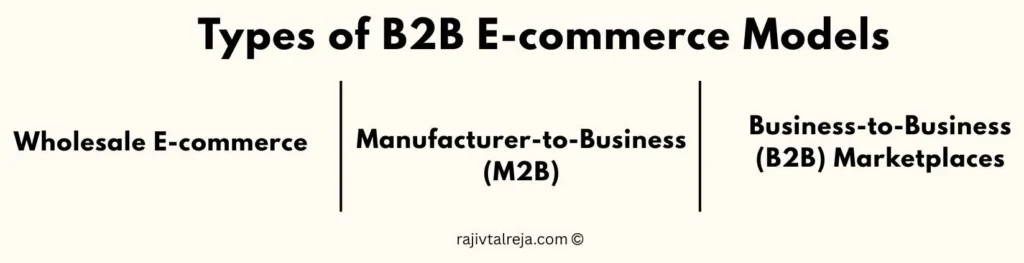
There are several types of B2B E-commerce models, and picking the right one depends on your business and goals.
Let’s explore the main types of b2b e-commerce.
This is a classic wholesale ecommerce model where your business (often a distributor or manufacturer) sells products in bulk to other businesses, like b2b retailers.
Your online store would be built to handle large orders, with features like tiered pricing (the more they buy, the cheaper it gets per item), minimum order quantities, and easy reordering for your network of retail partners.
In this model, the manufacturer sells directly to other businesses online, cutting out traditional middlemen like distributors.
This could mean selling finished goods to retailers or selling components to other manufacturers (e.g, a chip maker selling to a laptop company).
The big advantages here are higher profit margins, more control over your brand, and a direct relationship with the businesses using your products.
For MSME businesses, a business-to-business marketplace often provides the most effective and easy-to-use way to start selling online.
These b2b online marketplaces fall into three groups –
A big supplier sets up a website for its many business clients to make purchases. MSME businesses don’t create these, but they might sell their goods on one.
A major buyer creates a website and asks multiple suppliers (like you) to compete for their business. This happens a lot with government contracts or when big companies need to buy supplies.
A neutral third-party company (like Alibaba or IndiaMART) runs a massive platform connecting thousands of buyers with thousands of sellers.
For an MSME, joining an intermediary marketplace is often the fastest route to growth.
These platforms solve your biggest challenges –
Navigating this transition can be complex, and this is where a structured business coaching process can be invaluable. Following a clear plan, often with guidance from a b2b business coach, ensures you make the right strategic choices from day one.
Your first big decision is where you will sell online.
Choice A – Join a Current B2B Marketplace.
Sites like Alibaba or Amazon Business offer quick access to a massive customer pool. It’s quick and cheap to begin, but you’ll pay a cut on sales and have less control over your brand image.
Choice B – Launch Your Own B2B Storefront.
This gives you full control over your brand and customer experience on your own b2b e-commerce website.. Here, you face a choice –
If you decide to start your own store, pick a platform made for b2b ecommerce. Look for these key b2b commerce features –
Once your store is ready, you need to bring in buyers to your new b2b storefront. Focus on these proven B2B marketing strategies –
Finally, be crystal clear about your position and optimise supply chain.
It’s important to understand the difference between a supplier and a distributor, as well as a distributor and a wholesaler.
Are you a –
Knowing your role determines exactly who your customer is, which allows you to tailor your entire e-commerce strategy to meet their specific needs.
This real-life example of b2b e-commerce shows how the right technology can change an MSME.
The story of Filtrous, a laboratory supply company, shows how the right technology can change an MSME.
Seeing the issue, Filtrous switched to a new specialized b2b business platform (B2B on Shopify).
Filtrous journey shows that implementing the right e-commerce platforms is a way to boost efficiency, make customers happier, and increase profits in the long run.
MSME businesses must embrace online selling to survive and grow. It’s not a choice anymore.
Business buyers are online, and they expect a seamless, digital buying experience from their suppliers. Old beliefs about high costs and complexity no longer hold true. Today’s platforms boost your team’s effectiveness, cut waste, and connect you with new customers worldwide.
The biggest risk isn’t in trying, but in being left behind. Your journey starts now.
Ready to take the next step? Explore more articles and learn to build a powerful B2B e-commerce strategy.


