Every year, brands spend crores on Valentine’s Day campaigns, but only a few truly stay with us.
Why?
Because the best Valentine’s Day ads of all time didn’t sell chocolates, jewellery, or discounts. They sold belonging, insecurity, nostalgia, love, guilt, hope, and sometimes even loneliness.
Valentine’s Day is one of the rare moments when human buying behaviour becomes visibly emotional. People don’t compare prices. They compare feelings.
They don’t ask, “Is this logical?” They ask, “Will this make someone feel loved, or make me feel more seen?”
That’s why Valentine’s Day marketing campaigns are important for business owners who want to understand –
In this blog, we’ll decode the 17 best Valentine’s Day ad campaigns of all time and unpack the psychology behind why they worked, so you can apply the same principles, even without big budgets.
Before we dive into the ads, let’s understand why Valentine’s Day is such a powerful lens to study buying behaviour.
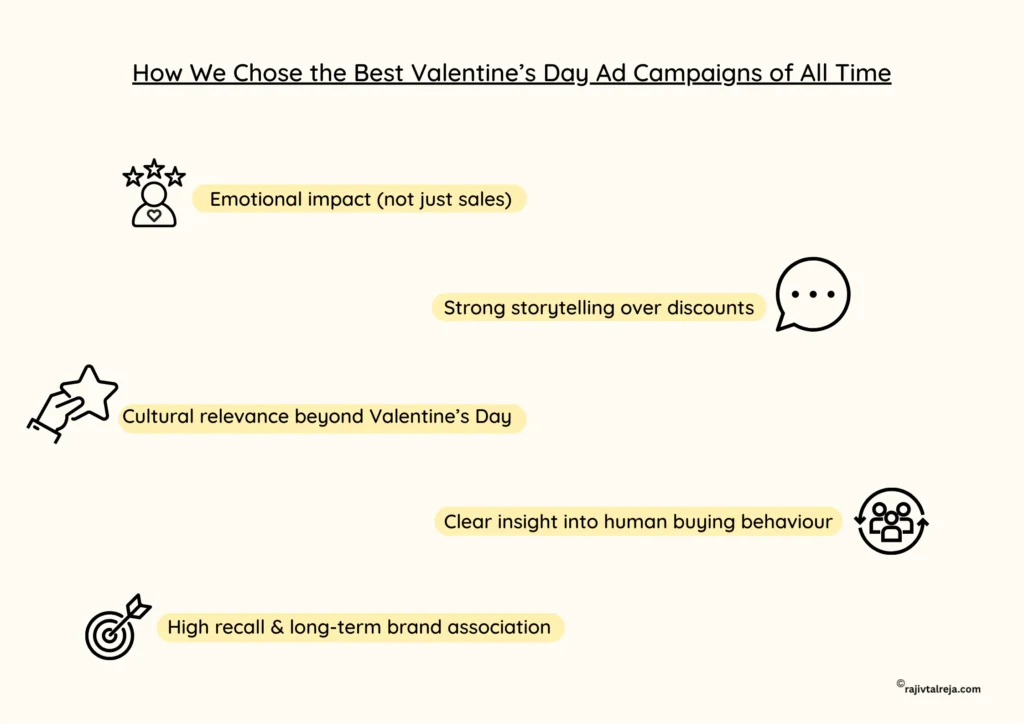
Valentine’s Day compresses human emotions into a single purchase decision… People aren’t buying products.
They’re buying –
On this day, logic takes a backseat.
The fear of disappointing, the desire to belong, & need for connection drive decisions far more than price or features.
That’s why Valentine’s Day ad campaigns by brands are perfect case studies.
They make it clear how emotion, timing, & storytelling influence buying behaviour more than almost any other marketing moment.
Before Hallmark, Valentine’s Day wasn’t a “must-participate” occasion. Hallmark’s early Valentine advertising did something subtle but powerful: They normalized emotional inadequacy.
Their ads implied: “You may not know how to express love, and that’s okay. We’ll help.”
This removed performance anxiety and replaced it with emotional outsourcing. People didn’t buy cards because they were romantic. They bought them because they were afraid of saying the wrong thing.
Lesson for business owners:
If your product reduces emotional risk, it becomes a default choice rather than a luxury.
De Beers’ Valentine messaging didn’t talk about beauty or craftsmanship.
It introduced a dangerous but effective idea: “If love is forever, the symbol must be too.”
This reframed diamonds from ornaments → evidence.
Once that belief took hold, price sensitivity disappeared. People weren’t buying a stone. They were buying relationship security.
Diamond demand didn’t rise because people loved jewellery more. It rose because social expectations were quietly engineered.
This ad campaign created one of the strongest emotional moats in marketing history.
Lesson for business owners:
The strongest brands don’t sell products. They define what the product means.
When Cadbury entered Valentine’s communication in India, romance alone didn’t work culturally.
So Cadbury did something brilliant:
It de-romanticised Valentine’s Day.
Instead of lovers, they showed:
The insight was simple: Indians don’t celebrate romance openly, but they celebrate sweetness together.
They used cultural permission bias, which makes people buy when a brand makes behaviour socially acceptable.
Cadbury became the default emotional currency, not just a chocolate brand.
Lesson for business owners:
If a festival feels “not for me,” expand your definition of “for me.” Don’t fight it.
Google’s Valentine film didn’t feel like advertising at all.
Why?
Because it used interface familiarity as a storytelling device.
This ad worked because Google never appeared as a brand… It appeared as a witness.
Google became emotionally invisible yet unforgettable.
Lesson for business owners:
When your product disappears into the story, belief increases.
Zomato noticed something brands ignored: Valentine’s Day causes emotional stress, not joy, for many people.
So instead of amplifying romance, Zomato diffused pressure…
Humour made them feel included, not inadequate.
The psychology they used was relief-based buying… People pay to escape guilt and expectation.
Zomato owned Valentine’s Day without ever selling love.
Lesson for business owners:
Sometimes the best way to sell is to remove emotional weight.
Instead of running a new Valentine’s commercial, Coca-Cola reused its “Share a Coke” idea with a romantic twist [names, nicknames, and relationship labels like “Bae” and “Love”].
They used identity bias + ownership effect.
People feel emotionally attached to anything that carries their name or represents a relationship.
Sales didn’t grow because of couples. They grew because people bought multiple bottles, one for each important person, triggered by fear of exclusion (“What if I miss someone?”).
Coke turned a low-involvement product into a social currency.
Lesson for business owners:
Personalisation doesn’t just increase conversion. It increases the basket size.
Tanishq featured unconventional love stories, second marriages, interfaith couples, & mature relationships, without aggressively selling jewellery.
This is basically value alignment & moral signalling.
People support brands that reflect their beliefs, even before purchase intent.
Many viewers didn’t buy immediately, but later chose Tanishq for life milestones because trust had already formed.
Tanishq moved from “jewellery brand” to cultural authority.
Lesson for business owners:
Long-term trust beats short-term festive discounts.
Airbnb positioned Valentine’s Day as an experience, not a gift [romantic stays, shared memories, unique locations].
The buying psychology usedhere is the anticipatory pleasure… People emotionally enjoy experiences before and after they happen.
Bookings increased even for future months, proving emotion works beyond seasonal urgency. Airbnb stopped being “accommodation” & became a memory brand.
Lesson for business owners:
Sell the experience around your product, not just the product.
Dove focused on self-love, body confidence, and personal care… No couples, no romance pressure.
They used emotional validation… People buy from brands that reduce emotional stress.
Single women engaged with this content more than couples, a segment most brands ignore on Valentine’s Day.
Dove strengthened emotional loyalty rather than chasing festive sales.
Lesson for business owners:
Sometimes the most profitable audience is the one everyone else ignores.
Nike reframed Valentine’s Day around discipline, self-respect, and personal goals.
Identity reinforcement was used in this campaign. People buy brands that support who they want to become.
Nike’s engagement spiked among young solo consumers, not couples.
Nike owned Valentine’s Day without using romance clichés.
Lesson for business owners:
You don’t need to follow the festival narrative. Rewrite it.
Publix focused on everyday moments, like sharing cake, cooking together, small gestures of care, rather than grand romance.
They used the psychology of comfort & familiarity bias. People trust brands that feel like part of their daily life. Familiar love feels more real than dramatic love.
Publix positioned itself as a caretaker brand. Valentine’s Day became about care, not pressure.
Lesson for business owners:
Show how your product fits into real, ordinary moments. Everyday love converts better than big promises.
Swiggy positioned food as comfort for singles, couples, and the emotionally confused.
The buying psychology this brand uses is the substitution effect. When emotional needs aren’t met, people substitute comfort purchases.
Late-night orders spiked more than dinner orders.
Swiggy owned “comfort consumption.”
Lesson for business owners:
Understand when emotions peak, not just what they are.
Apple let users tell love stories using iPhones, instead of showcasing specs.
The buying psychology used here is called the user-as-hero bias. People prefer tools that make them look creative.
Apple didn’t promote Valentine’s directly… The audience did it for them.
Apple reinforced emotional superiority without selling.
Lesson for business owners:
Let customers market themselves using your product.
Netflix normalised staying in, watching content, and avoiding Valentine’s pressure.
The buying psychology used here is the effort minimisation! People choose options that reduce social stress.
Subscriptions rose even among users who weren’t in relationships.
Netflix became the default companion.
Lesson for business owners:
Convenience is an emotional benefit.
Spotify used listener data to create personalised love insights and playlists.
The buying psychology used here was self-recognition. People trust brands that understand them better than they understand themselves.
Users shared Spotify’s insights voluntarily… No CTA needed.
Spotify became emotionally intelligent, not just algorithmic.
Lesson for business owners:
Data is powerful when used empathetically, not aggressively.
Interflora focused on the recipient’s reaction, not the bouquet.
They have used emotional forecasting in this ad. Buyers imagine the reaction before purchase.
Reminder-based ads performed better than discount ads.
Interflora sold anticipation, not products.
Lesson for business owners:
Market the reaction, not the item.
Puma linked love to passion, ambition, and lifestyle.
Buying psychology used here is called identity consistency. People buy brands that fit their self-image.
Campaigns resonated more with young achievers than with couples. Puma strengthened lifestyle positioning.
Lesson for business owners:
If your brand fits their identity, price becomes secondary.
Before marketing, ask: “What should my customer feel after buying this?” Market that feeling, not the product.
A handwritten note, a personalised WhatsApp message, or a customer story will outperform a glossy ad with zero emotion.
Instead of “20% off,” tell:
That’s storytelling in sales.
Stop trying to please everyone. Pick one customer, one emotion, one message, and go deep.
Not every campaign needs immediate ROI. Some campaigns are about becoming the first brand they think of later.
You don’t need all three. Just pick one emotional tone your brand can own consistently.
The best Valentine’s Day marketing campaigns worked because they understood:
Say the right thing at the right moment, even to a small audience.

The best Valentine’s Day ad campaigns of all time didn’t win because of budgets or celebrities. They won because they understood people.
They spoke to emotions people rarely articulate [love, insecurity, nostalgia, belonging] and told stories that felt human, not promotional. That’s the real lesson for business owners.
You don’t need a big brand or a big spend. If your message makes someone feel seen, understood, or connected, it will work… on Valentine’s Day and every other day of the year.
For more marketing case studies, business insights, and practical lessons for MSME owners, visit our blog page!
Valentine’s Day ads work because they tap into universal emotions like love, belonging, and validation, which strongly influence buying decisions across cultures and age groups.
Both. But primarily brand recall and emotional connection. Sales often come later because emotionally connected customers are more likely to choose the brand when they’re ready to buy.
The most effective Valentine’s Day marketing campaigns use love, nostalgia, humour, empathy, and self-worth, not urgency or discounts.
Yes. Many small businesses succeed using organic social media posts, customer stories, WhatsApp messages, email notes, and in-store experiences instead of paid ads.
Ads go viral when they feel relatable and human, not promotional. Campaigns fail when they focus only on products, offers, or clichés without emotional depth.
Absolutely. Brands targeting self-love, friendships, family, food, experiences, or community often outperform traditional couple-focused campaigns.
Trying to sell too hard. The best Valentine’s Day ad campaigns prioritise emotion and storytelling first, and sales follow naturally.