


Dilemma of many MSME business owners…Orders come in. Machines run. Products are delivered. Yet, money feels tight.
You think, “Profit dikh raha hai, paisa kyun nahi?”
Many MSME owners don’t get this, but sales aren’t always the issue.
The real problem is choosing the wrong type of manufacturing industry setup for your business stage.
Running a job shop like a mass production plant or trying to stock without enough cash kills your cash flow.
This blog will explain the types of manufacturing industries in India, focusing on how each affects your profits.
Pay attention. One bad choice here can drain your business.
Your production approach determines how you receive payment, how much money gets tied up, and if you can weather slow periods.
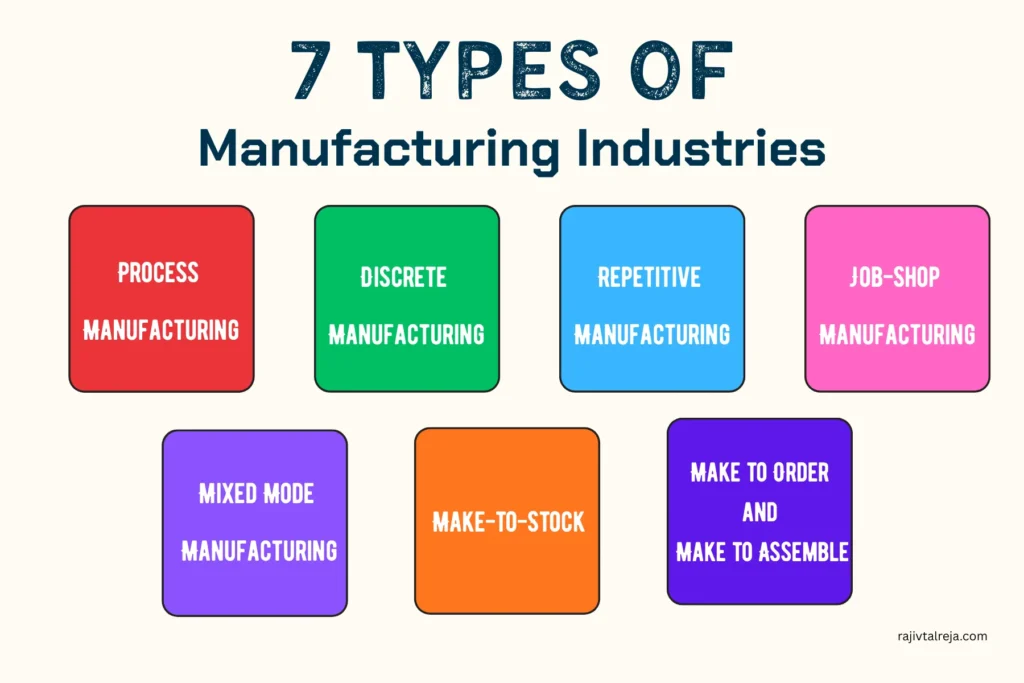
Let’s examine the different types of manufacturing industries.
Process manufacturing involves changing materials or formulas chemically or physically.
This category includes liquids, powders, gases, food, paint, and chemicals.
In India, this model is the main one for drugs, food and drinks, paints, and special chemicals.
Profit doesn’t just come from machines.
It comes from formulas, recipes, and staying the same. Your secret sauce is your formula.
This is a risky area. One bad batch means you lose it all.
You can’t fix or reuse it. Raw materials often go bad, which ties up your money.
Discrete manufacturing makes countable single items.
Screws, machines, auto parts, and gadgets are typical examples.
You can take apart the end product into its pieces.
Your parts list holds hidden profits.
Smart choices in buying and designing determine if you’ll make money.
As buyers worldwide ask more about where things come from, you need to know which piece came from which batch.
This approach has a weak spot.
A missing ₹10 part can hold up sending out a ₹10-lakh machine.
To avoid this, small businesses keep extra stock, which ties up cash.
The same product, the same process, and the same production line, every single day, repeating.
Speed and consistency drive everything.
Small margins per unit make repetitive manufacturing model work through volume.
Workers become quicker because tasks stay the same.
Efficiency offers the biggest advantage in this type of manufacturing.
This system lacks flexibility.
If demand falls, machines remain unused.
You can’t switch to a different product overnight.
This is distinct from different types of manufacturing because it relies solely on speed rather than customization.
In Job-Shop Manufacturing business operates in a setting with many different types of manufacturing process outputs, but in small quantities.
They handle unique jobs like prototypes.
Each project has its own design, setup, and schedule.
The business can adapt easily, but it doesn’t produce much.
Machines spend more time getting ready than manufacturing a product.
You’re selling expertise and problem-solving. No mass production here.
This is where many MSMEs get stuck.
You get stuck in pricing jobs, overseding production, and checking quality.
The business relies on you. Growth slows because you become the bottleneck.
| Being stuck in daily operations is a common trap. An MSME business coach can help you identify exactly where your process is breaking down. |



Mixed-mode manufacturing combines several methods.
Factories make standard parts in bulk, while customisation occurs later.
This approach helps to find a balance between productivity and adaptability.
This model requires robust systems.
You need ERP software that can manage both BOM-based and process-based production.
Without proper systems, disorder takes over the factory floor.
Inventory imbalance often occurs.
You might have too many standard parts but not enough custom components.
Money gets tied up in the wrong areas.
Manufacturers create products based on predictions.
They make items before selling them.
This approach is typical for consumer goods industries.
Quick action is key. Success comes from having products ready when buyers want them.
This model benefits FMCG and clothing businesses.
Mistakes in forecasting cost money.
Even a small drop in sales can lead to overstocked warehouses. Profits can turn into unsold inventory.
| Managing inventory, cash flow, and production schedules can feel like a war zone. You shouldn’t have to choose between cash flow and delivering orders. The best business coach can help you restructure it for profitability. |
You don’t start production until a PO (Purchase Order) lands in your inbox.
This is the safest approach to control inventory.
You often need to pay for raw materials upfront, but you don’t get paid until delivery. This creates a cash gap that services like TReDS aim to bridge.
This is the “Subway Sandwich” model.
You have all the ingredients ready (bread, veggies, meat), but you don’t put the sandwich together until someone orders it.
It reduces wait times compared to make-to-order, without the risks that come with make-to-stock dead inventory.
To wrap up, success in manufacturing today doesn’t mean pushing machines harder.
It’s about choosing the right type of manufacturing industry for where your business stands.
Whether you choose to stock, make to order, or a mix, your decision should match your cash flow, not your pride.
Look over your current setup. Spot problems in your process manufacturing or discrete manufacturing lines.
Get your systems in order before growth reveals costly errors.
Want to improve profits and systems? Click here to read more MSME growth articles.
The four main types are Process manufacturing, Discrete manufacturing, Repetitive manufacturing, and Job-Shop manufacturing.
The 3 Ps mean People, Process, and Product, which play a key role in quality and growth across all types of manufacturing industries.
The 4 Ms stand for Man, Machine, Material, and Method, the main factors that drive production efficiency in different types of manufacturing processes.
The steps are Design, Sourcing, Production, Quality Control, and Distribution
They are Primary (raw materials), Secondary (manufacturing), Tertiary (services), and Quaternary.


