


You run ADS.
You post on SOCIAL MEDIA.
You even have a WEBSITE.
But enquiries trickle in randomly, and most people who visit your site never come back.
Sound familiar?
The missing piece is a digital marketing funnel, a step-by-step system that takes a stranger online and turns them into a paying customer.
A digital marketing funnel is a structured path.
Instead of hoping people buy from you, a funnel guides them from “who is this?” to “I want to buy.”
In this blog, we’ll break down every digital marketing funnel stage, the psychology behind each one, why most funnels fail, and how to build one that actually works, even if you have a small team and a limited budget.
A digital marketing funnel is a system that maps the journey a potential customer takes online from the moment they discover your business to the moment they buy from you (and beyond).
| According to industry benchmarks, 96% of website visitors leave without converting into a lead or sale. That’s not a TRAFFIC problem. That’s a FUNNEL problem. |
Picture a funnel. WIDE at the top, NARROW at the bottom.
Many people enter at the top through social media, Google searches, or ads.
As they move down, some lose interest. The ones who stay are your real leads.
And at the bottom? Those are your paying customers.
The purpose of an online marketing funnel is simple: stop relying on random enquiries.
Instead, create a structured process that brings people in, earns their trust, and moves them toward a purchase. Consistently.
Without a funnel, your marketing is like pouring water into a bucket full of holes.
Money goes IN. Very little STAYS.
Let’s talk numbers first.
According to HubSpot, 68% of companies have not identified or even attempted to measure their sales funnel.
That means most businesses are spending on marketing without knowing where they’re losing customers.
And in India, the gap is even wider.
A SIDBI survey from 2025 found that only 13% of Indian MSMEs actively use digital marketing to reach customers. (Source: SIDBI, 2025)
The rest are still relying on word of mouth, trade events, or print ads.
So why is the digital marketing funnel important?
Here’s what it actually does for your business:
In our experience working with hundreds of businesses, the ones that grow fastest are not the ones spending the most on ads. They are the ones with a clear funnel in place.
| A predictable funnel is the engine of a growing business. To build the rest of your growth systems, a business coach in India can guide you step-by-step. |

Most articles will list the digital marketing funnel stages and move on.
But here’s what they miss: every stage has a buyer psychology behind it.
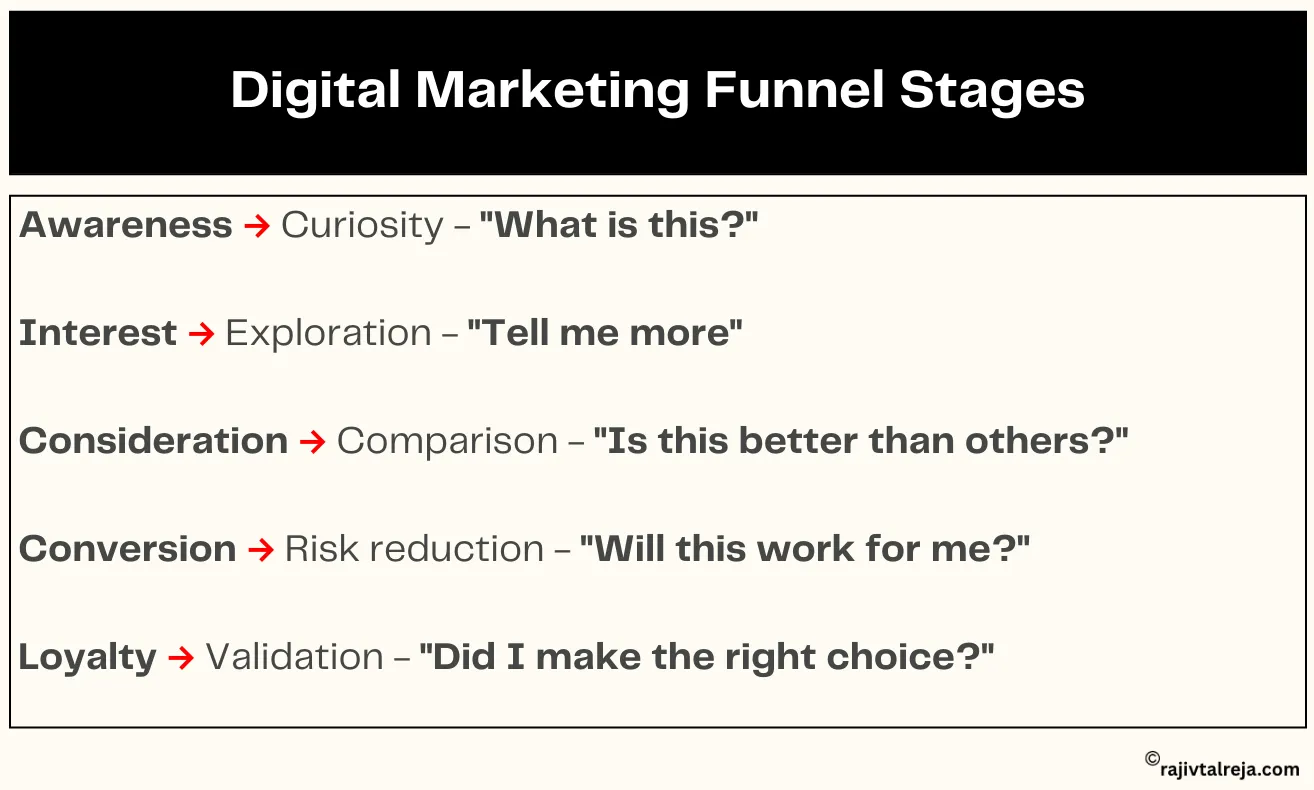
Understanding what your customer is thinking and feeling at each stage changes everything about how you communicate.
Let’s break it down.
| Stage | Goal | Buyer Psychology | Content That Works | Key Channels | Metric to Track |
| Awareness | Get noticed | Curiosity – “What is this?” | Educational blogs, short videos, and social posts | SEO, social media, and Google Ads | Reach and impressions |
| Interest | Build engagement | Exploration – “Tell me more” | Lead magnets, guides, and YouTube videos | Website, YouTube, and email opt-in | Traffic and engagement rate |
| Consideration | Earn trust | Comparison – “Is this better than others?” | Case studies, testimonials, and email sequences | Email, retargeting, and reviews | Open rate and time on site |
| Conversion | Close the deal | Risk reduction – “Will this work for me?” | Landing pages, offers, and sales calls | Landing pages, WhatsApp, and calls | Conversion rate and CPL |
| Loyalty | Retain & grow | Validation – “Did I make the right choice?” | Follow-ups, referral programs, and community | Email, WhatsApp, and events | Repeat purchase and referral rate |
Notice the pattern here?
At the top of the funnel, people are curious. In the middle, they are comparing. At the bottom, they want reassurance that their decision is safe.
Here’s a digital marketing funnel example.
| Suppose you run a coaching institute in Pune. A parent searches “best tuition classes near me.” They land on your blog (awareness). They download your free “Study Plan” PDF (interest). They read a parent testimonial (consideration). They book a demo class (conversion). You follow up after a month to ask how their child is doing (loyalty). |
That’s a funnel. Simple. Structured.
And it works whether you sell products, services, or courses.
| To put this into action, download our free Digital Marketing Funnel Planner, a ready-to-use template with stage-by-stage action items, examples, and metrics for both service and product businesses. [DOWNLOAD FREE TEMPLATE here.] |
Not all funnels look the same.
The right type of digital marketing funnel depends on your business model, whether you sell products, services, or subscriptions.
Here’s a quick comparison.
| Funnel Type | Shape | Best For | How It Works | Product or Service? |
| Linear Funnel | Top-to-bottom | Simple, one-time purchases | Customer moves from awareness to purchase in a straight line | Product (e.g., retail, e-commerce) |
| Hourglass Funnel | Wide-narrow-wide | Retention-focused businesses | Adds loyalty & advocacy stages after purchase | Both – especially service businesses with repeat clients |
| Looping Funnel | Circular | Subscription or repeat models | Customer re-enters through referrals and repeat engagement | Service (e.g., coaching, salons, clinics) |
If you run a salon in Bangalore, a looping funnel makes sense because you want customers coming back every month, not just once.
If you sell handmade furniture online, a linear funnel works fine for each sale.
The key is: choose the shape that fits how your customers actually buy from you.
This is the part nobody talks about.
Most businesses that try to build a funnel still struggle.
Not because funnels don’t work, but because they get the basics wrong.
Here are the most common reasons a digital marketing funnel strategy falls apart:
You’re running ads, but they’re reaching people who have no need for your product.
A garment manufacturer in Surat running Instagram ads targeted at teenagers is burning money.
The traffic is real. The audience is wrong.
Your lead magnet or first touchpoint doesn’t give the visitor a reason to stay.
A vague “Sign up for our newsletter” is not enough. Offer something specific, a checklist, a free audit, or a sample.
People land on your site and see no testimonials, no case studies, no social proof.
In a world where everyone claims to be “the best,” trust is earned through evidence.
Someone downloads your PDF or fills out a form… and never hears from you again.
What we’ve seen time and again is that businesses collect leads but never follow up.
That’s not a funnel problem. That’s a people and process problem.
This is the biggest trap. If your funnel leaks at every stage, doubling your traffic just doubles the waste.
Fix the funnel first. Then scale the traffic.
Before you fix anything, you need to diagnose the problem.
Most business owners throw money at marketing without knowing which stage is actually leaking.
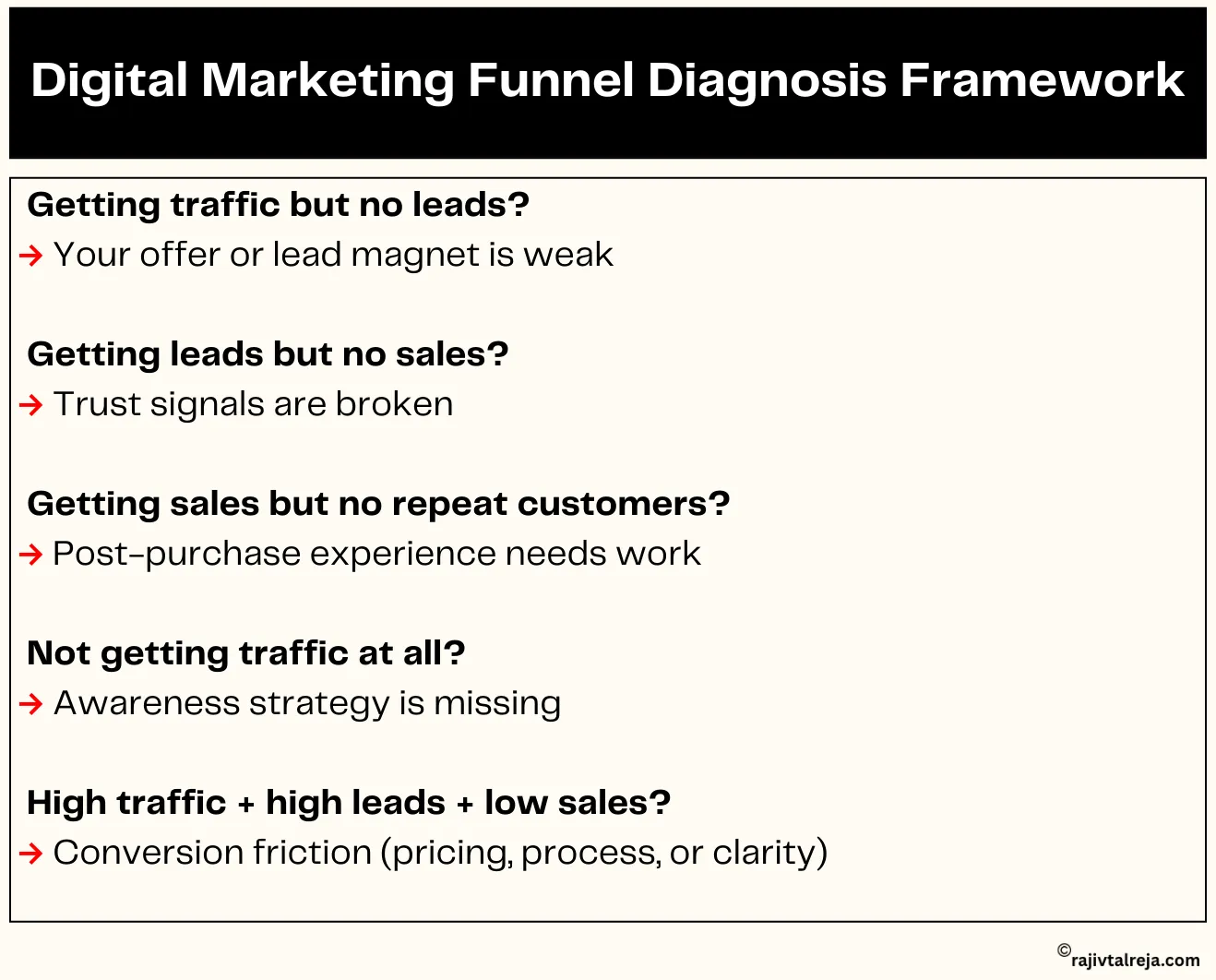
Here’s a simple diagnostic framework.
| Symptom | Likely Problem | Stage Affected | What to Fix |
| Low or no website traffic | Wrong channels or no awareness strategy | Awareness | Improve SEO, start social media, run targeted ads |
| Traffic but no leads | Weak offer or no lead magnet | Interest | Create a valuable free resource, fix your landing page |
| Leads but no sales | Trust gap or no nurture sequence | Consideration → Conversion | Add testimonials, build email follow-ups, and improve offer clarity |
| Sales, but no repeat customers | No post-purchase engagement | Loyalty | Set up a follow-up system, ask for referrals, and build a community |
| High spend, low returns | Funnel leaks at multiple stages | All stages | Measure CPL and CAC, identify the biggest drop-off, and fix one stage at a time |
The point here is…
Stop trying to fix everything at once.
Find the one stage that is leaking the most and fix that first. Then move to the next.
This is what separates smart business owners from those who keep spending without results.
Here’s the good news: you don’t need a big budget or a marketing team to create a digital marketing funnel.
You just need clarity and a simple process.
This is the lead generation digital marketing funnel framework we recommend for business owners:
Who are you trying to reach?
What problem are they searching for?
A bakery owner in Jaipur targeting wedding orders has a very different customer than one targeting daily walk-ins.
Don’t try to be everywhere.
Pick one channel where your audience already spends time, like Google, Instagram, YouTube, or WhatsApp and focus there first.
Something valuable you give away for free in exchange for their contact details.
A free checklist, a sample consultation, a mini-guide.
This is what moves people from “browsing” to “interested.”
One page. One offer. One call to action. No distractions.
Free tools like Google Sites or Canva can get you started for Rs 0.
Once someone gives you their phone number or email, follow up within 24 hours.
Then again in 3 days. Then again in a week. Most leads are lost simply because nobody followed up.
When the lead is ready, your offer should be easy to understand.
What they get, how much it costs, and what the next step is. Remove confusion.
Check your numbers every week.
How many people visited? How many became leads? How many bought?
Fix the weakest number first.
| A common question we hear: “Should I invest in paid ads or organic first?” Our answer: Build the funnel organically first. Make sure your landing page converts, your follow-up works, and your offer is clear. Then add paid ads to scale what already works. |
You can’t fix what you don’t measure.
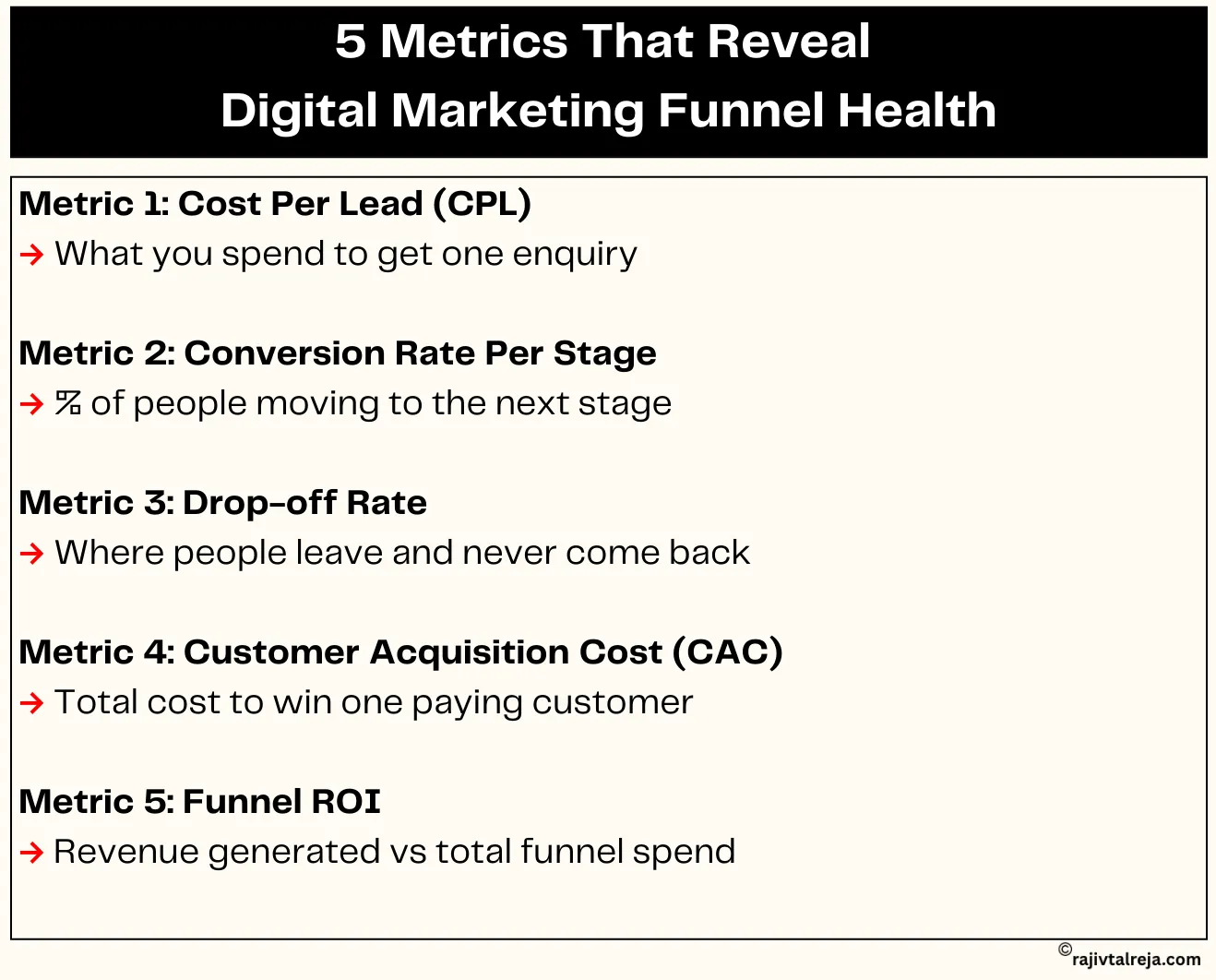
These five numbers tell you whether your digital marketing funnel strategy is working or bleeding money.
How much are you spending to get one enquiry?
If you spend Rs 10,000 on ads and get 20 enquiries, your CPL is Rs 500. Track this MONTHLY.
What percentage of people move from one stage to the next?
If 1,000 people visit your site and 30 fill out a form, your visitor-to-lead rate is 3%.
Industry average is about 2–5%.
Where exactly are people leaving?
If 80% of your leads never open your follow-up email, the problem is in your nurturing, not your traffic.
This is the total cost to win one paying customer.
Include ad spend, tool costs, and team time.
If your CAC is higher than your profit per customer, your funnel is unprofitable.
Revenue generated from funnel customers divided by total funnel spend.
This is the number that tells you whether your entire online marketing funnel is worth the investment.
Teams that get this right tend to make decisions faster.
Instead of arguing about which ad to run, they look at the numbers and act.
You don’t need expensive software to build a working funnel.
Here are the digital marketing funnel tools that work well for Indian business owners, even on a small budget:
| Purpose | Tool | Why It Works? | Cost |
| Landing pages | Google Sites / Canva | Free, easy to use, no coding needed | Free |
| Email follow-ups | ConvertKit / Mailchimp | Simple automation for nurture sequences | Free tier available |
| CRM & lead tracking | HubSpot CRM / Zoho CRM | Track every lead from enquiry to sale | Free tier available |
| Social media scheduling | Buffer / Meta Business Suite | Plan and schedule posts in advance | Free/low cost |
| Analytics & tracking | Google Analytics / Google Search Console | See where traffic comes from and what converts | Free |
| WhatsApp follow-ups | WhatsApp Business / Interakt | Reach leads on the platform they actually use in India | Free/affordable plans |
Start with the free tools. Get the system running. Upgrade only when you see results and need more features.
A digital marketing funnel isn’t a fancy marketing concept. It’s a SYSTEM.
And like every system in your business, from sales to operations, to hiring, it needs to be built, measured, and improved.
You don’t need a big team or a big budget.
You need clarity on who your customer is, a simple process to guide them from awareness to purchase, and the discipline to track what’s working.
Start small. Build one funnel. Measure the numbers.
Fix the leaks.
And watch what happens when your marketing finally has a system behind it.
Learned from this?
Click here and head to our blog page for more practical insights on business growth, leadership, and building a business that actually works for you.
A system guiding online visitors from awareness to purchase.
Awareness, interest, consideration, conversion, and loyalty.
Marketing attracts leads; the sales funnel converts them.
Products use linear funnels; services rely on relationship-driven funnels.
Spend more where the funnel leaks most.
Low traffic, weak leads, or poor conversions show funnel gaps.
Paid funnels: 2–4 weeks. Organic funnels: 3–6 months.
Start organic. Fix conversion first, then scale with paid ads.
Education for awareness, proof for conversion.
Chasing traffic, poor follow-ups, and ignoring customer retention.


