


You’ve probably spent money on ads, posted regularly on social media, and maybe even hired someone to handle your marketing.
But if you don’t know where people lose interest between noticing your brand and buying from you, you’re wasting money.
There’s one simple framework that can save your MONEY.
It’s called a marketing funnel.
It’s the difference between guessing and growing.
In this blog, you’ll learn exactly how to build one, what to say at each step, and which mistakes quietly kill your conversions.
Let’s fix this.
The journey from “never heard of that PRODUCT” to “take my money” is the marketing funnel.
A marketing funnel is the path your customer takes from being a stranger to becoming a buyer.
It’s broad at the top because many people learn about you, and narrow at the bottom because fewer actually buy.
3 Stages of the marketing funnel:
That’s it.
You’re probably thinking: “This sounds great, but what do I actually get?”
Fair question.
Here are the hard numbers on the benefits of marketing funnels:
Next, let me break down the three stages so you know exactly what to do at each one.
| To build a funnel that actually delivers these results, you need a business coach to guide the execution. Join us today. |
Let’s break this down like you’re explaining it to your team over chai. To master the marketing funnel, you must understand these phases.
At this stage, your customer doesn’t know you exist yet.
To be honest, they might not even realize they need your solution.
People are searching online for things like “why does my back hurt” or “how can I cut down on accounting costs.”
Your job? Give them helpful answers. Not sales talk.
What works here:
Cast a wide net here and focus on helping, not selling. This is the start of the marketing funnel stages.
At this point, they know solutions exist, and you’re one of them.
But you’re not alone. They’re looking at a few other companies, too.
This is where you capture their email with something valuable, like a free guide, a discount code, or a checklist.
After that, connect through emails that help build trust.
What works well here:
Share success stories, tackle concerns, and show why you’re the top pick.
They’re convinced.
But they’re nervous.
What if it doesn’t work? What if it costs too much?
Your role is to remove every hesitation and make the path clear.
What works here:
Make it so simple and risk-free that they’d be foolish not to buy.
Next, you’ll see how this plays out online.
The great thing about digital marketing is how trackable it is.
Your digital marketing funnel isn’t just an idea. It’s something you can measure.
Check Google Search Console to see what keywords people are typing.
If you’re a dentist, focus on “causes of tooth sensitivity,” not “book dentist now.”
That’s how you think about the top of the digital marketing funnel.
Those pop-ups that appear when someone’s about to leave, offering 10% off?
That’s middle-funnel magic. Grab emails before people exit.
Tools like Hotjar show you where users face issues. Like rage-clicking, skipping your call-to-action, or leaving during checkout.
Click here to set up Google Search Console if you haven’t already.
It’s free, and it’s the best way to understand what your audience really wants from you.
Not all content works the same way.
What succeeds at the top can fail at the bottom.
Here’s a quick guide to your content marketing funnel:
The content marketing funnel is about posting the right content.
Next, how to turn this into a step-by-step plan you can use in your business.
| Content, digital tracking, stages… it can get overwhelming. One-on-one business coaching gives you the clarity to focus on what converts. |



Okay, enough theory.
Here’s your action plan to build a solid marketing funnel strategy:
Not “everyone who needs X.” One specific person with one specific problem. Picture their name. What problem keeps them up?
Write down the questions they ask at each stage:
Start simple:
Let your marketing funnel strategy run for a month.
Identify where users leave:
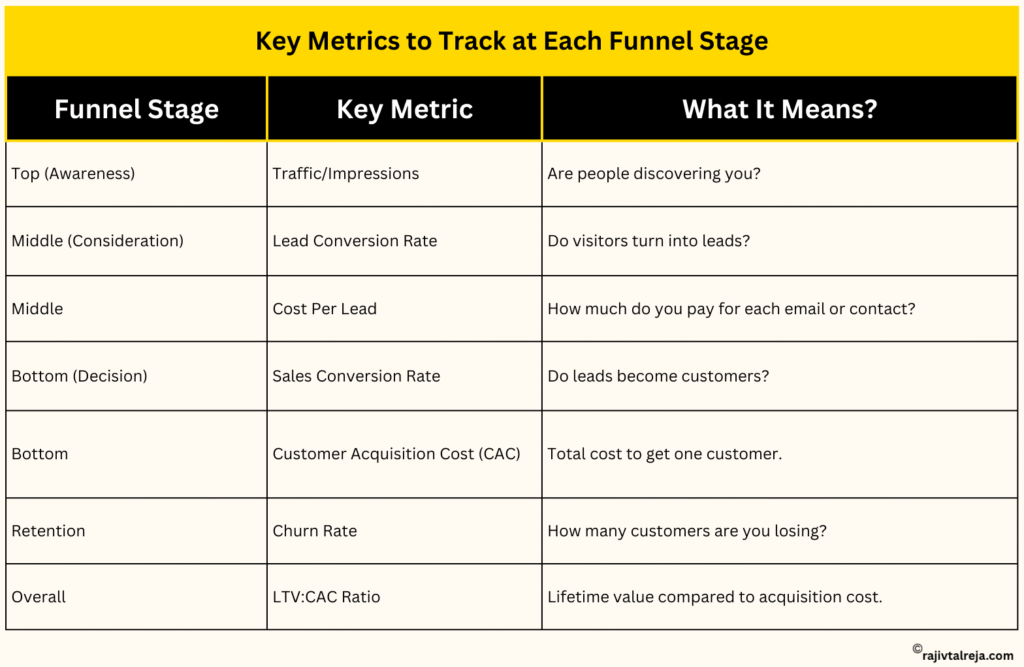
Not all funnels are the same.
When you sell to businesses, your funnel looks different from when you sell to consumers. Learning the difference between b2b and b2c marketing funnels is important.
| Feature | B2B Funnel | B2C Funnel |
| Sales Cycle | Long (weeks to months) | Short (minutes to days) |
| Decision Makers | Multiple (committees, approvals) | One person (impulse-driven) |
| Content Style | Logic, ROI, detailed case studies | Emotion, visuals, social proof |
| Key Channels | LinkedIn, webinars, whitepapers | Instagram, influencers, ads |
| Purchase Value | High-ticket | Volume-based |
| Sales Approach | High-touch (calls, demos) | Low-touch (automated checkout) |
If you’re building a b2b marketing funnel, patience wins.
If you’re B2C, focus on speed and emotion.
Adapt your strategy to fit your market.
Let’s get practical.
Not everyone who visits your site is a lead.
There are stages in a marketing sales funnel:
| Stage | What does it mean? | Action Required |
| Visitor | When someone lands on your website. | Track their behaviour, see what interests them. |
| Lead | When they share their email fora valuable asset. | Start nurturing with helpful content. |
| MQL | They’re engaging, opening emails, and clicking links. | Send targeted content based on their interests. |
| SQL | Your sales team confirmed they’re ready to talk. | Schedule a call, OR send a proposal. |
| Customer | They bought from you. | Deliver great service and ask for feedback. |
This marketing sales funnel shows how visitors move step by step toward becoming customers.

You now know something that 90% of MSME owners don’t: marketing isn’t random.
It’s a system.
The marketing funnel gives you X-ray vision into your customer’s journey.
You see where they enter, where they trust you, and where they buy. Or leave.
Start simple.
Pick one funnel above.
Build it this week.
Track it next month.
Then keep improving it forever.
Here’s the truth: every rupee you spend without a funnel is a risk. Every rupee you spend with one is an investment.
Stop guessing.
Begin creating.
Your marketing funnel is ready for you.
Ready to grow? Read more MSME growth blogs and scale your business today.
Define your specific customer, map their questions, and create one piece of content per stage.
It is broad because many people become aware of you, but fewer move down to actually buy.
Awareness (help them), Consideration (capture emails), and Decision (remove hesitation).
B2B relies on logic and long sales cycles; B2C focuses on emotion, visuals, and speed.
Top: Blogs/Reels. Middle: Case studies/Guides. Bottom: Demos/Reviews.
Yes. Use search keywords for discovery and retargeting ads to bring people back.
Visitors become Leads (email), then MQLs (clicks), and finally SQLs (ready to buy).
Use tools like Mailchimp to send valuable guides or codes to build trust before selling.
Selling too early, low traffic (awareness issues), or poor offers (decision issues).


