


You are likely the hardest worker (Yes, you, business owner) in your office.
You show up early, stay late, and still feel like profits are slim and stress follows you home.
On National Productivity Day, this is the real question to ask:
If I’m working this hard, why does work still feel slow?.
The real reason is workplace productivity leakage, a hidden cost that slows down every job, every sign-off, and every check-in.
It is about cutting out obstacles so work keeps moving even when you are not involved.
In this blog, you will learn that boosting workplace productivity is not about pressuring people or buying more software or AI tools.
In 2026, workplace productivity does not mean how long your team sits at their desks.
It means how much value goes out the door without getting stuck. It is Total Value divided by Operational Friction.
How well a company turns inputs (labour, capital) into valuable outputs.
In the 2026 “Productivity Paradox,” basic efficiency is high, but real growth needs value-addition over volume. This is the core theme of National Productivity Day.
Better margins, quicker delivery, and less employee productivity burnout.
Disruptions, “Synchronous Overload” (too many meetings), and fuzzy priorities.
Smart companies now use workplace productivity tools to automate “boring” tasks like compliance.
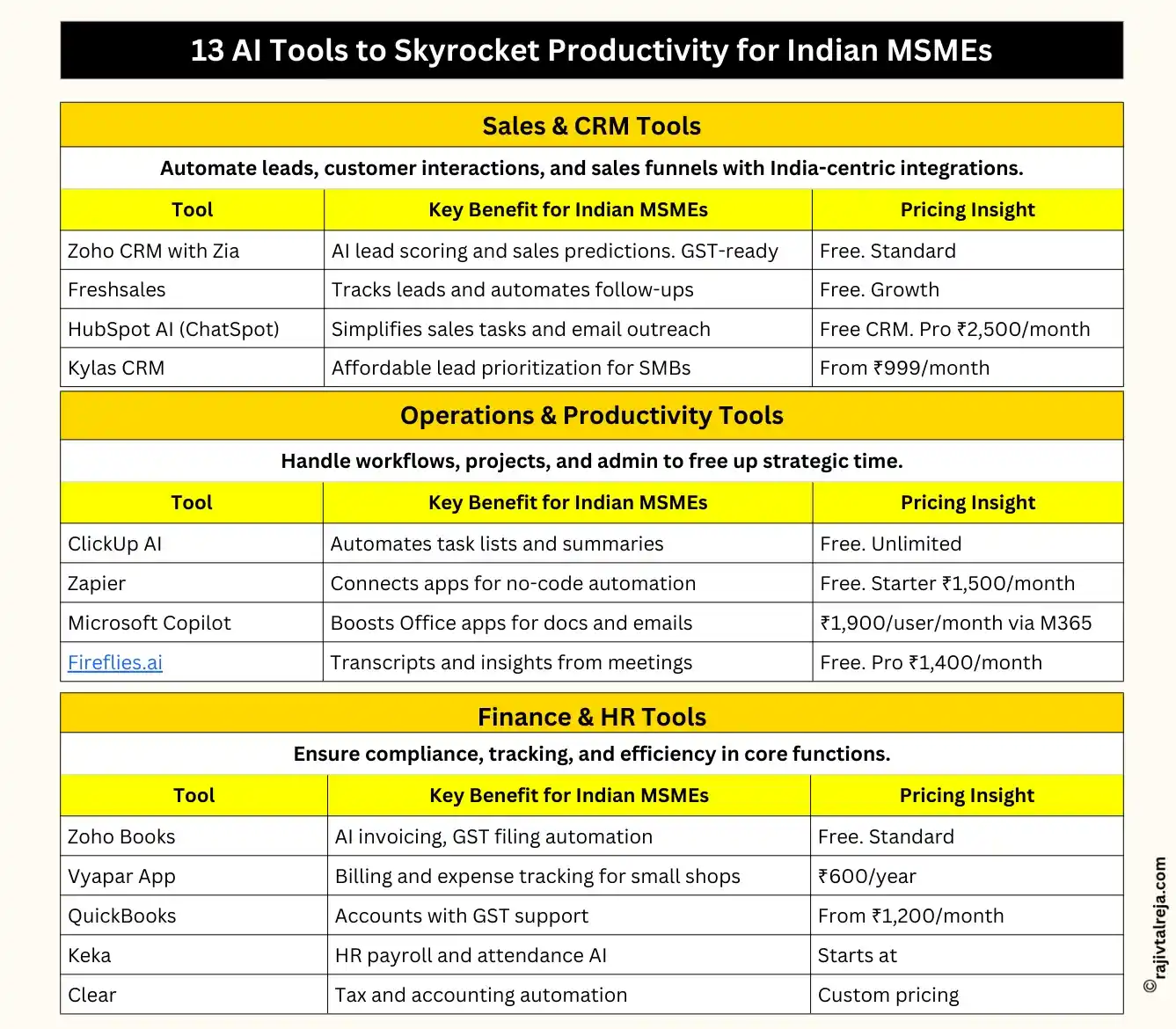
To improve productivity with AI tools, MSME teams can use the list below and save time on planning, coordination, and routine tasks.
| What is the annual economic drain caused by attrition in the Indian business sector? ₹45,000 crore |
Most business owners think productivity means tighter control, longer hours, and more tracking.
That thinking itself is the productivity trap.
| What Owners Usually Believe | What’s Actually Happening |
| “If my team is slow, they lack discipline.” | Work slows down because decisions wait for approvals. |
| “If I monitor more, output will increase.” | Monitoring increases reporting, not real work. |
| “If everyone is busy, productivity is happening.” | People are busy fixing confusion and redoing tasks. |
| “Longer hours mean more results.” | Longer hours create fatigue and more mistakes. |
| “Tools will fix productivity.” | Tools expose broken systems; they don’t fix them. |
| “Pressure improves performance.” | Pressure shifts focus from priorities to firefighting. |
Most productivity advice is not wrong. It’s just not made for MSMEs.
| If you recognise yourself in this table, you are not alone. Understanding this “productivity trap” is the first step. The next step is getting a business coach to help you break free from it and focus on real growth. |
For MSMEs, National Productivity Day is less about celebration and more about rethinking how work actually gets done.
To grow in 2026, you need to stop putting out fires and start building systems.
The R.E.M.O.V.E plan shows you how to get rid of the roadblocks slowing down your small business. This is the ultimate workplace productivity improvement strategy.
Stop relying on casual loans.
Use tools like TallyPrime to keep your books clean and ready for audits. This helps you get cheaper bank loans and stabilizes workplace productivity.
Switch to Async Chats. If you can share updates through email or a quick Loom video, skip the meeting.
Remember that succinct workplace communication improves productivity by safeguarding your team’s focused work time.
Improve productivity with AI by letting it handle dull jobs like GST checks, paychecks, and answering common customer questions.
Run a “Waste Check” to spot where time gets wasted. Often, this is waiting for the boss’s sign-offs or fixing typos.
Get rid of these steps completely to see work productivity improvement.
Move from counting “hours at the desk” with an employee productivity tracker to tracking “key wins.”
Look for error-free production runs or how fast you solve client issues.
Tackle the 2026 mental health problem by setting up “no-ping” areas.
Invest in training to close the skill gap in your team and enhance employee productivity.
| You can’t train your team effectively if you are always reacting to a crisis. This is why successful owners take business coaching and mentoring that gives them the freedom to focus on leadership, not daily fixes. |



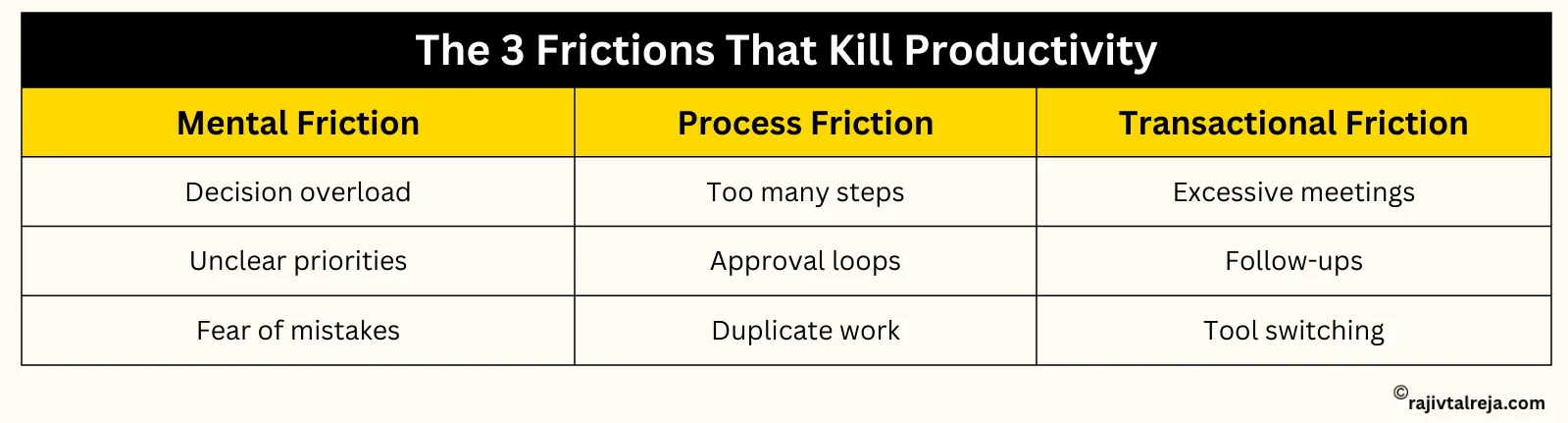
To build a high-performing team, you need to teach them to spot the “brakes” they hit without knowing.
This 60-minute session shifts the mindset from “non-stop work” to “smooth progress.” It is essential for workplace productivity.
Tell your team, “When work feels tough, something is in the way. That is a problem with the system, not a personal shortcoming.”
Ask staff to write down one job they put off, one that feels “tough,” and one they think too much about.
Figure out the feeling (like fear, uncertainty, or boredom) that leads to the delay.
Show them how to say, “This job brings up [feeling]” instead of “I am no good at this.”
Each person picks one fix to use for a week, such as a set time slot or checking in with a coworker. This simple act improves productivity.
In weekly standups, ask “What got stuck?” instead of “Why is this not done?”
Pay attention to what made the work easier, not just the end result.
One Rule for Managers/Business owners – Never ask “Why didn’t you do it?” Always ask, “Where did it get stuck?” This change removes shame and speeds things up.
Success in 2026 does not mean pushing your team harder. It means clearing obstacles from their path. To win, you need to stop thinking that “hours = results.”
Whether it is National Productivity Day or just a regular Tuesday, the goal is the same.
So, quit telling people off and start fixing problems, and things speed up.
This approach guarantees workplace productivity that lasts.
Ready to streamline your business with the correct systems? Click here to read more MSME growth blogs.
It is Total Value divided by Operational Friction, not just hours worked.
Use the REMOVE framework to cut obstacles and build better systems.
Automate dull tasks like GST checks, so your team can focus on big goals.
They often track the mess instead of fixing broken processes or workflows.
Teach teams to spot “brakes” and emotions that cause work delays.


